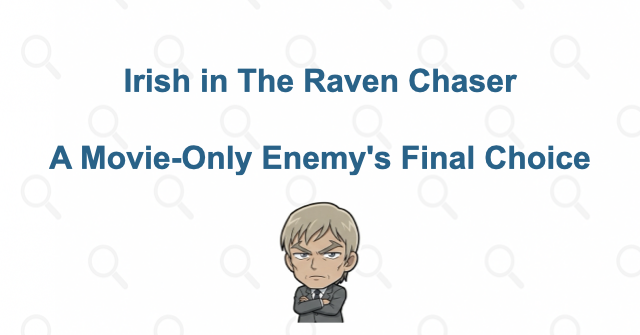
Spoiler warning: This article reveals Irish’s identity, his discovery about Conan, and the ending of The Raven Chaser. Irish’s story is movie-only; it is not a revelation from the main manga.
Irish is the Black Organization operative who impersonates Kiyonaga Matsumoto in The Raven Chaser. He independently discovers that Conan Edogawa is Shinichi Kudo, but hopes to use that knowledge against Gin rather than immediately report it to him. The Organization ultimately turns on Irish, and he dies after protecting Conan.
His final choice does not erase his violence or make him an uncomplicated hero. What makes him memorable is the contrast: a frighteningly capable enemy shows a last measure of humanity toward the boy he had cornered.
Who is Irish?
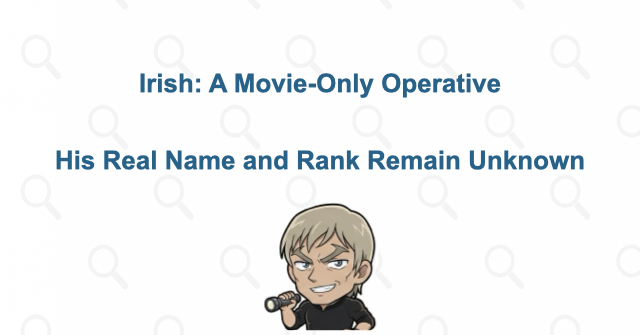
Irish was created for The Raven Chaser, the thirteenth Detective Conan film, released in Japan in 2009. In this movie-only story, his alcohol-derived codename and assignment to infiltrate the police place him among the Black Organization’s active operatives.
His real name, age, and nationality are unknown. His imposing build and composed manner suggest experience, but cannot establish an age such as forty or older. His Japanese voice actor is Yuji Mikimoto, whose low, weighty delivery reinforces the menace behind the police official’s face.
His exact rank is also unclear. Being trusted with a major infiltration establishes that he is useful to the Organization; it does not prove that he holds the same rank as Gin or outranks him. Their personal hostility is a different issue from their position in a formal hierarchy.
Irish’s background remains largely unexplained. That lack of detail gives his few established relationships unusual importance: his attachment to Pisco and resentment of Gin tell us more about his decisions than an invented age or rank would.
Why he infiltrates the police
In this movie-only plot, Irish is sent to recover a memory card containing sensitive information about the Organization’s operatives. The card’s holder has become a victim in a serial murder case unrelated to the Organization’s own activities, putting the card within reach of a police investigation.
The Organization cannot safely wait outside the investigation for that information to emerge. Irish confines the real Kiyonaga Matsumoto and takes his place inside the Tokyo Metropolitan Police Department, using the joint investigation meetings to track both the murders and the card.
The danger comes from his position. The investigators believe a senior police figure is directing the case, while an Organization operative is learning exactly how far they have progressed. Once the disguise is revealed, those apparently routine meetings become much more unsettling on a second viewing.
The important distinction is the direction of the threat: the card could expose the Organization’s people. It should not be assumed to be a list of hostile intelligence agents infiltrating the Organization.
The three skills that make Irish so dangerous
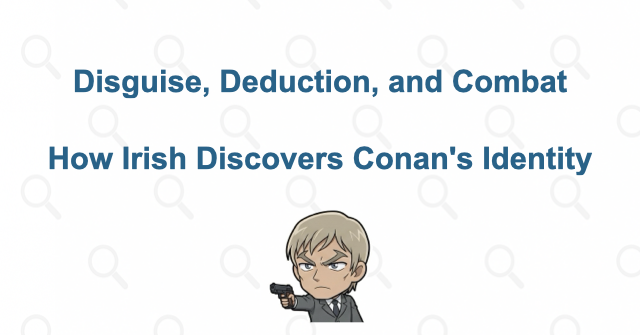
Impersonating Kiyonaga Matsumoto
Vermouth helps with the disguise, while Irish, whose build suits the role, performs the impersonation. In this movie-only operation, a convincing face is only the beginning: he must also reproduce Matsumoto’s voice, manner, and conduct well enough to take part in police meetings without quickly arousing suspicion.
Matsumoto occupies a position of authority over the investigators. Irish therefore gains more than a false identity; he gains access to information and the appearance of someone entitled to receive it. The police structure itself makes the disguise useful.
Vermouth’s involvement matters when assessing his skill. Irish does not accomplish every technical part alone. His achievement lies in sustaining the role under observation while collecting information for a separate purpose. Knowing the truth makes his ordinary expressions and responses feel ominous on a rewatch.
Matching Conan’s fingerprints to Shinichi’s
Irish does not stop at a resemblance or the suspicion that Conan is unusually intelligent. In the film, he obtains Shinichi Kudo’s fingerprints from the Dark Knight helmet used at the Teitan High School festival and Conan’s fingerprints from a clay creation. The prints match.
That physical comparison gives this movie-only discovery its force. Irish reaches Conan’s identity through an investigation of his own, rather than a confession or years of familiarity. He concludes that the child Conan Edogawa is the supposedly dead Shinichi Kudo.
The consequences could have extended well beyond Conan if that information had reached Gin. Ran Mouri, Professor Agasa, and Ai Haibara might also have been endangered. That remains a possible consequence, not something the film actually depicts happening.
Irish’s discovery must also stay within its proper scope: it establishes what he learns in The Raven Chaser, not a new state of knowledge for the Organization in the main manga. His ability to reach the answer is clear, but who receives that answer is a separate question.
Holding his own in a direct fight
Irish’s movie-only threat is physical as well as investigative. He subdues multiple police officers, fights Ran at Toto Tower, and keeps going after taking her attacks. He also watches for Conan’s tranquilizer and other tools, regaining the advantage after Conan briefly counters him.
His comment about turning the situation around captures that recovery of control. The tension is not merely that Irish is large: he can keep thinking under pressure and adjust to a detective who depends on surprise and equipment.
Those scenes do not establish an absolute ranking. It would go too far to call him definitively stronger than Ran or the strongest member of the Organization. What the film demonstrates is an unusually dangerous combination of disguise, information gathering, deduction, and combat ability.
Conan is facing someone who can recognize his tactics, survive his counterattack, and identify the person behind the child’s face. At Toto Tower, those strengths converge, leaving him very little room to escape.
Pisco, Gin, and the reason Irish wants Conan alive
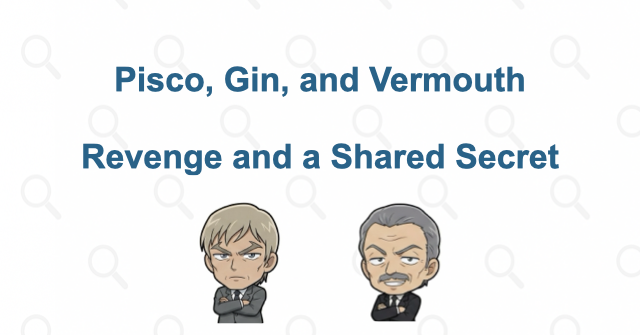
Pisco was like a father to him
In this movie-only account of Irish’s relationships, he regarded the veteran Organization member Pisco as a father figure. Pisco was photographed carrying out an assassination, creating a risk of exposure, and Gin killed him after that failure.
For the Organization, it was the disposal of a compromised member. For Irish, the man Gin killed was much more than a colleague. His resentment gives the film’s internal conflict an emotional source: affection still exists inside this ruthless group, even when its rules treat members as expendable.
Pisco’s death therefore does not end with Pisco’s own story. Through Irish, it becomes the motive for another member to challenge Gin. The Organization can act together on a mission while its members pursue bitterly opposed personal aims.
Shinichi’s survival could expose Gin’s failure
Gin administered APTX 4869 to Shinichi and believed he had killed him. Irish learns that Shinichi instead survived in Conan’s body. In the movie-only conflict, he wants to bring Conan before the boss as living evidence that Gin failed, undermining the man who killed Pisco.
This explains why Irish does not simply kill Conan or promptly tell Gin what the fingerprints revealed. Conan is both a dangerous witness to the Organization’s activities and the evidence Irish needs for his own plan. Keeping him alive serves the revenge he hopes to pursue.
Irish’s remark to Gin about disposing of the high-school detective with the drug establishes that he knows about Gin’s attack and the means used. His intended accusation connects that past action to the boy standing before him: the target was not eliminated after all.
That plan does not prove that Irish is Gin’s equal in rank. It shows that he hates Gin and sees a way to damage his standing with the boss. Personal confidence, a valuable secret, and formal authority should not be collapsed into the same claim.
The irony is that Irish understands one weakness in the Organization but cannot escape another. Its members are divided by resentment, yet its willingness to kill a compromised operative applies to him as readily as to the man he wants to avenge.
What changes between Irish and Vermouth?
Vermouth and Irish cooperate over the Matsumoto disguise in the film. That is a concrete working relationship; it does not establish that they are close friends or trust one another in every respect.
Vermouth also knows Conan’s identity and keeps it from the Organization. She regards him as a Silver Bullet and protects him. Irish initially fails to understand the special regard she has for him, even though he has learned the same dangerous secret.
The crucial change comes after Irish is wounded. Conan tries to save him despite everything he has done. Irish may then begin to understand Vermouth’s attachment: the boy reaches out even to an enemy who knows his identity and has attacked people he cares about.
That reading is strongly suggested by the movie’s final encounter, but should not be inflated into certainty about every thought Irish has. The revealing parallel is simpler: two Organization members know Conan’s secret, and his actions move them in a direction that the Organization’s interests alone cannot explain.
Why does the Organization kill Irish?
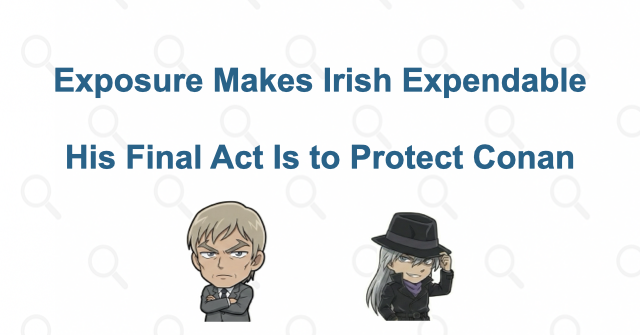
Exposure makes him expendable
In the movie-only climax, the rescue of the real Matsumoto exposes the impersonation. The police surround Toto Tower, leaving Irish at risk of capture. Gin abandons his extraction and orders Chianti to shoot him.
The central reason is the Organization’s need to suppress information. If Irish is arrested, his knowledge and the information on the memory card could reach the police. His hostility toward Gin is part of the personal conflict, but the film’s disposal of an exposed operative should not be reduced to a private quarrel alone.
Irish’s competence cannot save him once the Organization decides that preserving its secrets matters more than preserving his life. The same cruelty that killed Pisco now turns against the man trying to avenge him. That repetition gives the ending its bitterness.
Why he protects Conan at the end
After Irish is shot, Conan tries to help him. This is still the enemy who discovered his identity, assaulted Ran and police officers, and tried to take him to the Organization. Conan’s refusal to abandon him is what makes Irish’s final response meaningful.
In the movie-only ending, Irish shields Conan from the Organization’s subsequent attack and dies. He addresses the boy as Shinichi Kudo and urges him to continue the pursuit. One possible reading is that he entrusts Conan with the fight he can no longer continue.
Protecting Conan does not amount to proof of complete redemption. Irish remains responsible for the violent actions the film has shown. The ending gives him a human response to compassion, rather than rewriting his entire life as virtuous.
That is why calling him a good person is too simple, but dismissing the final act misses its force. A dangerous enemy becomes Conan’s shield at the moment when his own organization discards him. The contrast is moving precisely because the earlier danger was real.
Where does Irish appear?
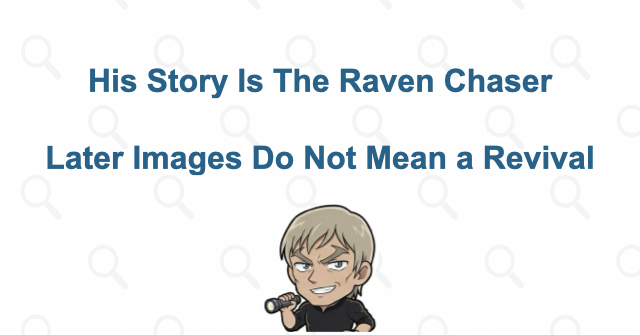
Irish’s substantial story is The Raven Chaser. His infiltration, discovery of Conan’s identity, grievance against Gin, and death all belong to that film’s plot. He is a movie-only character, separate from the main manga and the regular television series’ ongoing cases.
Black Iron Submarine includes a retrospective or introductory treatment of Irish among the Organization’s past and deceased figures. That is not a new mission, and it does not establish survival or resurrection. To follow his actual story, The Raven Chaser is the essential film.
There is an important qualification to saying he is not in the manga: film comics and manga adaptations of The Raven Chaser do include him. Those adaptations of the movie are separate from Gosho Aoyama’s main serialized manga. A film-derived manga appearance should not be used to erase that distinction or assign him an ordinary television episode number.
Irish has an unusually complete dramatic role within a single film. The fingerprints make him a credible threat, Pisco explains the personal motive behind his choices, and Conan’s attempt to save him gives the ending its emotional reversal. His death does not undo what made him frightening; it adds a final, bitter glimpse of the person the Organization was willing to throw away.



Comments