Spoilers: This article explains the dying message, weapon and culprit.
The Akabeko and the Three Lucky Men, international episode 1160 (Japanese episode 1102), is an anime-original story. Fukumoto is the killer, but the dying message cannot identify him simply by matching a name. The red akabeko and the word fuku must be read together, leading to the red loincloth used as the weapon.
A word that implicates three men
Conan, Ran and Sonoko attend an exhibition by Motoko Bekobe, an artist who combines traditional akabeko figures with contemporary art. A scream leads them to a waiting room, where Bekobe has been strangled.
An akabeko is held in her left hand. Beside the fingers of her right hand is a message written in blood: fuku. The immediate temptation is to read the word as part of someone’s name, but Fukui, Fukumoto and Fuku all fit that starting point.
The clue seems unusually direct while being remarkably unhelpful. That is the first misdirection: finding a plausible name fragment feels like progress, although it leaves every principal suspect in play. The object in Bekobe’s other hand has to do more than decorate the scene.
What the akabeko adds to fuku
The akabeko is a red folk toy associated with Aizu. Here, its relevance is also linguistic: the message points toward a red fundoshi, a traditional loincloth, rather than merely toward the character shared by three names.
The solution uses a Fukuoka dialect meaning of fuku connected with a loincloth. Taken together, the word and the red figure redirect the inquiry toward the murder weapon. That second reading explains why Bekobe left both clues rather than relying on the written fragment alone.
The surrounding details make the wrong reading attractive. Fukui has dance clothing, while Fuku is an akabeko craftsman; fabric and the red toy do not initially belong to only one suspect. The episode keeps several associations available until the linguistic clue and physical evidence can be brought together.
The red cloth supplies the physical evidence
Conan’s deduction focuses attention on Fukumoto’s red loincloth. Its abnormal length and the blood on it provide the physical irregularities that the wordplay alone cannot supply.
This is an important distinction in the solution. A suggestive interpretation of a dying message is a route to evidence, not a substitute for evidence. The cloth turns a plausible association into a concrete explanation of how Bekobe was strangled.
Fukumoto had worked with Bekobe on the venture, and he became enraged when she moved toward claiming it as her own. The motive concerns shared work and credit being taken away, rather than a complicated hidden financial mechanism. His resentment gives the otherwise comic-looking weapon a bitter context.
The completed chain is straightforward: the blood writing leaves three apparent name matches; the akabeko changes what the writing refers to; the red cloth supplies the weapon and incriminating traces. Fukumoto is exposed as the killer, with both method and motive accounted for.
Sonoko drives the comedy without removing the stakes
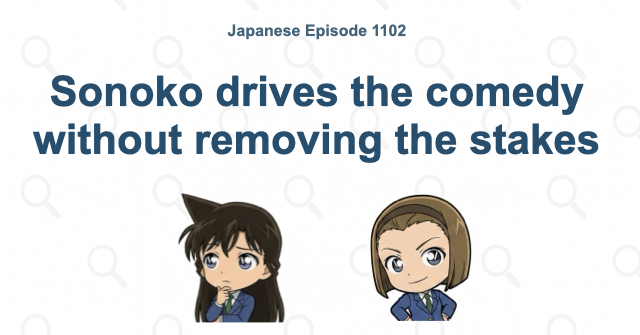
Sonoko’s determination to solve the case gives the investigation its brisk comic energy. Her demand that a suspect remove his trousers is deliberately forceful, while Ran’s reaction and the police exchanges keep the awkwardness visible. Conan’s role in directing the deduction contrasts with the usual Sleeping Kogoro setup.
The comedy is memorable because the objects retain their uncomfortable second meaning. A charming local toy becomes a dying clue; a garment used for a visual gag is also a strangulation weapon. The episode does not need to erase those connections to land its jokes.
The most satisfying twist is therefore not merely the unusual weapon. It is the change from reading a word as a person’s name to reading it as an object. Once the two hands of the victim are considered together, the apparently generous clue becomes precise.



Comments