Spoilers: This article covers the complete murder solution, Yamamura’s childhood connection and Hiromitsu Morofushi’s death.
Nakata kills Tsukishima and creates a false window silhouette to establish an alibi. The Body on the Gunma-Nagano Border (Part 1) and The Body on the Gunma-Nagano Border (Part 2) are international episodes 1181–1182 (Japanese episodes 1123–1124). They adapt Volume 102, Files 1082–1084: Murder on the Border, Memories of the Border and Micchan’s House.
The case has a second answer beyond the killer’s identity: Misao Yamamura’s childhood friend Hiro was Hiromitsu Morofushi. The murder is resolved through physical evidence, but Takaaki Morofushi’s conversation with Yamamura leaves a quieter sadness around the brother he has lost.
A search for local food becomes a joint investigation
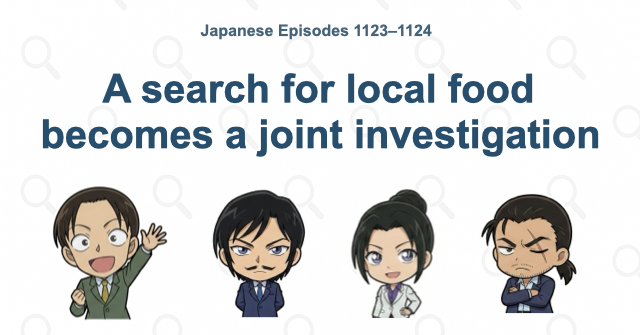
Kogoro, Ran and Conan are in Gunma after an assignment to find a runaway son. Hoping for a recommendation for local food, Kogoro contacts Inspector Yamamura. Instead, Yamamura asks him to help with a murder on the prefectural boundary.
At the hotel on the pass, they meet Nagano officers Kansuke Yamato, Yui Uehara and Takaaki Morofushi. The body was found directly on the line separating Gunma and Nagano, so neither police contingent wants to concede the case. Takaaki proposes a joint investigation and gives the argument a practical conclusion.
The jurisdictional dispute is comic, especially with Yamamura’s relaxed manner beside the Nagano officers’ sharper approach. Yet the border is more than a reason to assemble them: the position of the body will turn out to be a deliberate clue.
The victim’s last pose has been disturbed
The victim is Tsukishima, a thirty-year-old video creator, found in the parking area behind the hotel. He has been beaten to death. Security footage shows a hooded attacker striking him while he repeatedly looks toward the boundary line and his watch.
By the time the investigators work through the scene, the body has been removed and an outline remains. Another difficulty is Yamamura’s handling of the arms before Uehara photographed them. The original pose must be recovered from memory rather than accepted from the altered arrangement.
A later discussion over soba gives Uehara the reminder she needs. Seeing Kogoro after the meal, she recalls the victim’s left hand at his tie and right hand at his belt, along with his open mouth and splayed legs. These are not simply the untidy positions of a fallen man.
Tsukishima uses his body together with the painted border as a visual dying message indicating Nakata’s name. The location that initially produced a dispute over police responsibility becomes part of his final attempt to identify his attacker.
The camera appears to place Nakata in her room
The investigation centers on three people connected to Tsukishima: Nakata, Hoshikawa and Hanayama. Their association reaches back to a rescue five years earlier, while the present visit includes a lighthearted video comparison of soba from the two regions. The cheerful filming contrasts sharply with the parking-lot attack.
Nakata appears to have a strong alibi. A security camera records what looks like her figure at her room’s window, complete with the outline of her distinctive hair bun. The image seems to show her looking outside when she should therefore be away from the murder scene.
The figure is assembled from a ring light and a bath towel, supported on a suitcase. Its shape imitates her appearance rather than requiring her presence. Recognizing a familiar outline is not the same as seeing an identifiable person inside it.
Two phones make the false figure appear at the right time
Nakata also rigs the curtain with thread and a phone. After the killing, she calls that phone from a second one. The arranged phone falls, pulling the mechanism so that the curtain opens and exposes the prepared silhouette to the camera.
The ring light, towel and suitcase create the apparent person; the phones and curtain supply the timing. Those functions matter separately. A fake figure alone would not explain why the camera seems to catch an occupant at the relevant moment.
Once the setup is understood, the recorded image no longer establishes Nakata’s whereabouts. The alibi is a staged view of her room, not footage of her personally responding to the events outside.
The ring light is not the murder weapon
Tsukishima is killed with a weighted sock: wrist weights are placed inside one of his socks to make a blunt striking weapon. The ring light belongs to the alibi, while the weights account for the fatal blows. Confusing the two objects would obscure the structure of the plan.
Nakata hides the weights inside her hair bun afterward. An older photograph shows her hair at about shoulder length, making the size of the current bun suspicious. The hairstyle has therefore served twice—first as the distinctive shape copied in the window, and then as the hiding place for evidence.
The weights had been given to Nakata by Chizu Yuba. Their recovery links the physical weapon to a relationship central to the motive. Together, the border message, the dismantled camera alibi and the concealed weights make the accusation much more than a guess based on appearance.
A celebrated rescue concealed a devastating choice
Five years earlier, Chizu and her mother were trapped in a car at risk of falling from a cliff. Tsukishima, Nakata, Hoshikawa and Hanayama happened to come upon them. Chizu was rescued, but the car fell with her mother inside, killing her.
The rescue was remembered as a remarkable success. The concealed part was Tsukishima’s behavior delaying the effort to help, which cost Chizu’s mother a chance of survival. The story of the rescue therefore carried a different meaning for the people who later learned what had happened.
Chizu discovered footage of the incident on Tsukishima’s computer and confronted him. He chased her, and she fell down stairs, leaving her unconscious. The old loss was followed by a second devastating injury when she tried to expose it.
Nakata learned about both events and chose revenge. She also held Hoshikawa and Hanayama responsible and wanted suspicion to fall on them. Her scheme consequently combines murder, a fabricated alibi and an attempt to make others bear the blame.
The painful background explains the direction of her anger without making the killing a repair of what happened to Chizu. The truth about the rescue and the truth about the murder are both grim, and neither cancels the other.
Yamamura’s childhood friend was Hiromitsu Morofushi
The border also holds a very different history. Yamamura remembers playing near it as a child with a boy he knew as Hiro. Seeing Takaaki helps bring those memories back, including the secret base they shared. Hiro was Takaaki’s younger brother, Hiromitsu Morofushi.
Hiromitsu is often understood through his undercover identity, Scotch, and his connection with Tooru Amuro. Yamamura instead remembers the child who spent ordinary afternoons with him. That perspective adds a life before the dangerous work for which Hiromitsu is usually remembered.
Takaaki does not plainly tell Yamamura that Hiromitsu has died. He speaks in a way that conveys his brother’s commitment to justice as a police officer, leaving a gap between what he knows and what Yamamura remembers.
His restraint may reflect an effort not to shatter Yamamura’s image of his friend in that moment. That is an interpretation of the silence, not a stated explanation from Takaaki. What is clear is that the conversation gives the resolved case an emotional ending beyond the recovered weapon.
The same boundary holds evidence and memory
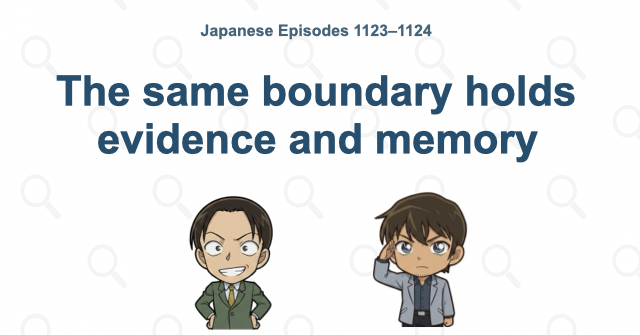
The case uses the border in three connected ways: it brings the two police teams together, completes the victim’s message and returns Yamamura to a place from his childhood. None is merely scenery around an otherwise unrelated puzzle.
The alibi and hidden weapon provide the mechanical satisfaction of the solution. Yamamura’s Hiro supplies the more lasting ache: an unexpectedly ordinary friendship survives in memory while Takaaki carries knowledge of how his brother’s life ended.





Comments