
Spoiler warning: Spoilers for Picking Wild Plants and Clovers and the revelations about Rumi Wakasa’s past in the seventeen-year-old case.
Rumi’s discarded clover can be read as a refusal of happiness by someone burdened with surviving Amanda Hughes and Koji Haneda. It is a persuasive interpretation of her actions, not an explanation she states. The handkerchief, Maika Zenda’s words, and the bishop Rumi keeps each support a different part of that reading. Her possible intention to let Conan see the gesture is a separate, unresolved question.
Why Rumi Wakasa Threw Away the Four-Leaf Clover

The strongest contrast is between what Rumi discards and what she keeps. Ayumi’s clover offers present-day kindness; Koji’s bishop carries a memory of people she could not protect. Reading the two together makes her refusal of happiness painfully plausible. Neither object, however, is a spoken confession of motive, and neither proves that she knows Conan is Shinichi.
A compelling reading is that Rumi rejects the clover because survivor’s guilt leaves her feeling unworthy of the happiness it represents. The story does not directly state her reason.
A four-leaf clover is commonly treated as a symbol of good fortune. Ayumi’s gift is an innocent attempt to share that happiness with her teacher, yet Rumi cannot simply take it.
She places a handkerchief between her hand and the clover, then ultimately throws the gift away. That small barrier makes the moment feel more deliberate and more painful than a casual refusal.
The contrast is striking. Ayumi’s gesture is warm and childlike, while Rumi’s response turns the atmosphere cold. The more we learn about Rumi’s past, the heavier this harmless object becomes.
Rumi’s past makes guilt over failing to protect Amanda Hughes and Koji Haneda a stronger reading than guilt for killing them. Her gesture can suggest the burden of surviving, but it does not confirm that motive.
What Happened in Picking Wild Plants and Clovers
Picking Wild Plants and Clovers (Part 1) and Picking Wild Plants and Clovers (Part 2) are international Episodes 1068-1069 (Japanese episodes 1011-1012), adapted from Volume 97.
Ms. Kobayashi and Rumi accompany the Detective Boys on a trip to Gunma to gather wild plants. During the outing, Ayumi finds a four-leaf clover.
The place where Ayumi found it helps Conan realize that a car has been moved. Within the case, the clover is therefore a practical clue to the culprit’s actions.
Its role does not end with the solution. After the case, the clover returns as an object that reveals something about Rumi without requiring her to explain herself.
The same prop operates on two levels: it is a piece of the mystery and a symbol of Rumi’s emotional distance from happiness. That double use is what gives the final scene its lingering effect.
Maika Zenda’s Words Struck a Nerve
Maika Zenda’s words appear to be the immediate emotional trigger for Rumi’s rejection of the clover.
Reflecting on what she has done, Zenda says in effect that she cannot accept a four-leaf clover as a symbol of happiness. This is a paraphrase of Zenda’s words rather than a direct quotation.
Her sense that she is unworthy of happiness seems to resonate with something in Rumi’s own past. The canon does not state this connection directly, but Rumi’s later action makes the parallel difficult to ignore.
Ayumi giving the clover to Rumi should have been a gentle scene: a child offering her teacher a token of good luck. Instead, Rumi cannot accept the gift in the spirit in which it was offered.
Rumi normally presents herself as a clumsy teacher. Behind that performance, however, lies the loss of Amanda and Koji in the case from seventeen years ago.
The clover may simply have felt too bright for someone still carrying that past. Zenda’s words give Rumi’s silent response a possible emotional vocabulary, but they do not turn the interpretation into a confirmed confession.
The Handkerchief Kept Happiness at a Distance
Accepting the clover through a handkerchief can be read as Rumi refusing direct contact with the happiness it symbolizes, although the story does not confirm that interpretation.
If she merely did not want the plant, she could have taken it normally and discarded it later. The decision to put cloth between her hand and the clover creates a visible layer of separation.
That distance seems directed less at the physical clover than at Ayumi’s pure goodwill and the promise of happiness attached to it. Rumi neither openly rejects Ayumi nor allows herself to receive the gift without a barrier.
The handkerchief may also suggest that she does not want to stain that innocence with the regret she carries. That is an interpretive detail, but it fits the carefully staged contrast in the scene.
One thin piece of cloth becomes an image of the emotional distance Rumi maintains between her present life and the pain of seventeen years ago. It is a small action that captures much of what makes her character so bitter and compelling.
The Meaning Changes Once Rumi Wakasa Is Revealed as Asaka
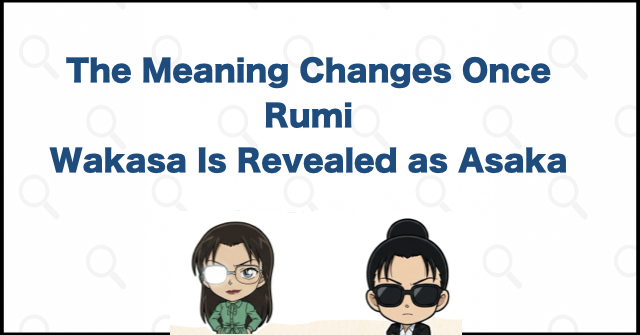
Once Rumi Wakasa is understood to be Asaka, the clover scene can be read as survivor’s guilt rather than hidden guilt for murder.
Earlier theories could interpret her refusal of happiness as evidence that she had killed someone. Her revealed past instead points in a different direction.
Rumi is Rachel Asaka, the former bodyguard of Amanda Hughes. Seventeen years ago, Amanda and Koji Haneda died, while Asaka was sent away by Amanda and sheltered by Koji.
This separates two very different kinds of guilt. The scene does not need to imply that Rumi killed Amanda; it can instead reflect her pain at failing to protect people who protected her.
Throwing away the clover is not proof of a crime. It may instead suggest that Rumi has not forgiven herself for surviving.
Guilt Over Failing to Protect Amanda and Koji
Survivor’s guilt over Amanda Hughes and Koji Haneda offers a plausible explanation for Rumi’s rejection of the clover.
Asaka was Amanda’s bodyguard, a role defined by the duty to protect her. Yet Amanda lost her life in the incident seventeen years ago, and Koji, who hid Asaka, was also killed.
Rumi is the person among them who survived. Amanda enabled her escape, and Koji offered her protection; that sequence gives her survival an especially painful weight.
Read through survivor’s guilt, the gesture raises a painful question: how can she accept happiness when the people who saved her are gone? That is an interpretation of her silence, not a question she voices.
In that light, discarding the clover is not simply a cold act; it can suggest that Rumi still cannot forgive herself. The sadness comes from watching her refuse kindness rather than from seeing her reject Ayumi personally.
The Contrast Between the Four-Leaf Clover and the Bishop

The clover gains another layer of meaning when it is contrasted with Koji Haneda’s bishop piece.
Rumi throws away the four-leaf clover, a symbol of happiness offered by Ayumi. By contrast, she continues to keep the bishop associated with Koji.
The contrast suggests that she can release an offer of present happiness but cannot release the memory, regret, and purpose tied to the past. This symbolic reading is compelling, although the full private meaning of the piece is not directly stated in the story.
The clover belongs to Rumi’s life now: it comes from a child who wants nothing from her. The bishop connects her to Koji, the incident seventeen years ago, and her continuing conflict with RUM.
Rumi lets happiness go but holds on to regret and duty. That is why two small objects can express her character more sharply than a long explanation.
The Clover Means Happiness; the Bishop Means Regret and Duty
The four-leaf clover represents happiness Rumi cannot accept, while the bishop represents regret and duty she cannot abandon.
Ayumi’s clover is pure goodwill directed at the Rumi who exists in the present. It carries no demand to revisit the old case, the Black Organization, or RUM.
That freedom from the past may be exactly what makes the gift impossible for her to accept. Happiness asks her to imagine living beyond the burden she has chosen to carry.
The bishop is different. It remains bound to Koji’s death, RUM, the incident from seventeen years ago, and Rumi’s regret as Asaka.
She discards the clover but keeps Koji’s piece: she may deny herself happiness, yet she refuses to put down the past. The exact symbolic equation is interpretive, but the visual contrast is unmistakable within that account.
Why Rumi Wakasa Discarded It Where Conan Could See

Rumi may have discarded the clover in Conan’s sight to show, without words, that she is not merely an ordinary teacher.
This should not be treated as confirmed intent. The scene does not provide a direct explanation, but her action also does not look entirely thoughtless.
Rumi has repeatedly allowed Conan to glimpse an ominous side behind her clumsy-teacher persona, while Conan has recognized that something about her is unusual. During this case, he also demonstrates his deductive ability in front of her.
Rumi may therefore see Conan as more than an ordinary elementary school student. That possibility does not establish that she knows his full identity, his circumstances, or the complete truth behind him.
The act can be read not as a deliberate revelation of every secret, but as a moment in which Rumi chose not to hide her darkness from Conan. Their silent exchange is unsettling precisely because neither character explains it.
A Silent Message to Conan
Throwing away the clover can plausibly be read as a silent message to Conan, but its exact content remains unclear.
On the surface, Rumi is a clumsy teacher. Beneath that role, she has a past as Asaka and a deep connection to the Koji Haneda case.
Conan notices the inconsistencies in Rumi’s behavior, and Rumi has opportunities to observe Conan’s exceptional reasoning. It would therefore be reasonable for her to suspect that he is no ordinary child.
Discarding the clover where he can see might suggest that she does not feel entitled to happiness. It might also be a challenge: an invitation for Conan to interpret the gesture for himself.
Those possibilities remain interpretations. Rumi offers no explanation, shows no tears, and simply lets the action speak.
By briefly exposing a shadow without defining it, Rumi preserves the tense distance between herself and Conan. The silence is more effective than an explicit declaration would have been.
Do Not Assume She Knows Conan Is Shinichi Kudo
This scene does not confirm that Rumi knows Conan is Shinichi Kudo (Jimmy Kudo).
She may recognize that Conan is not an ordinary child. His deductions, movements during cases, and directions to the adults around him make his unusual ability difficult to miss.
Recognizing Conan’s intelligence is not the same claim as knowing that he is Shinichi Kudo. It also does not automatically mean that Rumi knows why he appears as a child or understands every part of his situation.
The clover scene works without assuming knowledge of Conan’s identity. Rumi can be testing or addressing a remarkably perceptive child while Conan, in turn, remains alert to her contradictions.
The mutual suspicion alone is enough to make their relationship unsettling. Keeping these layers separate preserves the uncertainty supported by the scene.
What the Four-Leaf Clover Reveals About Rumi Wakasa
A compelling interpretation is that Rumi discards the four-leaf clover because survivor’s guilt makes her feel unworthy of the happiness it represents. Her private reason is not stated.
Ayumi gives her the clover out of simple kindness. Rumi receives it through a handkerchief and eventually discards it, creating the impression that she cannot bring herself into direct contact with that kindness.
Guilt over failing to protect Amanda and Koji is the reading supported by her past; the clover is not evidence that Rumi killed Amanda. Amanda helped Asaka escape, Koji sheltered her, and Rumi survived while they did not.
Her decision to discard the clover within Conan’s view is also suggestive, but it does not prove a specific message. She may regard Conan as unusually perceptive and may have chosen not to conceal this glimpse of her true emotional state.
That possibility must remain separate from the unresolved question of whether she knows Conan is Shinichi Kudo. Awareness of his intelligence is not knowledge of his full identity.
Within the mystery, the clover helps reveal that a car was moved. Within Rumi’s larger story, it becomes a symbol of guilt, distance, and rejected happiness.
The contrast with Koji’s bishop is especially painful: Rumi throws away happiness but keeps the object tied to regret and duty. She cannot accept the present gift, yet she refuses to abandon the past.
At first glance, Picking Wild Plants and Clovers is a self-contained outing and murder case. Revisited after the Asaka revelation, its final clover scene carries the weight of the central story.
A cute symbol leaves a bitter aftertaste, and that tension captures the appeal of Rumi Wakasa. The scene grows more affecting precisely because it never turns her pain into a direct explanation.







Comments