Are Chihaya and Jugo a couple?
Is his crush one-sided, or does she feel the same way?
Chihaya Hagiwara and Jugo Yokomizo have not been confirmed as a couple in the manga covered here, through File 1166. Jugo’s crush is hard to miss; Chihaya’s teasing, concern, and willingness to share her past leave room for romance, but do not give a clear answer about her own feelings.
They are close colleagues in the Kanagawa Prefectural Police who call each other by their first names. Dinner invitations, a concealed injury, and a jealous misunderstanding gradually make that familiarity more personal. The 2026 movie, Detective Conan: Fallen Angel of the Highway, adds a memorable rescue in which Jugo catches and carries Chihaya in his arms. Even that moment does not establish an agreement to date.
Spoilers follow for their manga and anime appearances, the ring case in Files 1154-1156, and the 2026 film. The manga discussion is limited to material through File 1166; the film’s romantic moments are considered within its own story. Matsuda’s place in Chihaya’s memories matters to both, but it does not turn her future into a contest between two men.
Are Chihaya Hagiwara and Jugo Yokomizo Dating?
Chihaya and Jugo have not been explicitly established as a dating couple. His attraction is increasingly obvious, while her teasing and concern leave room for hope without providing a clear romantic answer.
Their chemistry is clearer than their relationship status. They can banter with the ease of people who already know each other, yet the story has not introduced them as boyfriend and girlfriend. The pleasure of these scenes lies in watching that familiar rhythm acquire a romantic edge.
Jugo tends to give himself away through what he does. Chihaya answers with a joke that keeps her own position harder to read. He can look hopelessly transparent while she still has the last word; that imbalance makes their romantic comedy so enjoyable.
They Are Not Confirmed Lovers or Spouses
In the manga through File 1166, Chihaya and Jugo have not been confirmed as dating or married. Inviting her to dinner is an approach, but it is not the same as asking to begin a relationship, and no scene introduces them to others as an established couple.
The movie’s final carry is a striking romantic image. Jugo does not use it to ask Chihaya to be his girlfriend, however, and she does not accept such a request. The rescue changes the atmosphere without supplying that missing conversation.
That makes ‘not confirmed as a couple’ more precise than an absolute claim about everything that might happen off the page or off screen.
Their growing closeness is nevertheless important. Compared with their early scenes, the story gives readers more reasons to imagine a future romance. Possibility and development should simply remain distinct from confirmed relationship status.
Jugo's Crush Is Strongly Conveyed
Jugo's behavior provides strong evidence that he has romantic feelings for Chihaya. He invites her out, covers for her potentially troublesome conduct, tries to escort her despite being injured, and reacts jealously when he sees her with Detective Takagi.
Any one gesture could be explained as ordinary concern for a colleague. Taken together, the invitations, overexertion, and jealousy are much harder to read as merely professional consideration.
In the film's official cast-comment relay, Jugo's Japanese voice actor Akio Otsuka describes him as seemingly very fond of Chihaya. This is an actor's interpretation, not an in-story confession, but it fits his behavior.
A blunt, hot-tempered inspector becomes remarkably easy to read whenever Chihaya is involved. His toughness does little to disguise his crush, and that gap is endearing: he can face an investigation with authority and still be completely wrong-footed by her teasing.
Chihaya Cares About Jugo; Her Romantic Answer Is Still Open
Chihaya notices Jugo and cares about him, but she has not explicitly said that she loves him romantically. She remembers his dinner invitation and detects the injury he tries to hide.
She does not keep him at a distance. Their easy banter shows familiarity, and her reaction while he carries her in the movie can be read as embarrassment or sudden self-consciousness.
The combination makes it plausible that she recognizes his interest. What it cannot tell us is whether she has decided that she wants a romantic relationship herself. Awareness of a crush, trust, and returning that crush are three different things.
An encouraging response is not the same as confirmed mutual love. The relationship remains compelling precisely because his interest is visible while her answer is still partly concealed.
Their Profiles and Familiarity with Each Other
Both characters work for the Kanagawa Prefectural Police. Chihaya is a 31-year-old motorcycle-police squad leader, while Jugo is a 35-year-old inspector, four years her senior.
Their roles differ, but they call each other Chihaya and Jugo rather than maintaining a strictly surname-based professional distance. Their first shared scenes already suggest a history of familiarity.
That foundation matters as much as the romantic hints. They understand one another as capable police officers and can cooperate without either needing to dominate the other.
A 31-Year-Old Motorcycle Officer and a 35-Year-Old Inspector
Chihaya leads a motorcycle-police squad and combines exceptional riding ability with fast judgment. She acts decisively when a case demands it, living up to the goddess-of-the-wind image associated with her introduction.
Jugo is an inspector who investigates crimes including murder and kidnapping. His work places him in a different role from Chihaya's traffic duties, even though both belong to the same prefectural force.
They work in different police roles, rather than being presented as a straightforward supervisor-and-subordinate pair. Their scenes emphasize mutual respect for each other's professional strengths.
Their four-year age difference does not make Jugo the unquestioned leader in their personal exchanges, either. Chihaya is more than capable of setting the tone herself.
They Call Each Other Chihaya and Jugo
They address each other as Chihaya and Jugo, without surnames. For readers used to first names at work, the detail may seem ordinary; in their Japanese workplace, Hagiwara and Yokomizo would be a more formal choice. Their first-name address suggests familiarity, especially alongside the ease with which she teases him.
Chihaya does not seem intimidated by Jugo's harsh language. She answers him with teasing remarks, while he understands her impulsive side well enough to anticipate when she may need support.
Their manner of speaking does not prove that they are lovers. It does show that their connection is less guarded than a purely formal working relationship.
Neither is always protecting the other’s pride. Chihaya can challenge Jugo despite his seniority, and he can respond without their connection falling apart. That gives the possible romance a foundation in an existing relationship rather than a sudden attraction the story has to manufacture.
Kenji Hagiwara's Older Sister and Sango Yokomizo's Younger Twin
Chihaya is Kenji Hagiwara's older sister. Kenji was part of the Tokyo Metropolitan Police Department's explosive ordnance disposal unit and died in the line of duty in a bombing.
His loss remains important to Chihaya. In the 2026 film, memories of Kenji and his close friend Jinpei Matsuda help sustain her through the present-day danger.
Jugo is the younger twin brother of Sango Yokomizo of the Shizuoka Prefectural Police. They look very similar, but Sango's gentler manner contrasts with Jugo's rougher, more impatient temperament.
His abrasive words do not erase the kindness in his actions. That is part of the appeal of this pairing: Chihaya can see past the inspector’s rough manner, while Jugo takes her ability seriously rather than needing to be the stronger presence in every exchange.
Matsuda connects Chihaya's past to the developing relationship. Her story with Jugo carries the memories of the police-academy group alongside the lighter romantic comedy, giving it a distinctive emotional weight.
Manga and Anime Scenes That Reveal Jugo's Feelings
Jugo's interest is communicated more through actions than through a direct confession. He protects Chihaya, asks her to dinner, conceals an injury, and becomes jealous of another man.
Seen in sequence, those moments move from an invitation to personal concern and then jealousy. The change is small enough to fit inside ongoing cases, but clear enough that a tense investigation can suddenly become romantic comedy whenever Chihaya catches him off guard.
Goddess of the Wind: Covering for Her and Inviting Her to Dinner
Their first major relationship material appears in Volume 101's Chihaya Hagiwara, Goddess of the Wind. During the pursuit, Chihaya takes Conan on her police motorcycle without a helmet.
Jugo supplies a less incriminating explanation: she was carrying a helmet on her back to deliver it to a subordinate who had forgotten it. That account gives her cover for the helmetless ride. Chihaya immediately brings up the dinner invitation she previously declined and teases him that she might consider it after all.
She leaves the possibility open while keeping control of the exchange. Instead of becoming flustered because he helped her, she makes him confront the invitation he has already made. His protective gesture becomes an opportunity for her to tease him.
The scene is funny because their roles are so clear from the start. His interest is visible; she has enough confidence in their relationship to put him on the spot. The romantic hint grows out of the way they already talk, not an abrupt change in either character.
His defense of her need not be attributed solely to attraction. He may also be protecting a colleague whose actions helped resolve the case. The dinner invitation adds the personal dimension without erasing the professional one.
The Matchmaking Party: Trying to Escort Her While Injured
In Volume 102's Chihaya and Jugo's Matchmaking Party, they unexpectedly encounter each other at a matchmaking event. During the resulting case, Jugo suffers an injury to his right side.
He hides the wound and still offers to escort Chihaya after the case. She notices blood seeping from his right side and responds with an exasperated remark about another fool. The visible blood is what anchors the concern in the scene; her reaction is not just a joke at his expense.
Taken on its own, her remark could sound dismissive. In context, she has seen through his attempt to appear fine and noticed that he is pushing himself when he needs care. The affection in this reading comes from what she notices and when she speaks, rather than a tender line the scene never gives her.
Duty may be part of his motivation, and affection may be another. The scene works because the two are not easily separated: he wants to do his job and take care of her, even when he needs care himself.
A matchmaking party promises light romantic comedy, only to become a murder case and end with a glimpse of blood. That shift makes her understated worry land harder. The scene gives their relationship an emotional weight that the party setting alone could not provide.
The Red-Brick Warehouse: Jealousy Toward Detective Takagi
The Red-Brick Warehouse and the Vanishing Kidnapper makes Jugo's jealousy especially clear. Chihaya and Wataru Takagi pose as a couple while investigating at a pancake restaurant.
Unaware of the operation, Jugo sees them together and reads the situation as a genuine personal connection. His thoughts turn hostile toward the man he believes is making a move on Chihaya.
Takagi and Chihaya are only playing roles for the investigation. Jugo's mistake exposes a feeling that he has not openly expressed to her: he dislikes imagining her with someone else.
The joke lands because Jugo is acting like a rival before he has established a relationship with Chihaya himself. He can be forceful in a police investigation, yet seeing her beside another man sends him into a jealous misunderstanding. It is hard not to smile at how thoroughly his feelings give him away.
Compared with the earlier dinner invitation, this is a more urgent reaction: he now dislikes the thought of someone else taking his place. That reading shows how his crush is developing, while still leaving Chihaya’s choice entirely her own.
Does Chihaya Like Jugo, and Has She Noticed His Crush?
Chihaya's behavior suggests that she may be aware of Jugo's interest. She remembers the invitation, teases him about it, notices his injury, and allows him into conversations about her past.
None of that makes her indifferent to him. It also does not amount to a direct declaration of romantic love. Her concern and her relationship status need to be assessed separately.
She Remembers His Invitation and Can Tease Him About It
Chihaya does not treat the dinner invitation as something too unimportant to remember. She brings it up at a moment when Jugo has just helped her, making his interest part of their banter.
Rather than firmly rejecting the idea, she leaves room to consider it. That can be read as recognition of his approach and a willingness to keep the possibility open.
It can also be read as a joke between familiar colleagues. The scene does not tell us that she has privately decided to date him.
What the exchange does show is ease. Jugo makes an approach, Chihaya lightly sidesteps it, and neither has to end the conversation. That rhythm is satisfying precisely because she can keep the door open without having to give him the romantic answer he wants.
She Notices His Injury and Shows Concern
At the end of the matchmaking-party case, Chihaya sees the blood Jugo is trying to hide. His performance of being perfectly fine does not convince her.
Her response is indirect: instead of offering openly tender reassurance, she expresses exasperation at his recklessness. The concern comes through the context rather than through an affectionate declaration.
For someone usually so decisive, an indirect expression of concern is revealing. She sees exactly what he is trying to conceal but does not make the moment emotionally simple. Her exasperation lets the scene stay recognizably theirs, even as it becomes more serious.
Caring about an injured colleague is not proof of romantic attraction. Still, the scene shows attention and genuine concern, making it harder to regard him as an emotionally insignificant person in her life.
She Has Not Said She Loves Him or Agreed to Date Him
Chihaya has not given a clear verbal answer to the romantic question. Remembering a dinner invitation, worrying over an injury, and appearing embarrassed in someone's arms are not interchangeable with accepting a relationship.
Even the film's suggestive ending stops short of such confirmation. It offers a change in atmosphere, not a formal announcement of mutual love.
Her willingness to share important memories with Jugo points toward trust. That is meaningful in its own right, without requiring every intimate conversation to function as a confession.
The next major development could come from her showing more of what she feels. Until then, the most satisfying reading leaves room for romance while acknowledging that her answer has not yet been stated.
How Does Jinpei Matsuda's Memory Affect Their Relationship?
Matsuda is an important part of Chihaya's past. She was his first love, and his school-day interest was expressed directly and repeatedly rather than remaining a private admiration.
Chihaya's own romantic feelings toward him are not confirmed. What is clear is that she treasures memories of both Matsuda and her younger brother Kenji, and she becomes willing to share that past with Jugo.
This is not simply a contest between a living suitor and a dead rival. Jugo's challenge is to understand the person Chihaya is, including the memories she continues to carry.
Chihaya Was Matsuda's First Love
Matsuda fell for his friend Kenji's older sister. The later flashbacks show him making his interest plain during their high-school years, including repeated attempts to approach her romantically.
At a festival shooting stall, he linked winning a ring to the idea of Chihaya becoming his wife. The remark has a teenager's bravado, but it also makes the intensity of his feelings unmistakable.
He invited her to the movies as well. His approach was characteristically direct: rather than quietly waiting for his feelings to disappear, he repeatedly put them into words and actions.
That teenage directness becomes poignant in a flashback: Matsuda cannot return to speak to Chihaya as an adult or hear how she now remembers him. The ring joke remains lively, but the reader knows that the boy making it has no future in the present-day story.
From Jugo's perspective, Matsuda remains a powerful presence in her life. He is someone Jugo can neither meet nor compete with on equal terms, which helps explain the uneasy humor of recognizing him as a formidable rival.
Chihaya's Romantic Feelings for Matsuda Are Not Confirmed
Matsuda's love for Chihaya does not prove that it was reciprocated. She knew of his interest, and she continues to value him as Kenji's close friend and an important person from her youth.
No scene establishes that Chihaya accepted Matsuda as a boyfriend or that they dated. His love is clear, while her romantic response remains unresolved.
A person can matter for more than one reason. Matsuda was Kenji’s close friend, belonged to Chihaya’s youth, and repeatedly directed his feelings toward her. Those connections explain why his memory carries weight without requiring the story to turn them into a former couple.
The unresolved answer is what makes the memory bittersweet. Matsuda’s feelings are plain, while Chihaya’s cannot be reduced to a romantic yes or no. Her continuing affection for that past is meaningful even when its exact label remains open.
Jugo Is Learning to Accept Her Memories, Not Replace Them
The ring case in Files 1154-1156 deepens this part of the relationship. Afterward, Jugo approaches a reflective Chihaya, and she is ready to tell him stories about Matsuda and his foolish behavior. The detail that matters is her willingness to make that personal history part of a conversation with Jugo.
Jugo treats the dead Matsuda as a formidable rival. The line has jealous humor, but it also acknowledges that Matsuda occupies a place in Chihaya’s life that Jugo cannot simply ask her to set aside. His discomfort and her openness exist in the same exchange.
Chihaya's willingness to talk is a sign of trust, not proof that she has chosen a boyfriend. She is letting him hear an emotionally important story rather than keeping the past entirely private.
Nor does the scene show Jugo defeating or surpassing Matsuda. A dead person's place in someone's memory is not a competition that a present-day relationship can straightforwardly win.
The warmer possibility is that Jugo can listen without asking Chihaya to forget. A new relationship could grow alongside her grief and affection for the past. That is a more convincing prospect for these adults than treating Matsuda’s memory as an obstacle someone must defeat.
Their Relationship in Fallen Angel of the Highway
The 2026 movie gives Chihaya and Jugo a more overtly romantic visual moment than their everyday banter. Jugo supports her judgment and, near the ending, catches her as she falls.
The resulting bridal-style carry changes the emotional tone of the scene. This movie-only development does not automatically establish a new relationship status in the manga.
Even within the movie, neither a formal confession nor an agreement to begin dating occurs in that moment. The development is one of closeness and presentation rather than an announced partnership.
Jugo Supports Chihaya in the Present
In the film, Jugo does more than attempt to shield Chihaya from danger. He recognizes her abilities and supports her because he trusts that she can act effectively.
His support does not depend on making Chihaya helpless. He can trust her judgment and still be useful when she needs him. That makes him feel more dependable than a suitor whose only role is to worry or become jealous.
Memories of Kenji and Matsuda encourage Chihaya, while Jugo is there in the present to respond and help. Those different forms of support can coexist.
Read this way, the film gives Chihaya two kinds of support: memories that help her keep going, and a living colleague who can act beside her. It is an interpretation of how those scenes fit together, not a claim that Jugo replaces Kenji or Matsuda.
Where the manga often emphasizes his transparent jealousy, the film also gives him a steadier quality. He can act as someone who understands and backs her rather than only as a man nursing a crush.
The Bridal-Style Carry Changes the Atmosphere
Near the film's ending, Jugo catches Chihaya and holds her in his arms. He does not immediately set her down, giving the image room to turn from a rescue into a romantic-comedy beat.
Chihaya appears more self-conscious than in her usual teasing exchanges. Embarrassment is a plausible reading of her reaction, but the film does not turn that expression into a spoken declaration of love. The appeal lies partly in seeing her familiar composure briefly unsettled.
After so much danger, that sudden sweetness is especially effective. The woman usually rushing to help others becomes the one caught in someone else’s arms. The rescue remains practical, while the lingering carry gives it the softness of a romantic-comedy ending.
Knowledge of Matsuda's old feelings adds another layer, but it does not turn the scene into a victory over him. Memories of the past remain intact while someone in the present is physically there for Chihaya.
The scene gives a visible shape to closeness that the manga has built more gradually. Its impact comes from that history, even though it stops short of establishing an official couple.
The Movie Does Not Confirm a Confession or a Relationship
Being carried in Jugo's arms is not equivalent to agreeing to date him. The film does not supply the missing conversation in which he asks and she accepts.
What changes is their emotional distance, or at least the way the film invites us to perceive it. His support becomes especially tangible, and her response seems less completely guarded.
Through File 1166, the manga does not confirm that they have begun dating. The film’s ending has meaning within its own story, but a romantic image there cannot stand in for a new manga scene in which they choose a relationship.
Their next shared manga scenes may build on similar feelings, or they may retain the familiar pattern of his earnest interest and her teasing. That remains something to watch for, not a settled outcome.
Important Cases and Appearances to Follow
Their relationship develops in stages: the dinner invitation in Volume 101, the injury and concern in Volume 102, jealousy in Volumes 105-106, and the sharing of Matsuda's memories in the later ring case.
The film adds a separate, more visually romantic development. Following these appearances in order makes it easier to see what each scene contributes without treating every hint as a confession.
Volume 101: Chihaya Hagiwara, Goddess of the Wind
Chihaya's major introduction is in Volume 101, chapters 4-6. It is adapted as international Episodes 1156-1157 (Japanese Episodes 1098-1099), Chihaya Hagiwara, Goddess of the Wind (Parts 1 and 2).
The case showcases her motorcycle skills and introduces the familiarity between her and Jugo. He covers for her conduct, and their conversation reveals that he had already invited her to dinner.
Chihaya remembers the invitation and answers with a teasing suggestion that she might reconsider. Their romantic-comedy dynamic is already recognizable at this first major encounter.
The case returned in a digitally remastered broadcast in February 2026, ahead of the movie's release. The original episode numbers above are the reference for its first broadcast.
Volume 102: Chihaya and Jugo's Matchmaking Party
This case appears in Volume 102, chapters 5-7, and international Episodes 1173-1174 (Japanese Episodes 1115-1116), Chihaya and Jugo's Matchmaking Party (Parts 1 and 2).
Both characters turning up at a matchmaking event is inherently suggestive, but the case does not simply pair them off. A murder interrupts the setting, and Jugo's injury changes the emotional tone afterward.
His effort to conceal the wound and Chihaya's ability to notice it place his recklessness and her concern in the same scene. The ending is more emotionally revealing than the party's romantic premise alone.
This case also received a digitally remastered broadcast in February 2026. The rebroadcast revisits the same point in their relationship rather than adding a new encounter.
Volumes 105-106: The Red-Brick Warehouse and the Vanishing Kidnapper
The case spans Volume 105, chapter 10, through Volume 106, chapter 2. Its adaptation is international Episodes 1242-1243 (Japanese Episodes 1184-1185), The Red-Brick Warehouse and the Vanishing Kidnapper (Parts 1 and 2).
Chihaya and Takagi pretend to be a couple for an investigation. Jugo does not understand the situation and reacts as though Takagi is a genuine romantic rival.
His jealousy makes the personal dimension of his interest especially clear. It is a comic interruption to a tense kidnapping case, but it also advances the continuing story of his feelings.
The important distinction is that the apparent couple is an investigative role. Neither Chihaya's relationship with Takagi nor Jugo's relationship with her changes into an established romance here.
Files 1154-1156: The Memories Surrounding a Ring
The ring-related story runs from Volume 108, chapter 11, into the opening two chapters of Volume 109. Its overall chapter numbers are Files 1154-1156, beginning with File 1154, A Ring and A Spring.
The chapters were serialized before collection in book form. The publication information used here lists October 16, 2026 for Volume 109’s Japanese release; the relationship analysis concerns the serialized Files 1154-1156 and does not depend on treating the collected volume as already available.
These chapters add concrete memories of Matsuda's first love and repeated approaches to Chihaya. After the case, she becomes willing to share those stories with Jugo.
What changes is who gets to hear her memories. Chihaya is willing to give Jugo access to a meaningful part of her past. No confession or start to dating is confirmed, but that trust is a substantial development in its own right.
The 2026 Movie: Fallen Angel of the Highway
Detective Conan: Fallen Angel of the Highway opened in Japan on April 10, 2026. Chihaya is a key figure in the story and confronts the danger alongside Conan Edogawa.
Jugo appears as an important member of the Kanagawa police side of the story. His support for Chihaya complements the influence of her memories of Kenji and Matsuda.
The ending gives their relationship its memorable bridal-style carry. It is a substantial romantic-comedy image, while still leaving their dating status unconfirmed.
The film is therefore best discussed as bringing them closer in its own story, not as supplying a marriage announcement or a guaranteed manga development.
Could They Become a Couple or Get Married?
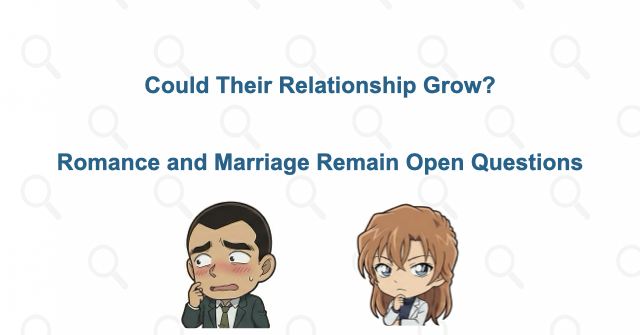
A future romance is plausible: Jugo's feelings are strongly conveyed, Chihaya does not simply shut him out, and their shared scenes increasingly involve trust as well as teasing.
What remains unresolved is her explicit response, whether he will directly ask for a relationship, and how future manga material will develop the connection. Marriage would require even more development and is not an established destination.
The question is no longer merely whether Jugo has a crush. The more interesting uncertainty is how Chihaya will choose to respond to it.
Will Chihaya Put Her Feelings into Words?
Chihaya has shown attention, concern, and a willingness to share memories. In the film, her response to being carried also permits a romantic reading. She has not, however, clearly stated that she loves Jugo.
Her habit of answering with a joke gives a plain response extra weight. If she stops teasing long enough to say what she wants, even a small shift could matter more than another scene demonstrating Jugo’s already obvious interest.
That is a possible future direction, not a prediction guaranteed by the story. For now, her words and choices remain the missing part of a relationship in which his feelings are already easy to recognize.
Will Jugo Make a Direct Confession?
Jugo's invitations, jealousy, and willingness to overextend himself all suggest romantic feeling. None replaces a direct request to begin dating.
Even the film's embrace leaves that conversation unspoken. He has acted more openly, but he has not removed the ambiguity through an explicit agreement with Chihaya.
They are adults with demanding work and complicated histories. Their relationship could develop gradually through accumulated trust rather than through one dramatic speech.
His jealousy is already doing much of the talking for him. There is a gently frustrating comedy in that: he can react to a supposed rival, yet still leave the one person whose answer matters free to tease him. A more direct conversation would have to give Chihaya room to answer for herself.
How Will the Movie's Development Connect with the Manga?
The film gives them a more openly romantic image, but its influence on future manga scenes is unknown. Their dating status remains unconfirmed through File 1166.
The next step would need to come from the characters themselves: a clearer expression of her feelings, a direct invitation from him, or a new shared experience.
Future appearances may show increased closeness or may continue the established pattern of Chihaya lightly evading Jugo's advances. The next meaningful change would be new evidence from those scenes themselves.
How Can Matsuda's Memory Coexist with a New Romance?
A relationship with Jugo would not require Chihaya to erase Matsuda. He was her brother's close friend and someone who openly cared about her, and those memories remain part of her life.
Jugo is beginning to engage with that history rather than pretending it does not exist. Listening to her stories offers a way to know her more fully, not a way to force a comparison he can win.
The film's embrace can be read in the same spirit: memories of Kenji and Matsuda support Chihaya emotionally, while Jugo is present to catch her. The roles differ without canceling one another out.
That is what gives their romance its distinctive aftertaste. The lightness of Jugo’s crush sits beside the grief in Chihaya’s past, and neither has to erase the other. Whether they eventually date remains open; the trust growing between them already gives the relationship more to offer than a yes-or-no shipping question.




Comments