Spoilers: this discussion covers both parts, the two murders, Iori’s police background and the unidentified passenger in the ending.
Momiji Ooka’s Sweet Trap (Part 1) and Momiji Ooka’s Sweet Trap (Part 2), international episodes 1193–1194 (Japanese episodes 1135–1136), adapt Volume 102, Files 1088–1090: A Sweet Trap, The Cracked Open Door and The Truth Behind the Door. Inaba kills theater director Kabumoto by combining a drugged pizza, a temporarily obstructed door and poisoned water. The apparent locked room creates his opportunity to kill; it does not prove the victim was already dead when the door failed to open.
A theater project gives Momiji a way to separate Heiji and Kazuha
Kogoro Mouri and Heiji Hattori are invited to Kyoto for a play built around characters modeled on them. Conan accompanies them to Kabumoto’s home for the planning meeting, where members of the production team are also gathered. Osamu Kenzaki is due to play the Kogoro-inspired Daigoro, while Hyoga Komoto is to play the Heiji-inspired Heiichi.
The arrangement is not quite as straightforward as it first sounds. Heiji finds that his fictional counterpart has a fiancee, and Momiji Ooka appears with a personal interest in that role. The Ooka group is sponsoring the production. Her claim to be Heiji’s intended bride is part of her romantic maneuvering, not confirmation of an engagement between them.
Meanwhile, Ran Mouri and Kazuha Toyama are enjoying a lavish Kyoto sweets tour arranged through the sponsor. Muga Iori serves as their guide under Momiji’s instructions. The treats keep Kazuha away from Heiji while Momiji has the chance to move closer to him.
When the two realize what is happening, the tour becomes a frustrating obstacle. Iori insists that completing the whole course is a condition of the arrangement. Ran encourages Kazuha, but each additional stop consumes time she wants to spend returning to Heiji. The sweetness of the title is therefore also a practical means of delaying a rival.
Hyoue Kuroda of the Tokyo Metropolitan Police Department is also present at the meeting, cooperating with Momiji. His presence introduces a different kind of tension into an occasion that initially looks like a mixture of theatrical business and romantic comedy.
Kabumoto’s nap leads to an apparent suicide
Producer Karuo, stage manager Kimata and screenwriter Inaba join the discussion at Kabumoto’s home. Delivered pizza becomes part of the meeting, although Kabumoto appears to be avoiding it because he is dieting. He subsequently becomes sleepy and goes upstairs to rest.
Kuroda asks about an actress, Gyoda, who died in an earlier case thought to be suicide. The question brings an uncomfortable past into the room before the new death has even been discovered. Kabumoto’s connection to that earlier case will turn out to be central to his own killing.
When the others check on Kabumoto, the upstairs room’s door will not open. They move around toward the window to look inside and discover him dead. An almond-like smell from his mouth leads the investigators in the story to suspect a cyanide-type poison.
Inspector Fumimaro Ayanokoji initially treats the scene as a suicide by poison. Conan and Heiji see a problem with how it is presented: the poisoned water and small container do not come with the expected signs that Kabumoto mixed the poison himself. There is no spoon for that purpose and no indication of the bottle having been shaken to mix its contents.
The pizza’s missing center explains why only Kabumoto falls asleep
Kabumoto’s apparent refusal of the pizza conceals a particular eating habit. He cuts a thin portion from its center and eats that, rather than taking an ordinary slice. Inaba knows the habit and puts sleeping medicine in the central portion.
This explains both why the others are unaffected and why the person who seems not to have eaten becomes drowsy. Kabumoto’s retreat upstairs is not merely a convenient interruption to the meeting. It is the result of preparation aimed at getting him into the room asleep and unable to resist the next stage.
The clue matters because it changes the timeline before anyone reaches the troublesome door. Conan and Heiji must first establish how Kabumoto was incapacitated, then work out how the room’s apparent isolation was used against the witnesses.
A handkerchief and a disguised rubber ball create the false locked room
The door’s obstruction comes from a handkerchief beneath it and a rubber ball wedged between the doorstop and the floor. These small objects make the room appear inaccessible and encourage the group to leave the doorway to check from the window side.
Inaba uses that movement to enter the room and give the sleeping Kabumoto poisoned water. The important reversal is when the killing occurs: Kabumoto does not have to be dead at the moment everyone first finds the door blocked. The obstruction creates the interval in which the killer can act.
The rubber ball is concealed as a wrapped lollipop. Momiji notices that the supposed candy bounces strangely, and that observation helps expose its real nature. The wrapper also retains fingerprints linking it to Inaba.
Momiji’s contribution gives her a role beyond arranging the romantic distraction. Her attention to a small physical inconsistency helps dismantle another deception built around something apparently sweet. The candy wrapping hides an object whose purpose is to manipulate where the witnesses go.
The separate clues now have distinct jobs. Kabumoto’s pizza habit explains the sleeping medicine; the handkerchief and ball explain the blocked door; the group’s trip toward the window explains Inaba’s opportunity; and the absence of self-mixing traces undermines the suicide account. The wrapper connects the concealed tool to its user.
An earlier murder supplies the motive for Kabumoto’s death
Inaba also killed the actress Gyoda in the earlier case. Kabumoto had recognized the trick behind her supposed suicide and used that knowledge to blackmail him. The present murder is an attempt to eliminate someone who can expose a prior killing.
That history keeps the two victims’ roles distinct. Gyoda’s death is the concealed crime; Kabumoto’s knowledge of it gives him power over Inaba. His blackmail explains the pressure behind the second murder, but it does not turn Inaba into an innocent person defending himself.
Inaba reuses the same general approach to manufacturing an inaccessible room. The method that seemed to offer protection from discovery instead helps connect the cases. Once the current scene has been reconstructed, the earlier death and the continuing blackmail become part of the explanation.
Kyoto police take Inaba away. The immediate mystery is resolved, but the result is darker than the opening theater visit promised: one staged suicide has been followed by another murder intended to protect it.
Momiji’s romantic plan resumes after the case
Ran, Kazuha and Iori finally join the others at Kabumoto’s house. Momiji has managed to get uncomfortably close to Heiji, and her remarks provoke Kazuha’s anger. The episode returns briefly to the rivalry that set the Kyoto outing in motion.
The close encounter does not establish that Heiji and Momiji have begun a romance or become engaged. Its function is to keep Kazuha conscious of Momiji’s efforts and to give the title a second, personal meaning alongside the deceptive props used in the murder. The contrast between the light opening and the two deaths makes that return to comedy feel particularly abrupt.
Kuroda’s use of Sakakibara reveals Iori’s former work
Kuroda notices Iori’s continuing habit of checking his surroundings and addresses him as Sakakibara. Iori asks him not to use the name, explaining that it was an alias used during an earlier infiltration and brings back unpleasant memories. Their familiarity is therefore tied to professional history, not simply to the current theater meeting.
The exchange reveals Iori’s background in public security and his former superior-subordinate relationship with Kuroda. Iori has left police work and now serves as Momiji’s butler. His public-security background gives a concrete context to the abilities and vigilance he displays in that role.
The conversation also reaches the blond employee at Cafe Poirot, Tooru Amuro. Kuroda’s association with undercover work provides a reason to reconsider his earlier use of Amuro’s codename, Bourbon: knowing that name is not, by itself, proof that Kuroda belongs to the criminal organization Amuro has infiltrated.
The Sakakibara exchange reveals a real connection, but it does not give a complete account of every operation, assignment or identity question surrounding these characters. Iori’s discomfort with the old alias is clear; the full history behind that discomfort remains unrevealed here.
The passenger using a breathing device remains unidentified
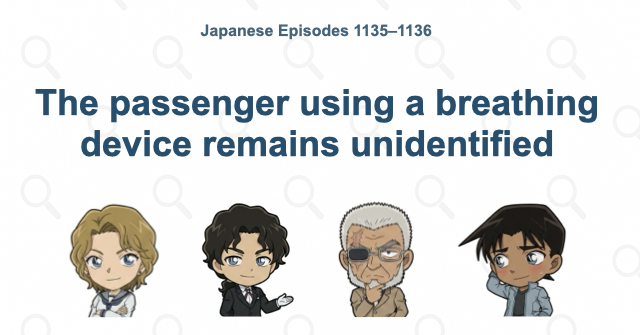
The ending introduces a black car carrying an elderly man using a breathing device and a man in sunglasses. The older passenger speaks contemptuously about the police, and Conan, Iori and Kuroda react as the vehicle passes. It is a final interruption to the sense that the Kyoto business is finished.
Renya Karasuma is one possible identity raised by the threatening presentation, but the passenger is not identified as Karasuma in this case. A hostile comment about police and an imposing appearance do not establish a name or an organizational position. The scene leaves an unresolved person to investigate rather than a confirmed answer.
That uncertainty is part of the ending’s effect. The murder has been reconstructed through specific objects and actions, while the car offers much less information. Momiji’s romantic scheme, Inaba’s criminal staging and the larger police-related mystery share the episode, but only the case has reached a complete resolution.


Comments