Spoilers: This article covers the Miyano and Akai families, Akemi Miyano’s death, Shuichi Akai’s identities, and developments through manga File 1166. A separate section discusses the 2023 film Black Iron Submarine.
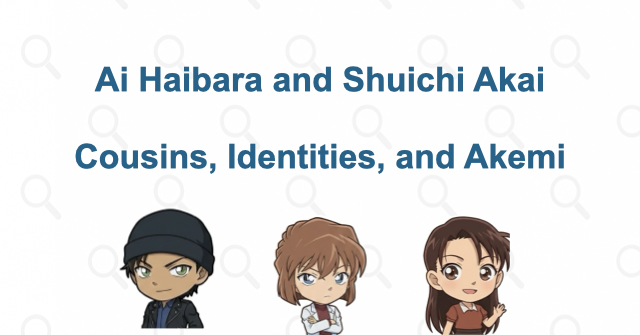
Ai Haibara and Shuichi Akai are maternal first cousins. Her mother, Elena Miyano, is the younger sister of his mother, Mary Sera. Akai also dated Haibara’s older sister, Akemi Miyano. What remains unclear is how much of that family connection the characters themselves know.
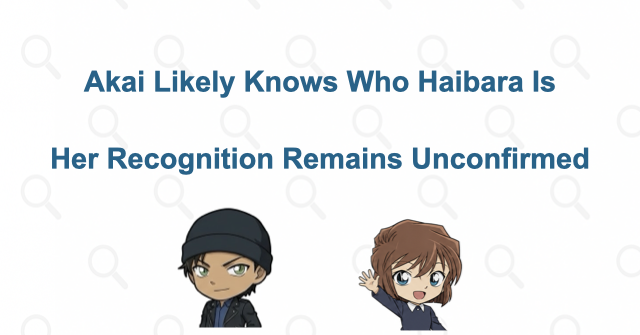
Akai’s conduct strongly suggests that he knows Ai Haibara is Shiho Miyano. Haibara’s knowledge is less certain: she suspects Subaru Okiya, but the story through File 1166 does not explicitly show her connecting all of his identities. His protection of her is clear; the full reasons for it, and the contents of Akemi’s email postscript, remain unresolved.
The family tree is straightforward once the missing link is supplied. Their lived relationship is not. They meet under assumed identities, share the loss of Akemi, and have not been shown speaking to each other as relatives. That closeness without an acknowledged family connection is what gives their scenes such an uneasy tenderness.
How the Miyano family and Akai family connect
Their mothers are sisters
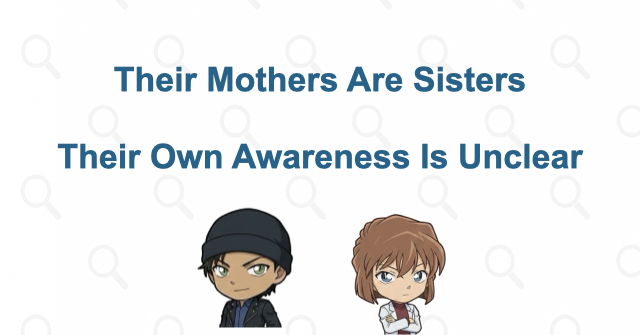
Mary Sera is Elena Miyano’s older sister. Mary and Tsutomu Akai are the parents of Shuichi Akai, Shukichi Haneda, and Masumi Sera. Elena and Atsushi Miyano are the parents of Akemi and Shiho Miyano, the latter now living as Ai Haibara.
The children of these two sisters are maternal first cousins. That makes Shuichi and Haibara cousins, and it also makes Shuichi and Akemi cousins. The relationship does not depend on the cover names they later adopt.
Volume 95’s cocktail case adds clues about Elena and the connection between the families. The confirmation that Mary and Elena are sisters comes in the birthday-party case spanning Volumes 98-99. Haibara’s resemblance to the physically younger Mary then takes on a clear family meaning.
The reveal is satisfying because it brings several apparently separate questions together: the resemblance, Akemi’s past with Akai, and his ongoing concern for her sister. It changes the reader’s perspective without automatically giving every character the same information.
Akai and Akemi were cousins as well as lovers
Akai approached Akemi under the name Dai Moroboshi as part of his infiltration of the Black Organization. They became romantically involved. The later family revelation makes them cousins as well as former lovers.
It is not established that Akai or Akemi knew they were cousins while dating. The two mothers formed households in different places, and the story does not depict routine contact between the families. They may have entered the relationship without knowing the connection, but that possibility should not be turned into a confirmed account of their knowledge.
The painful part is how the layers accumulate. One identity was deliberately invented for an investigation; another connection was hidden even from the audience. Knowing the family tree now does not tell us what either person understood then.
Do Akai and Haibara know they are related?
Their awareness of the cousin relationship remains unclear through File 1166. They have not been shown discussing Mary and Elena’s sisterhood with each other. Akai’s contact with the Miyano sisters might have given him information about their mother, but it does not prove that he traced the link to his own mother.
Haibara likewise has not been shown recognizing Mary as her mother’s sister. This is a separate question from whether she recognizes Akai’s disguise. Knowing a face, a cover name, or an FBI affiliation would not automatically supply the missing family history.
For now, readers can place them beside each other on a family tree more confidently than the characters can be said to do. A future conversation about that connection could change the relationship profoundly; the existing scenes do not let us assume it has already happened off the page.
Who knows which identity?
The four names belong to one man
Shuichi Akai is his name as an FBI agent. Dai Moroboshi is the identity he used when approaching Akemi to enter the Black Organization. Rye is the codename he received after proving his abilities within it.
Subaru Okiya is the identity he adopts after faking his death. With Yukiko Kudo’s disguise work and a voice-changing device from Professor Agasa, he presents himself as a graduate student living at the Kudo Residence.
Readers can connect those four names. Haibara’s understanding must be considered separately: she knew her sister’s boyfriend as Dai, but that alone does not show that she has connected Dai, Rye, Akai, and Okiya into one complete account.
Akai very likely knows Haibara is Shiho
Akai’s knowledge that Haibara is Shiho is strongly implied by his actions, rather than established here through a direct statement to her. During his infiltration, he knew the Miyano sisters and Shiho’s role as the scientist called Sherry. As Okiya, he follows Haibara’s situation and repeatedly helps protect her.
The Mystery Train operation is especially telling: he assists a plan intended to make the Black Organization believe Sherry has died. In Volume 103 he also accompanies the Detective Boys to guard Haibara when Conan is concerned about Rumi Wakasa.
These are more substantial clues than a resemblance between an adult woman and a child. His history with Shiho, his coordination with Conan, and the specific danger from the Organization together make the identification highly persuasive. The exact process by which he reached it, however, is not laid out.
He does not tell Haibara directly that he knows who she is. That restraint is part of what makes the protection feel characteristic of Akai: he acts on the danger without requiring her to acknowledge him first.
Haibara’s suspicion is not the same as recognition
Haibara senses something about Okiya that recalls the Black Organization. His calm graduate-student persona does not entirely conceal the atmosphere that frightens her. In Volume 77, she tries to investigate his neck, drawing close to the possibility of a concealed voice-changing device.
As he helps her, she becomes less openly resistant to his presence. Greater trust does not confirm that she has identified Okiya as Akai. Nor does knowing her sister’s boyfriend establish that she knows his FBI name and current disguise.
She may have connected more than she says, or may be choosing not to pursue her suspicions, but those remain possibilities. Through File 1166, the story does not explicitly establish that she has joined every identity together.
That leaves two feelings in the same scene. Okiya can be reassuring because he protects her, while the familiar trace of someone from her past is still unsettling. If the connection to Akemi becomes explicit, the emotional result need not be simple relief.
Akemi is the emotional link between them
A relationship that began as an infiltration route
Akai deliberately made contact with Akemi through a traffic incident and began a relationship under his Dai Moroboshi identity. Akemi held a relatively low-level place in the Black Organization, but her sister Shiho was an important scientist involved with APTX 4869. Approaching Akemi offered a route closer to the Organization’s center.
He eventually received the codename Rye and reached a position from which the FBI could attempt to capture Gin. The operation failed after Andre Camel’s intervention exposed the situation, bringing Akai’s infiltration to an end.
That beginning was exploitative. Acknowledging the later affection should not erase the fact that Akemi was first approached for an assignment. The tragedy comes partly from a man who could plan the contact being unable to keep the relationship emotionally contained within that plan.
Akemi understood the deception and still stayed
By the time of their conversation about his deception, Akemi knew he was an FBI agent and that he had used her to reach the Organization. When Akai asks why she remained with him, her reply makes her affection clear: she expects him to understand without needing a long explanation.
The scene supports genuine love on her side, rather than a woman who stayed only because she never discovered the lie. It does not require us to invent the exact instant when she first found out.
Akai is skilled at reading people, yet he still asks Akemi why she stayed. Her brief reply makes their awkward exchange especially poignant.
His breakup with Jodie matters too
Before Akemi, Akai had been dating fellow FBI agent Jodie Starling. He ends that relationship while continuing with Akemi, explaining that he cannot love two women at the same time.
The choice strongly supports the reading that Akemi had become more than a useful cover relationship. It is difficult to explain the emotional clarity of that breakup as mere indifference to the woman he was using to infiltrate the Organization.
Jodie’s remaining affection gives the decision a cost. There is no need to rank the two women or turn the story into a competition: Akai’s choices leave different wounds for each person. His controlled manner does not make the situation emotionally tidy.
The last email leaves a future unfinished
Before her death, Akemi sends an email asking whether, if she manages to leave the Organization, he will date her as a real boyfriend. Akai keeps the message and rereads it afterward.
Her request gives a concrete shape to the future she wanted: a relationship freed from the false identity and the assignment that brought them together. The fact that he keeps the message makes that unfulfilled possibility painfully tangible.
The text after Akemi’s P.S. is not revealed within this article’s cutoff of File 1166. It may concern Shiho, but the story covered here does not establish that Akemi used it to ask Akai to protect her sister.
An unseen line can become a powerful invitation to interpret later scenes. Every time he protects Haibara, it is tempting to fill in that blank. The temptation is part of the mystery, not evidence that the imagined wording has been confirmed.
Akemi’s death leads to Shiho’s escape
After Akai’s infiltration ends, Akemi undertakes a one-billion-yen robbery under the promise that she and Shiho can leave the Organization. The Organization does not intend to release them. Gin shoots Akemi after the robbery succeeds, and she dies after telling Conan what happened and where the money is hidden.
Shiho demands an explanation for her sister’s death and refuses to continue her research. She is confined, takes APTX 4869 intending to die, and instead shrinks to a child’s body. This enables her escape and her new life as Ai Haibara.
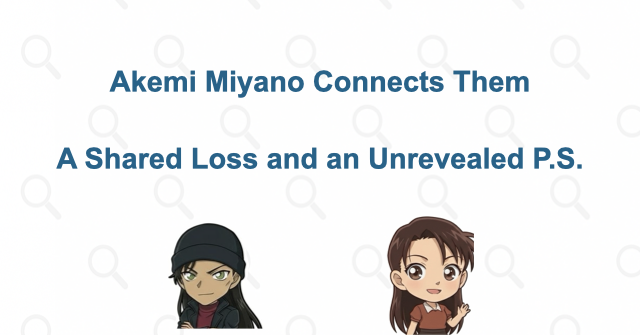
Akemi’s death therefore creates both losses at the heart of the present relationship. Akai has lost the woman he loved, and Haibara has lost her older sister. They have not been shown openly sharing that grief with each other.
Akemi connects them even in her absence. That is why a quiet protective action can carry more emotional weight than a direct conversation: the person who could have brought them together is the one neither can recover.
Why does Okiya protect Haibara?
Akemi’s sister, a person in danger, and possibly a promise
Haibara is the younger sister of Akai’s late girlfriend. His attachment to Akemi and regret over being unable to save her may help explain his determination to keep Shiho alive. His responsibilities as an FBI agent and their shared danger from the Black Organization may also matter.
Those motives can coexist. Akai has not supplied a complete account of them, so his protection should not be reduced to a single confirmed reason. In particular, calling it protection because she is his cousin would assume knowledge of the family connection that is still unclear.
The possibility of a promise to Akemi fits his actions, but the person involved and the precise content of the suggested promise remain unresolved through File 1166. The P.S. may eventually clarify matters; it cannot currently be used as an explicit instruction from Akemi.
The emotionally persuasive reading is that he could not save Akemi and now refuses to abandon her sister. It remains an interpretation of the pattern, rather than a complete statement of his thoughts.
Living next door lets him act without taking over her life
Okiya lives at the Kudo Residence beside Professor Agasa’s home, where Haibara stays. That places him close enough to respond to danger. At the same time, he participates in ordinary life by bringing dishes such as curry and meat-and-potato stew.
The mild graduate student carrying food and the FBI sniper are the same person. That contrast allows protective vigilance to exist inside familiar routines, though from Haibara’s perspective it also makes the mysterious neighbor harder to categorize.
Concealing his identity helps maintain his faked death. It may also spare Haibara the immediate emotional burden of learning that her protector is Akemi’s former boyfriend, but this additional motive is not confirmed. We can observe the distance he keeps without claiming full access to why he chooses it.
The Mystery Train makes the protection concrete
In Volume 78, Vermouth and Bourbon believe Sherry is aboard the train and move against her. Haibara considers facing the Organization alone in order to protect the people around her.
Conan, Yukiko Kudo, Kaito Kid (also romanized Kaitou Kid), and Okiya contribute to the operation that makes Sherry appear to have died on the train. Okiya follows the operation and acts from outside Haibara’s immediate view, helping her survive without revealing himself to her as Akai.
The emotional contrast is sharp. Haibara is ready to remove herself so that others will be safe; the people around her work to keep her alive. Akai’s part in that cooperation is meaningful without requiring him to step forward and demand her trust or gratitude.
Key manga cases and anime episodes
Volume 58: Akemi and the failed infiltration
Clash of Red and Black (Awakening), Episode 544 (Japanese episode 497), includes Akai rereading Akemi’s email. Clash of Red and Black (Innocence), Episode 549 (Japanese episode 502), supplies the past involving his approach to Akemi, her awareness of his FBI identity, and the failed operation associated with Camel.
These scenes change how later protection reads. Okiya’s calmness does not remove his history; once Akemi’s story is known, concern for Haibara can carry the possibility of regret and an effort to make amends.
Volumes 77-78: suspicion followed by rescue
Froth, Steam, and Smoke (Part 1) and Froth, Steam, and Smoke (Part 2) are Episodes 736-737 (Japanese episodes 684-685). Haibara’s attempt to investigate Okiya’s neck puts her suspicions at the center of the encounter.
The train story follows in Episodes 753-756 (Japanese episodes 701-704), from The Jet-Black Mystery Train (Departure) to The Jet-Black Mystery Train (Destination). Taken together, these cases move Okiya from a frightening unknown toward someone whose protection Haibara cannot simply dismiss. They do not establish complete recognition of his identity.
Volumes 95 and 98-99: the family connection
The Unsolved Cocktail Case (Part One) through The Unsolved Cocktail Case (Part Three), Episodes 1009-1011 (Japanese episodes 952-954), adds background on Elena and the family clues.
The Birthday Party of Divine Punishment (Part 1) and The Birthday Party of Divine Punishment (Part 2), Episodes 1102-1103 (Japanese episodes 1045-1046), cover the case in which Mary and Elena’s sisterhood is confirmed. This establishes the cousin relationship for readers; it does not show Akai and Haibara exchanging that information.
Volume 100: the same enemy from different positions
Episodes 1135-1137 (Japanese episodes 1077-1079), from The Black Organization’s Scheme (Hunt) to The Black Organization’s Scheme (Identity), depict the Organization’s campaign against FBI agents under Rum’s direction.
Haibara senses the danger, while Akai works with Conan and Yusaku Kudo to help the endangered Andre Camel. This is not a direct conversation between Haibara and Akai. Its value here is the broader picture: she recognizes the threat from one position while he confronts it from another, with more allies able to resist than when Akemi was lost.
Volume 103: Okiya accompanies Haibara as a guard
The Detective Boys and the Two Leaders (Part 1) and The Detective Boys and the Two Leaders (Part 2) are Episodes 1206-1207 (Japanese episodes 1148-1149). Conan becomes wary of Rumi Wakasa after a reaction connected to Shiho’s identity and asks Okiya to accompany the Detective Boys to protect Haibara.
Okiya and Wakasa remain outwardly civil while assessing each other. That watchfulness changes the atmosphere of a seaside outing. It demonstrates Conan’s trust in Akai as a protector; it does not, by itself, settle Wakasa’s intentions or Haibara’s understanding of Okiya.
Black Iron Submarine: a separate movie example
The 2023 movie Black Iron Submarine provides a movie-only example of Akai supporting Haibara’s rescue. The Pacific Buoy system exposes a connection between her and Shiho, leading to her abduction by the Black Organization.
In the movie, Okiya coordinates with Conan and supports the response with information. Later, Akai acts as an FBI sniper, providing long-range assistance to their counterattack. He does not reveal his identity or his past with Akemi to Haibara in these scenes.
That role echoes the manga pattern of helping from a distance, but it should not be used as an additional manga disclosure about what Haibara knows. The film’s central bond between Conan and Haibara does not erase the quieter significance of Akai helping Akemi’s sister survive.
What remains unresolved through File 1166
The blood relationship is established: Haibara and Akai are cousins, and Akemi was his cousin as well as his girlfriend. Their personal understanding of that relationship remains unclear. Akai’s identification of Haibara as Shiho is strongly supported by his conduct, while Haibara’s complete recognition of his identities is not explicitly shown.
His protection is real; a specific promise to Akemi and a request hidden after the email’s P.S. remain unconfirmed. Keeping those distinctions intact makes the relationship more affecting, not less. They are close enough to be family, yet so much of their contact still takes place through disguises and unspoken history.
If those secrets are eventually shared, the change will be more than the solution to an identity puzzle. It may be the first opportunity for them to face each other openly as two people who loved and lost Akemi.


Comments