Spoilers: This article covers the killer, a suicide attempt and the Chihaya-Jugo ending.
Chihaya and Jugo’s Matchmaking Party (Part 1) and Chihaya and Jugo’s Matchmaking Party (Part 2), international episodes 1173-1174 (Japanese episodes 1115-1116), adapt Volume 102, Files 1085-1087. Kaburagi kills the woman using the name Anju Tomari while secretly controlling her meetings from beneath a table. The case also draws Chihaya and Jugo closer, although it does not confirm that they are a couple.
Why the four selected men are not four equivalent suspects
A meal voucher takes Conan Edogawa, Ran Mouri and Kogoro Mouri to Bal Masqué, only to find the restaurant reserved for a masked matchmaking party. Kogoro’s lost key creates some ordinary confusion outside while the party supplies a very different kind of awkwardness indoors.
Jugo Yokomizo has attended at his family’s urging. Chihaya Hagiwara has come with Shinobu and is happy to take advantage of the free entry and restaurant food offered to women. She recognizes Jugo immediately despite his mask, while he becomes flustered and forgets her participant number.
His mistaken selection brings him into the sequence of men chosen by Tomari. She selects Kaburagi, Uetera, Enzaki and Jugo for private approach-time conversations. Jugo enters fourth and discovers her body, shot in the chest.
The central suspects are the three men who had earlier opportunities alone with her, not all four selected men in the same sense. Jugo’s role as the discoverer must be distinguished from the earlier interviews that the killer manipulated.
The first visitor never really leaves
Kaburagi enters first and uses a suppressed pistol to frighten Tomari with a warning shot. He then hides under the table and keeps her under threat while she speaks to the next two men.
Those conversations make her appear to be proceeding normally through the event. They also make it seem that the first visitor’s opportunity has ended. In reality, the same armed man is still present, controlling what the later visitors see.
After the third man leaves, Kaburagi shoots her and rings the bell to summon Jugo. Gloves and a plastic bag are part of his attempt to avoid gunshot residue. The arrangement exploits the event’s ordinary sequence of private meetings, turning apparent evidence of normal behavior into concealment of coercion.
A folded impression note becomes an accusation
Tomari records impressions of the men, a natural activity at a matchmaking party. The characters in her description of Kaburagi as a sincere person look odd. When the paper is folded along its crease, parts of those characters combine into wording that identifies him as the culprit.
This is a visual Japanese-writing clue, not an English pun. The apparent compliment, romanized as tokujitsu na hito, conceals hannin, meaning culprit, through the way the strokes line up after folding. The important action is reading the altered shapes, rather than translating the compliment literally and expecting the same effect in English.
Her note is also an act of resistance made while the attacker controls the room. The party stationery gives her a way to communicate without openly accusing the man threatening her.
Kaburagi claims to have been arranging his hair in the restroom, but he is unaware of the power failure that should have affected that activity. Gloves found in the toilet tank add physical evidence to the inconsistency. The note identifies the direction of suspicion; the outage and hidden gloves undermine his claimed movements and connect him with the preparation.
The revenge behind the chosen persona
Tomari’s real name is Yuri Sukiyama. She is a marriage swindler who targets men through matchmaking events. Kaburagi’s brother was one of her victims, giving her money, accumulating serious debt and eventually taking his own life.
Kaburagi uses what he knows of her selection habits to get close to her. She notices men who slip in the rain, especially those wearing expensive leather shoes, so he arranges to fall at the entrance and attract her attention. His inclusion in the meetings is preparation rather than a lucky accident.
The lost brother explains why the event is charged with anger for him. It does not make Tomari’s last effort to identify her attacker less desperate, or make the killing a neutral form of redress. The case keeps the damage caused by her fraud and the separate responsibility for her death in view.
Why Takagi brings Matsuda back to Chihaya
After exposure, Kaburagi attempts to kill himself. Wataru Takagi stops the blade with his bare hand, and Jugo restrains him. The detectives’ immediate task becomes keeping the culprit alive, even at personal cost.
Chihaya has already seen Takagi put his own foot between Jugo and broken glass when Jugo slips. The second risky intervention makes her reaction much stronger: she seizes Takagi’s tie and confronts him because his behavior reminds her of Jinpei Matsuda.
In her high-school memory, Chihaya was a third-year student and Matsuda a first-year student when Shinobu, distraught over lost love, tried to harm herself with a knife. Matsuda stopped her by grabbing it and injured his hand badly enough to withdraw from a boxing match.
Chihaya’s anger is inseparable from that memory and from the fact that Matsuda later died. She recognizes an instinct to put oneself in danger for someone else, and admiration does not cancel her fear of losing another person who behaves that way.
Her harsh description of such men reads as affection mixed with grief rather than simple contempt. The chapter title Idiots fits that recurring pattern, but it does not mean the episode endorses every unnecessary risk the men take.
What the anime callbacks add
The anime adds recollections of Takagi’s earlier dangerous actions, including hostage and bombing incidents and the notebook case connected with Wataru Date. These memories place the current interventions in a longer history for the Tokyo Metropolitan Police Department characters.
Their function is to help the audience understand the behavior Chihaya recognizes. She remembers Matsuda; the viewer is reminded that Takagi has repeatedly acted in a similar direction. The comparison is about an instinct and its cost, not a claim that the two men are interchangeable.
Miwako Sato has also lost Matsuda and now cares for Takagi, while Chihaya carries the loss of her brother Kenji Hagiwara. Those experiences give a possible future conversation between the women emotional potential, but this case does not establish that such a scene will occur.
Does Chihaya know who is really doing the deduction?
After the Sleeping Kogoro explanation, Chihaya directs her farewell toward Conan behind him. She already trusts Conan because of his role in bringing the bomber associated with Kenji’s death to justice.
That trust means she does not have to dismiss his actions as the luck of an ordinary child. Her farewell might carry an acknowledgment that he has again contributed more than he appears to. It is an intriguing reading of her attention, not proof that she understands how the Sleeping Kogoro performance works.
Recognizing Conan’s ability is also different from knowing his identity. The scene supports her unusual confidence in him while leaving the extent of her conclusions open.
The motorcycle ending suggests closeness, not a declaration
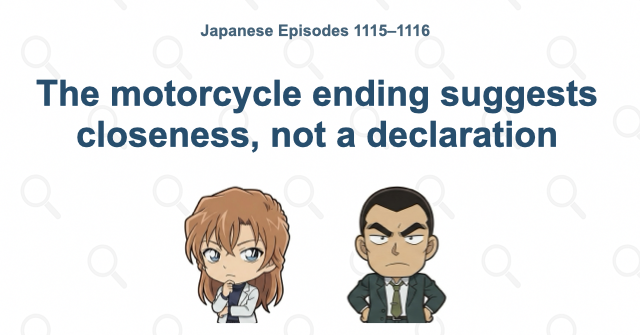
Jugo had been injured in another incident before the party and needed stitches. He kept quiet about it, and restraining Kaburagi reopens the wound. On the ride home, Chihaya notices blood near his abdomen and recognizes another example of the same self-sacrificing stubbornness.
She holds onto him from the passenger seat of the motorcycle. Along with her concern and teasing, the gesture suggests comfort and affection beyond a purely impersonal working relationship. It does not amount to a spoken romantic confession or an established couple status.
Jugo’s interest is clear in his awkward attempts at the party. Chihaya’s final response is warmer and less verbal, allowing worry to show through the teasing. The ending advances their emotional closeness while keeping the precise future of the relationship unresolved.
That restraint makes the ending more effective. The murder has a definite answer, while the feelings carry on after it. Matsuda’s memory explains Chihaya’s fear, Takagi makes that fear immediate, and Jugo brings it into the quiet space of their ride home.


Comments