Spoiler warning: Spoilers for The 17-Year-Old Truth, Amanda Hughes’s death, and Rumi Wakasa’s identity.
Amanda Hughes was a wealthy American with FBI and CIA connections, not a Black Organization member. Rum targeted her, used Asaka as leverage, and cornered Amanda into taking APTX 4869 herself. Her final warning about his eye is distinct from Koji Haneda’s clues. Understanding those choices is essential to understanding Rumi Wakasa’s grief seventeen years later.
Amanda Hughes was one of the central victims in the murder case involving Koji Haneda seventeen years ago. Although she first appears to be only a name from an old case, Amanda is deeply connected to the core of the Rum arc.
Her story links Amanda’s bodyguard Asaka, Rumi Wakasa, Koji Haneda, Hyoue Kuroda, and Rum. Once those links are placed side by side, the incident stops feeling like an isolated flashback and becomes part of the present conflict with the Black Organization.
Who Is Amanda Hughes? Her Identity Explained First
Amanda’s last actions and her dying message serve different purposes. Taking the drug denies Rum his leverage over her and protects Asaka; the warning about his eye gives a survivor information to carry forward. Koji’s clues form another trail from the same incident. Keeping those trails distinct makes both the deduction and Rumi’s loss clearer.
Amanda Hughes was not a member of the Black Organization; she was a wealthy American with connections to both the FBI and the CIA. She died at the same hotel as professional shogi player Koji Haneda seventeen years ago, making her indispensable to understanding his murder case.
The first distinction to keep clear is that Amanda was not a suspicious mastermind but a person targeted by Rum. A wealthy figure with access to major intelligence agencies naturally sounds like someone who might have a hidden role, yet the story presents her as a powerful outsider whose position could threaten or benefit the organization.
Amanda’s importance went beyond money. She had political influence, valuable contacts, and access to American intelligence circles. The story therefore suggests that bringing her under the organization’s control could have offered Rum major strategic advantages, while leaving her opposed to it could have made her dangerous.
That context gives added weight to Rum becoming personally involved. Amanda’s death connects the disappearance of Asaka, the present-day actions of Rumi Wakasa, Kuroda’s memories, and the mystery surrounding Rum’s left eye.
At first she seems like a victim whose name merely establishes an old mystery. Later revelations pull her into the center of the arc. Learning who Amanda was changes the emotional and narrative weight of the entire Koji Haneda case.
Amanda Was Rum’s Target, Not an Organization Member
Amanda was not aligned with the Black Organization. She belonged on the victim’s side of the conflict and was placed under direct pressure by Rum.
It may be too simple, however, to say that Rum wanted her gone only because she was an obstacle. The story strongly implies that Rum also wanted to exploit Amanda’s status and network, since gaining leverage over someone connected to the FBI and CIA could become an enormous asset.
Amanda was not someone who would submit easily. Rum therefore focused on Asaka, the bodyguard whom Amanda cherished like a daughter. Rather than relying on force alone, Rum attacked the relationship most likely to break Amanda’s resistance.
Amanda’s role is not that of an insider guarding the organization’s secrets, but of a victim whose fate demonstrates how Rum weaponizes personal bonds. At the same time, her final actions show that protecting Asaka mattered more to her than saving herself.
Why Was Amanda Hughes Killed? The Circumstances of Her Death
Amanda died after Rum cornered her and she took APTX 4869 herself in an effort to protect Asaka. The crucial nuance is that this was not simply a case of Rum forcing the drug into her mouth.
Under Rum’s threat and with Asaka in danger, Amanda made the terrible choice to take the drug herself rather than let Rum use her. Rum had treated Asaka as leverage against Amanda, but their bond was much deeper than an ordinary employer-bodyguard arrangement.
Amanda tried to create a way for Asaka to escape. She put Asaka’s safety ahead of her own survival. That choice turns a glamorous setting filled with an international chess event and prominent guests into one of the coldest episodes in the Rum arc.
Amanda’s decision disrupted what Rum hoped to achieve, but at an immense cost. Amanda lost her life, Asaka lost the person who had become family to her, and the consequences of the case continued for seventeen years.
Rum Apparently Intended to Control Amanda Through Asaka
Rum’s purpose appears to have extended beyond killing Amanda. The story suggests that Rum meant to use Asaka as leverage and make Amanda act in the organization’s interests, but it does not confirm his precise objective.
Amanda’s FBI and CIA connections made her potentially valuable in both intelligence and political terms. Threatening her directly might not have broken her resolve, so Rum targeted the person she most wanted to protect. This interpretation fits Rum’s method of studying an opponent’s relationships and turning affection into a vulnerability.
Asaka was more than hired security. Asaka’s father had also served as Amanda’s bodyguard, and that history helps explain why their relationship had become familial. Because Amanda regarded Asaka like a daughter, Rum’s pressure was not merely tactical; it was deliberately cruel.
Why Amanda Took APTX 4869 Herself
Amanda took APTX 4869 herself because she believed that doing so would protect Asaka from Rum. If Amanda remained alive and under the organization’s control, Asaka could continue to be used against her.
Her choice is important not only to the mechanics of the case but also to its emotional meaning. Amanda possessed wealth, influence, and powerful contacts, yet the last thing she tried to preserve was neither her authority nor her own life. It was Asaka.
That loss casts a long shadow over Rumi Wakasa’s present behavior. Her hostility toward Rum may involve more than a simple desire for revenge, but the story does not explicitly define the exact balance of grief, guilt, and anger.
One strength of this long-running mystery is the way established events from the past change how later expressions and actions feel. After Amanda’s death is revealed, even Rumi Wakasa’s casual smile can carry a more painful and unsettling undertone.
Amanda and Asaka: The Key Relationship Behind Rumi Wakasa
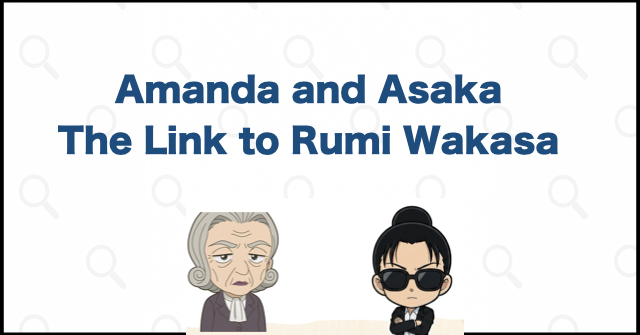
The relationship between Amanda and Asaka is the most important personal bond in Amanda’s story. Asaka served as her bodyguard, but their connection was far more intimate than a standard professional arrangement.
Asaka’s father had previously worked as Amanda’s bodyguard. Against that background, Amanda treated Asaka not merely as an employee but as someone close to family, specifically like a daughter.
That is precisely why Rum chose Asaka as leverage. Endangering Asaka offered a more effective way to pressure Amanda than threatening Amanda alone. Rum exploited Amanda’s compassion and loyalty, turning her best qualities into the means of trapping her.
Amanda nevertheless refused to let the situation unfold entirely according to Rum’s plan. She acted to help Asaka escape and took the drug herself, cutting off the future in which the organization could use her through that bond. The decision is tragic, but it also preserves Amanda’s dignity and agency.
This past changes how Rumi Wakasa reads in the present at Teitan Elementary School. Her outwardly clumsy or harmless moments stand beside flashes of perception and anger that become much more striking once the seventeen-year-old case is known. Amanda is therefore not only a past victim; she is central to understanding why Rumi remains connected to Rum and the old case.
The Meaning of Amanda’s Final Message, “Watch Out, Eye”
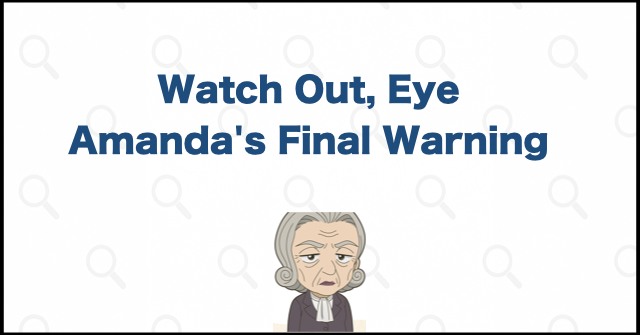
Amanda’s final message, rendered here as “Watch out, eye” (unofficial translation), warns others to beware of Rum’s eye. This clue is one of the most important pieces of setup in the Rum arc.
Amanda did not simply leave the culprit’s name. Instead, the message directs attention to the unusual danger associated with Rum’s eye. Focusing on the eye rather than the name makes the warning more unsettling because it points to the ability that makes Rum especially threatening.
Rum’s left eye has photographic memory, allowing Rum to retain what has been seen with extraordinary precision. On that reading, being observed by Rum may itself create danger, and Amanda’s message serves as a warning about Rum’s capabilities rather than only an identification of her attacker.
The clue gains force when its strange wording later connects to Rum’s eye and memory. Amanda refuses to remain a passive victim even in her final moments: she uses the little time available to leave information that could help others recognize the threat.
Keep Amanda’s Message Separate from Koji Haneda’s Clues
Amanda’s message and the clues associated with Koji Haneda do not perform the same role. Amanda’s “Watch out, eye” warning points specifically toward Rum’s eye and should be analyzed separately from the other messages surrounding Koji’s case.
The case can become confusing because Amanda, Koji, Asaka, Rum, Hyoue Kuroda, and Renya Karasuma all enter the larger chain of mysteries. Separating each clue by its source and purpose prevents one person’s message from being made to prove more than it actually does.
Amanda’s role is to leave a warning about Rum’s eye. Koji’s clues reach toward the broader truth of the case and the Black Organization. Together they move the Rum arc from different directions, but they should not be collapsed into a single dying message.
Seen this way, the incident from seventeen years ago is more than a standalone murder mystery. Multiple people risked everything to leave fragments behind, and the accumulation of those fragments gives the case its lasting weight.
Amanda Hughes Episodes: Manga and Anime Appearances
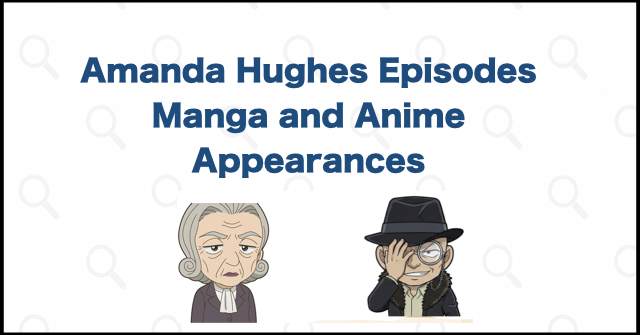
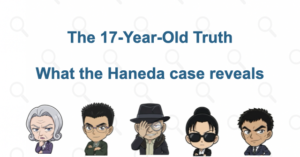
Amanda’s name and the old case become prominent in international Episodes 916-917 (Japanese episodes 861-862), “Just Like a 17 Years Old Crime Scene (Part 1)” and “Just Like a 17 Years Old Crime Scene (Part 2).” The circumstances of her death are then explored in much greater detail in international Episodes 1222-1225 (Japanese episodes 1164-1167), the four-part “The 17-Year-Old Truth” sequence.
In the manga, Amanda appears in the information surrounding the Koji Haneda case in Volume 89, File 948, “The Scissors in the Hand.” Volume 104, Files 1103-1109, beginning with File 1103, “Black-and-White Opening,” then develops the shared past of Amanda, Asaka, Koji, Rum, and Hyoue Kuroda.
For anime viewers, the sequence is:
- International Episode 916 (Japanese episode 861), “Just Like a 17 Years Old Crime Scene (Part 1)”: the old case and Amanda’s background become major clues.
- International Episode 917 (Japanese episode 862), “Just Like a 17 Years Old Crime Scene (Part 2)”: the case information continues to establish the seventeen-year mystery.
- International Episode 1222 (Japanese episode 1164), “The 17-Year-Old Truth (The Bloody Knight)”: the flashback case begins moving in earnest.
- International Episode 1223 (Japanese episode 1165), “The 17-Year-Old Truth (The Perceptive Devil)”: Rum’s disturbing abilities and methods take focus.
- International Episode 1224 (Japanese episode 1166), “The 17-Year-Old Truth (The Far-Sighted Bishop)”: more of the incident’s structure comes into view.
- International Episode 1225 (Japanese episode 1167), “The 17-Year-Old Truth (The Queen’s Gambit)”: the stories of Amanda, Asaka, and Koji are brought into a clearer arrangement.
Watching in this order shows how the questions raised in Episodes 916-917 are revisited and substantially answered in Episodes 1222-1225. What first looks like a mysterious past incident is repositioned as a central part of the Rum arc.
For anime-only viewers, Episodes 1222-1225 provide the clearest account of Amanda’s identity, choices, and death. They also reveal major elements of the ongoing plot, so viewers who have not reached them should expect significant spoilers.
Why Amanda’s Death Matters to the Rum Arc
Amanda’s death matters because it ties Rumi Wakasa, Hyoue Kuroda, Rum, and the Koji Haneda case into one continuing chain of events. Amanda died seventeen years ago, but the consequences remain active in the present narrative.
For the bodyguard later connected with Rumi Wakasa, Amanda was someone to protect and someone like family. Amanda’s loss can reasonably be connected with Rumi’s present hostility toward Rum, although the precise makeup of Rumi’s emotions is not fully established.
Hyoue Kuroda is also tied to what happened seventeen years ago. What he witnessed, what he remembers, and how he acts in the present connect his past to the truth of the Koji Haneda case. Amanda’s death is therefore part of Kuroda’s history as well, without implying that he possessed every detail of every participant’s plan.
The incident also makes Rum’s danger concrete. Rum does not remain a distant executive who merely issues orders. The story depicts Rum acting directly, exploiting personal relationships, cornering targets, and relying on an extraordinary visual memory associated with the left eye.
The Koji Haneda case is the kind of mystery that initially looks self-contained and later moves the main plot. Understanding Amanda brings Koji’s death, Asaka’s disappearance, Rumi Wakasa’s present role, Kuroda’s position, and Rum’s identity into much closer narrative proximity without making those distinct mysteries identical.
Amanda remains powerful in the story precisely because a victim from the past continues to shape the feelings and decisions of characters in the present. Her life ended before the current timeline, but her influence did not.
Summary: Amanda Hughes
Amanda Hughes was a wealthy American with FBI and CIA connections, not a member of the Black Organization. She was one of the victims at the center of the Koji Haneda case from seventeen years ago and became a key figure in the Rum arc.
Amanda died after Rum cornered her and she took APTX 4869 herself to protect Asaka. By refusing to let the organization control her through someone she loved like a daughter, Amanda paid the highest possible price and left consequences that continue into Rumi Wakasa’s present story.
Her final warning, rendered here as “Watch out, eye” (unofficial translation), directs attention to Rum’s eye and the danger associated with Rum’s photographic memory. The clue should be kept separate from Koji Haneda’s own messages, even though both sets of clues contribute to the same wider mystery.
Amanda connects Asaka, Koji Haneda, Hyoue Kuroda, and Rum, pulling a seventeen-year-old incident into the current Black Organization storyline. Once her role is understood, the Rum arc looks less like a collection of separate mysteries and more like the continuing aftermath of one devastating case.
The bright atmosphere of an international chess event gives way to the organization’s cold manipulation. That contrast, and the lasting pain created by Amanda’s choice, is what gives her story such enduring weight.


Comments