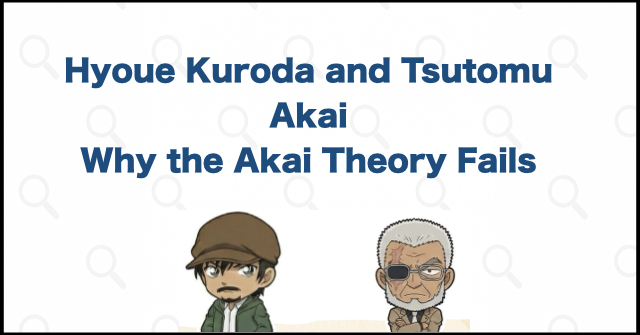
Spoiler warning: Spoilers for Volume 104 and the revelations about the seventeen-year-old case.
The seventeen-year-old case points to Hyoue Kuroda and Tsutomu Akai being different people. Kuroda was involved at the hotel on the day of the incident; Tsutomu was asked to investigate afterward. That difference in timing matters more than their mysterious absences or the possibility of disguise. Rejecting the same-person theory does not tell us whether Tsutomu is alive or where he is now.
Hyoue Kuroda and Tsutomu Akai are both important figures connected to the murder of Koji Haneda seventeen years ago.
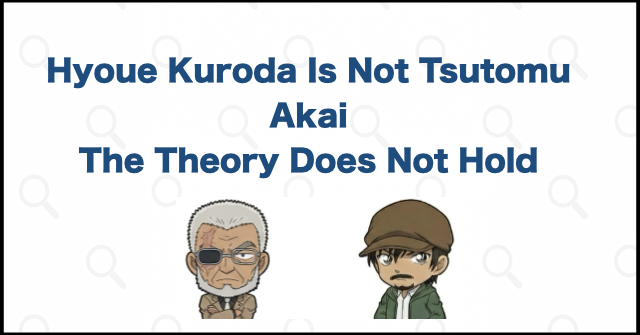
Conclusion: Hyoue Kuroda Is Not Tsutomu Akai
| Person | Position in the seventeen-year-old case | What remains unresolved |
|---|---|---|
| Hyoue Kuroda | At the hotel on the day of the incident | His wider history and the circumstances of his long coma. |
| Tsutomu Akai | Asked to investigate after the incident | His survival and present location. |
The resemblance theory draws strength from what is missing: Kuroda’s years in a coma and Tsutomu’s disappearance. The timeline supplies something more concrete. A man present during the incident and a man brought into the investigation afterward occupy different roles. Appearance, disguise, and Rumi’s reactions add context, but the case’s chronology does the main explanatory work.
Hyoue Kuroda and Tsutomu Akai are not the same person.
The account of the Koji Haneda murder case in Volume 104 places the two men in separate roles at different points in the timeline. Kuroda was present at the hotel in the United States on the day of the murders. Tsutomu, by contrast, was asked by the Haneda family to investigate after the case.
This timing is the most important distinction. Kuroda became caught up in events at the scene, whereas Tsutomu began pursuing the truth afterward.
One man was involved at the hotel on the day of the crime; the other entered the investigation after the crime had occurred. Once those roles are placed on a single timeline, the idea that Kuroda is Tsutomu becomes extremely difficult to sustain.
That conclusion answers only the identity question. It does not answer whether Tsutomu Akai is alive, where he may be, or what happened to him after his investigation. His current status remains unclear, so it should not be presented as settled.
Both characters still matter to the Rum arc and to the history surrounding the Akai family. Their stories overlap around the same case, but their functions are different. Separating them makes the structure of the seventeen-year-old mystery much easier to understand.
Why the Hyoue Kuroda Equals Tsutomu Akai Theory Emerged
The theory did not come from nowhere. Several deliberately suspicious details made it reasonable for readers to compare the two men.
Kuroda has a long period of unconsciousness in his past, an injured right eye, facial scars, and white hair. Tsutomu, meanwhile, vanished after taking up the investigation into the case from seventeen years ago.
Both men therefore stand close to the Koji Haneda murder case. Kuroda was at the hotel on the day of the incident, while Tsutomu pursued it afterward. Before the full order of those events was clear, it was easy to imagine those two lines joining.
There was also an institutional resemblance. Tsutomu is connected to the Secret Intelligence Service and is the father of Shuichi Akai, Shukichi Haneda, and Masumi Sera. Kuroda is not portrayed as an ordinary police administrator either; his knowledge and his relationship with Tooru Amuro suggest access to the hidden side of national security work.
That shared intelligence-world atmosphere gave the theory extra appeal. Both men seemed to possess information that ordinary investigators would not have, and both remained partially obscured from the reader.
Volume 104 does not make the earlier clues meaningless; it rearranges them by showing that Kuroda and Tsutomu are separate pieces connected to the same historical case. The mystery around each man remains, but it now points in two directions rather than one.
Evidence That Hyoue Kuroda and Tsutomu Akai Are Different People
Three main points support the conclusion: their different affiliations, the timeline from seventeen years ago, and Rumi Wakasa‘s contrasting reactions. Their different appearances can support the argument, but the timeline is the strongest evidence.
The events presented in Volume 104 separate the Kuroda who was at the hotel from the Tsutomu who was asked to investigate later. That distinction leaves little room for a simple substitution or disguise theory.
Hyoue Kuroda Can Be Understood as a Public Security Figure
Kuroda can be understood as a figure close to Japan’s public security apparatus. He holds a senior position within the police and displays an unusual degree of familiarity with Tooru Amuro.
His use of Amuro’s undercover name, Bourbon, and his apparent knowledge of Muga Iori under an earlier alias indicate that Kuroda has access beyond what one would expect from a routine police role. These details place him near the National Police Agency and its security side, although the story does not establish a complete formal account of every role he holds.
Tsutomu belongs to a different institutional line. He is associated with the Secret Intelligence Service and is the father of Shuichi Akai, Shukichi Haneda, and Masumi Sera. His background is therefore British rather than part of Kuroda’s Japanese police framework.
Different organizations alone could not prove that two characters never cooperated. The series repeatedly connects the National Police Agency, FBI, Secret Intelligence Service, and Black Organization. Even so, the difference in their established roles is a major obstacle to identifying Kuroda himself as Tsutomu.
Kuroda remains suspicious and important without being Tsutomu. That distinction preserves the tension around him: the answer to one identity theory does not reveal the full extent of his knowledge or his purpose in the Rum arc.
The Seventeen-Year Timeline Breaks the Same-Person Theory
The largest problem for the Kuroda-equals-Tsutomu theory is the sequence of events seventeen years ago.
Kuroda was staying at the American hotel to watch a chess tournament. He became involved in the disturbance surrounding Amanda Hughes, Koji Haneda, and the movements connected to Rum.
Kuroda was present during the case in which Amanda died and Koji was murdered. His severe injuries, damaged right eye, and long period of unconsciousness are tied to that past.
Tsutomu’s involvement begins on the other side of the crime. The Haneda family asked him to investigate after the incident.
Tsutomu moved to pursue the truth after Koji Haneda’s murder, while Kuroda had already been caught up in the events at the hotel. Their established timelines do not provide a basis for collapsing those two roles into a single person.
This is why the timeline is more persuasive than visual resemblance or speculation about disguises. What once looked like one hidden path now divides cleanly into an eyewitness-side history and a later investigation.
Rumi Wakasa’s Reactions Also Point to Two Different People
Rumi Wakasa’s reactions also make more sense if Kuroda and Tsutomu are different people. She is deeply connected to the old case and also had contact with Tsutomu.
Tsutomu remains in her memory as someone who helped her in the past. Her response to a person who seems to remind her of Tsutomu carries a mixture of warmth and sadness.
Her attitude toward Kuroda is markedly different. It conveys caution and tension rather than reassurance. That emotional contrast is suggestive, although a character’s expression by itself is not proof of identity.
Taken together with the timeline, the different emotional tone reinforces the reading that Wakasa is responding to two separate men. It works as supporting evidence rather than the sole basis of the conclusion.
Treat Appearance and Disguise as Supporting Evidence
Kuroda’s appearance also weakens the same-person theory. He is large, white-haired, scarred, and injured in his right eye, giving him a very different presence from Tsutomu.
Appearance cannot settle the question on its own. Disguises and impersonations are recurring possibilities in this series, and Kuroda’s appearance changed dramatically after his injuries and years of unconsciousness.
The visual difference is therefore supporting evidence, not the decisive point; the decisive point is the timeline. Readers could reasonably wonder about disguise when considering looks alone, but disguise does not resolve the two separate stages of involvement in the old case.
Kuroda is not Tsutomu, yet Kuroda still has a concealed past of his own. That is what keeps the answer from reducing him to a discarded suspect. His mystery survives even after this particular identity theory falls away.
How Were Hyoue Kuroda and Tsutomu Akai Involved in the Case Seventeen Years Ago?
Both Hyoue Kuroda and Tsutomu Akai are connected to the murder of Koji Haneda, but their timing and positions are different.
Kuroda belongs to the group drawn into events at the hotel on the day of the crime. Tsutomu belongs to the later effort to uncover what happened. They connect to the same central mystery from opposite sides of its timeline.
The Koji Haneda case links Amanda Hughes, Rumi Wakasa, Rum, the Black Organization, and the Akai family, making it much more than an isolated murder. Kuroda and Tsutomu are best understood as separate figures whose paths approach that mystery at different times.
Hyoue Kuroda Was at the Scene on the Day of the Case
Hyoue Kuroda was at the hotel on the day of the Koji Haneda murder case seventeen years ago.
He was in the United States to watch a chess tournament. While at the hotel, he became entangled in events involving Amanda Hughes, Koji Haneda, Rumi Wakasa, and Rum.
Kuroda noticed that something was wrong with Amanda and was subsequently drawn toward Koji’s room. The case led to his serious injuries, including the damage to his right eye, and to the long period in which he remained unconscious.
His importance lies not merely in looking suspicious. He was physically close to a case at the heart of the Black Organization’s history. The story does not establish how much of the entire plot Kuroda understood, so his full knowledge should remain an open question.
What can be stated is narrower: Kuroda was there, suffered life-changing consequences, and remains a key figure in the Rum arc. Those facts explain why his past matters even after the Tsutomu disguise theory is rejected.
Tsutomu Akai Was Asked to Investigate After the Case
Tsutomu Akai is not presented as someone acting at the hotel on the day of the murders. The Haneda family asked him to investigate afterward, and he then went to the United States.
As a figure associated with the Secret Intelligence Service and the father of Shuichi Akai and his siblings, Tsutomu brought a different investigative background to the case. His search may have taken him dangerously close to the Black Organization, but the story does not establish every detail of what followed.
He later disappeared after warning his family of danger. His survival, present location, plan, and complete circumstances remain unclear. None of those unresolved questions should be treated as answered simply because he is not Kuroda.
Tsutomu is therefore a separate major figure who began following the seventeen-year-old case after the crime, not the hidden identity of the man injured at the scene.
That separation makes his absence more significant, not less. Kuroda’s past can be examined through what happened at the hotel, while Tsutomu’s unresolved fate continues to cast a shadow over the Akai family and the larger mystery.
Summary
Hyoue Kuroda is not Tsutomu Akai. The timeline places Kuroda at the hotel on the day of Koji Haneda’s murder and places Tsutomu’s investigation after the case, when the Haneda family asked him to pursue the truth. That difference is the strongest reason the same-person theory fails.
Tsutomu’s current status is a separate question. His survival and whereabouts have not been conclusively revealed. Rejecting Kuroda as his disguise does not resolve what happened to Tsutomu himself.
Kuroda remains an important figure close to Japan’s public security world, while Tsutomu remains a separate unresolved link between the Akai family and the Koji Haneda case. Seeing them as two people clarifies their roles without erasing the mysteries around either one.
The case from seventeen years ago becomes more coherent when its participants are kept in their proper places. Kuroda, Tsutomu, Rumi Wakasa, Rum, Amanda Hughes, and Koji Haneda are connected, but connection does not mean identical knowledge, timing, motive, or identity.



Comments