Spoiler warning: This article discusses Kanenori Wakita’s identity as RUM, Rumi Wakasa’s connection to Rachel Asaka, the Koji Haneda case, and the revelations in The 17-Year-Old Truth.
What exactly is the shogi piece in Detective Conan?
And what did Wakita mean when he mentioned it?
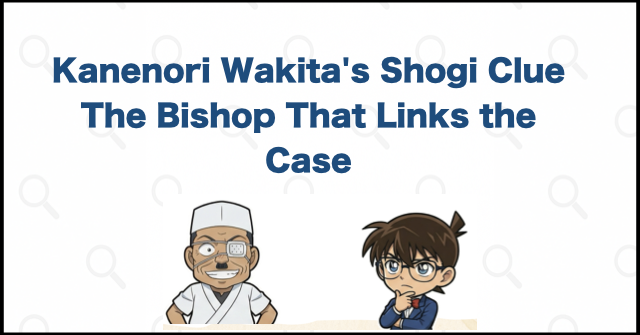
At the end of Yoko Okino and the Locked Attic, Kanenori Wakita makes a strangely specific remark to Conan. He says that when something is missing from where it ought to be, it tends to bother him, giving a shogi piece as his example (unofficial translation).
Because the reference arrives so abruptly, it feels less like casual conversation and more like a probe. This article examines what that missing piece represents and why Wakita may have brought it up.
What Is the Shogi Piece? Koji Haneda’s Bishop

The shogi piece at the center of this mystery is the bishop that Koji Haneda entrusted to Rachel Asaka.
That distinction matters. At first, a shogi piece can look like an obvious prop associated with a professional player. In this story, however, the bishop connects the seventeen-year-old deaths of Koji and Amanda Hughes, Rachel’s survival, Rumi Wakasa’s past, and RUM’s failed operation.
A bishop moves diagonally across the board and can exert influence from far away. That long reach can be read as a thematic parallel to the message Koji left with Rachel and to Rumi’s later position. The interpretation is evocative, but it should not be mistaken for a separately confirmed rule about her entire plan.
The piece is therefore more than physical evidence. It carries the memory of Koji’s attempt to help Rachel survive, as well as the pain and anger that appear to remain with Rumi. It is tiny, but the emotional and plot weight placed on it is enormous.
The Missing Keepsake from the Koji Haneda Case
The shogi piece is treated as a missing keepsake connected to the Koji Haneda case. Koji, a four-title shogi champion, died at an American hotel seventeen years earlier, as did Amanda Hughes.
The case connects RUM, the second-in-command of the Black Organization; Rachel Asaka, who served as Amanda’s bodyguard; and the woman later known as Rumi Wakasa. The bishop had been close to Koji, but its importance goes well beyond the unsurprising fact that a shogi player possessed a game piece.
After the incident, the missing bishop becomes a quiet link among the people who know what happened seventeen years ago. Knowledge of it is limited, so a character’s deliberate reference to a missing shogi piece can reveal an unsettling degree of familiarity with the old case.
That is why the object works like a silent alarm. Its appearance calls up Koji’s death, Rumi’s hidden history, and RUM’s shadow without requiring a dramatic confrontation. The contrast between an ordinary wooden piece and the dangerous knowledge attached to it makes the clue especially effective.
Why Rumi Wakasa Kept the Shogi Piece
Rumi has the bishop because Koji entrusted it to Rachel Asaka. Rumi is not merely an elementary-school teacher: she is Rachel, one of the survivors of the events surrounding Koji’s death.
The piece can be read as evidence of Koji’s final concern for Rachel. It also resembles a keepsake or protective charm rather than a clue she preserved only for investigative value. It seems to embody his hope that she would live long enough to make a move of her own.
That emotional reading changes how Rumi’s severity looks. Her actions may not be driven by revenge alone; she also appears to carry the memory of someone who helped her survive. The article’s interpretation remains just that: an interpretation of the object and her behavior, not proof of every motive she has.
The bishop holds two feelings at once: Koji’s kindness and Rumi’s anger. That warmth and menace in a single object reflect the dual impression Rumi herself creates.
The Far-Sighted Bishop and a Good Move
The idea that a far-sighted bishop can produce a good move is essential to the symbolism attached to Koji’s piece. The expression is presented here in an unofficial translation.
A bishop influences the board diagonally from a distance. Koji’s gesture can be interpreted as more than an instruction to flee: even from far away, and even while hidden, Rachel might someday find a strong move.
As a thematic reading, Rumi may be compared to a far-sighted bishop; this does not confirm when she formed a plan or how much of it she had decided in advance. She does not simply charge directly at RUM. She remains within ordinary life as a teacher near Conan and waits for an opportunity.
The shogi language works because it describes both a piece and, potentially, a way of living. Koji’s message still appears to shape how readers understand Rumi seventeen years later.
Why Kanenori Wakita Mentioned a Shogi Piece

Wakita may have mentioned the shogi piece to test whether Conan knew about the Koji Haneda case and its missing keepsake. The scene does not explicitly confirm that purpose, so it is best treated as a strong possibility rather than a settled fact.
The line is conspicuously abrupt. A case has just been resolved, yet Wakita introduces a missing shogi piece. The speaker is also the man later revealed to be RUM, which gives the remark a far more threatening context.
The standalone mystery may be over, but Wakita’s words reopen the larger Black Organization plot. What lingers is not the culprit or trick from the attic case, but the question of what Wakita wanted to learn from Conan’s reaction.
Which Episode Contains Wakita’s Remark?
Wakita mentions the piece in Yoko Okino and the Locked Attic. The story appears in Volume 99, Files 8-10, and in international Episodes 1116-1117 (Japanese episodes 1059-1060).
Kogoro Mouri, Conan, and Wakita become involved in a case at Yoko Okino’s villa. The locked attic and a playing-card code provide the immediate mystery, but the significant moment for this discussion arrives after the solution.
Wakita says, in effect, that it bothers him when something is absent from where it belongs, mentioning a shogi piece (unofficial translation). The line is not a clue to the attic culprit; it shifts the atmosphere from an isolated case back to the long-running RUM storyline.
Wakita May Have Been Testing Conan
One plausible reading is that Wakita deliberately floated the phrase to watch Conan’s response. In his public role as Kogoro’s apprentice, he has regular access to Conan and has reason to recognize that the boy is unusually perceptive.
The phrase about something missing from its proper place is especially ominous. It sounds like the perspective of someone who knows that the bishop disappeared from the context in which it should have been found. That makes a reference to the Koji Haneda case more likely than an unrelated comment about shogi.
Wakita may have been testing how close Conan had come to the old case, rather than testing whether he was Shinichi Kudo (Jimmy Kudo). The scene itself does not disclose his exact objective, and it does not establish the full scope of his knowledge about Conan.
The technique suits Wakita: make a loaded remark sound like small talk, then observe what it produces. Its menace comes from how little he has to reveal while gathering a possible reaction.
Conan May Truly Have Been Unaware of the Piece
It is also possible that Conan did not yet know the piece was the missing keepsake from the Koji Haneda case. Readers have already seen Tooru Amuro react to it in The Spark That Fell on the Ranch, but that does not automatically mean Conan possessed the same information.
Conan seems to brush off Wakita’s comment naturally. The scene does not resolve whether that response is an act or genuine ignorance. Based on the exchange alone, neither interpretation can be ruled out.
The tension comes from a possible information gap: readers recognize the danger while Conan may not yet understand the reference completely. Conversely, he may have noticed something and chosen not to show it.
Whichever reading is correct, Wakita’s sentence does not function as empty conversation. Its importance grows in retrospect precisely because the immediate scene leaves Conan’s knowledge unresolved.
How the Piece Connects RUM, Koji Haneda, and Rumi Wakasa

The bishop links Koji’s death, Rumi’s response to the past, and RUM’s failed operation across the larger series. It is not merely a clue contained within one murder mystery.
The route runs from the bishop Koji gave Rachel to the piece associated with Rumi in the present, and from Wakita’s interest back to RUM’s involvement seventeen years ago. A small object reveals distances between characters, old wounds, and unequal layers of knowledge.
Once viewers understand the bishop’s significance, otherwise casual lines and glances in the RUM arc gain another possible meaning. That retrospective effect is one of the clue’s greatest strengths.
Wakita’s Words Carry More Weight Once He Is Known as RUM
After Wakita is revealed as RUM, his reference to a shogi piece can no longer be heard as the idle curiosity of an amateur detective. RUM is directly tied to the side responsible for the events surrounding Koji’s death.
From that perspective, the missing object is connected to an old failure. It could help identify someone who survived, someone who knows the truth, or someone moving closer to it. The scene strongly suggests that Wakita is sounding out Conan and the people around Kogoro, although the precise target and purpose remain unconfirmed.
The contrast makes him frightening: a cheerful sushi chef on the surface, a senior Black Organization figure quietly revisiting a seventeen-year-old operation beneath it. Humor and menace occupy the same disguise.
The 17-Year-Old Truth Clarifies the Piece’s Meaning
The 17-Year-Old Truth makes the bishop’s importance much clearer. The story organizes the pasts of Koji, Amanda, Rachel, Hyoue Kuroda, and RUM and shows more of the circumstances around the hotel incident.
Within those revelations, the bishop has meaning as something Koji entrusted to Rachel. It resonates like a message to survive and retain the possibility of a move from afar, though that emotional paraphrase is an interpretation rather than a registered official quotation.
Koji is gone, but the piece and the meaning Rachel appears to draw from it remain seventeen years later. For Rumi, it seems capable of serving as both support and a focus for anger.
The anime adaptation makes this material available in international Episodes 1222-1225 (Japanese episodes 1164-1167). Those episode numbers establish where the adaptation appears; they do not by themselves verify every interpretive claim about Rumi’s feelings.
A Series-Wide Clue, Not a Clue to the Attic Case
The shogi piece does not point to the culprit in Yoko Okino and the Locked Attic; it belongs to the larger RUM arc.
This distinction keeps the two mysteries clear. The culprit and method of the attic case are resolved within that story. Wakita’s closing remark introduces a different line of suspense after the immediate solution.
The calm ending of a familiar investigation is interrupted by the Black Organization’s longer shadow. Although the local case is over, the reader’s anxiety increases because the bishop connects Koji’s past, Rumi’s present, and RUM’s continuing attention.
That delayed connection is characteristic of the series. A small inconsistency or passing phrase can acquire new force once later information supplies the missing context.
Manga Files and Anime Episodes Featuring the Shogi Piece

The clearest route through the shogi-piece thread is The Spark That Fell on the Ranch, Yoko Okino and the Locked Attic, and The 17-Year-Old Truth.
First, Tooru Amuro reacts to the piece in the ranch story. Next, Wakita mentions a missing shogi piece at the end of the attic story. Finally, the seventeen-year-old case explains why the bishop mattered to Koji and Rachel.
Watched in that order, the object develops from an ominous possession into a central link in the RUM storyline. The progression turns several isolated moments into one connected thread.
Amuro Notices the Piece in The Spark That Fell on the Ranch
In The Spark That Fell on the Ranch, Tooru Amuro recognizes that the shogi piece is connected to the missing keepsake from the Koji Haneda case.
The story covers Volume 99, Files 4-7, and international Episodes 1110-1111 (Japanese episodes 1053-1054). Rumi Wakasa, Tooru Amuro, and Yuya Kazami are involved. Apart from the immediate case, an ominous undercurrent develops around the piece.
Amuro’s reaction signals to readers that this is not an ordinary possession. His public-security background also makes his recognition significant. Yet his knowledge must remain distinct from Conan’s: the scene does not establish that they had shared everything they knew.
That uneven distribution of information prepares the ground for Wakita’s later remark. The ranch story looks domestic on the surface while quietly advancing the central plot beneath it.
Wakita Mentions It in Yoko Okino and the Locked Attic
In Yoko Okino and the Locked Attic, Wakita mentions the shogi piece after the case. The manga chapters are Volume 99, Files 8-10, while the anime adaptation is international Episodes 1116-1117 (Japanese episodes 1059-1060).
On the surface, the plot concerns a locked-room death at Yoko’s villa. At the end, however, Wakita talks about how the absence of something that should be present can draw attention, and he uses a shogi piece as his example.
Because Wakita is RUM, the remark retrospectively sounds like a reference to the keepsake missing from the Koji Haneda scene. It may be an attempt to test a reaction, but the dialogue does not state that conclusion outright.
The immediate mystery ends cleanly, yet the final note remains bitter. Wakita has allowed the larger conspiracy to intrude without openly exposing himself.
The Koji Haneda Case Comes Into Focus in The 17-Year-Old Truth
The 17-Year-Old Truth reveals much more about how the bishop connects Koji and Rachel.
- International Episode 1222 (Japanese episode 1164): The 17-Year-Old Truth (The Bloody Knight)
- International Episode 1223 (Japanese episode 1165): The 17-Year-Old Truth (The Perceptive Devil)
- International Episode 1224 (Japanese episode 1166): The 17-Year-Old Truth (The Far-Sighted Bishop)
- International Episode 1225 (Japanese episode 1167): The 17-Year-Old Truth (The Queen’s Gambit)
The four episodes draw together the deaths of Koji and Amanda, Rachel’s escape, and the involvement of Kuroda and RUM. Within that history, the bishop becomes a keepsake Koji entrusted to Rachel rather than an incidental piece of equipment.
The far-sighted-bishop image gives emotional shape to Koji’s concern for her. Revisiting the ranch and attic stories afterward changes the weight of the object: an ordinary-looking piece now links Koji’s final actions to Rumi’s present.
Final Thoughts on the Shogi Piece in the Attic Case

The shogi piece is the bishop Koji Haneda entrusted to Rachel Asaka. It connects the seventeen-year-old case, Rumi Wakasa’s past, and Wakita’s activity as RUM.
It is more than a missing keepsake. The bishop can symbolize Koji’s attempt to help Rachel survive and the grief and anger Rumi continues to carry. Those emotional meanings are strongly suggested readings, not a complete statement of her motives.
Wakita’s comment becomes especially disturbing once his identity is known. What sounds like casual conversation may be a calculated attempt to see who recognizes the reference. The possibility is compelling, but Conan’s knowledge and Wakita’s exact intention remain unresolved.
To follow the thread, revisit The Spark That Fell on the Ranch, Yoko Okino and the Locked Attic, and The 17-Year-Old Truth in that order. Together, they show how one unobtrusive object can carry a major storyline across years.
The appeal of this clue lies in delayed recognition. A small piece and a strange sentence become far more meaningful once the past is revealed, leaving Koji and Rumi’s story with a lasting, uneasy resonance.

Comments