Spoiler warning: This article discusses later revelations about Tooru Amuro and Bourbon, Subaru Okiya, and Shuichi Akai’s apparent death, including the Mystery Train and Scarlet series.
The scarred man in “Won’t Forgive Even One Millimeter” is not the real Shuichi Akai. His appearance seems to be part of Bourbon’s attempt to test Akai’s supposed death through the reactions of people who knew him.
Ai Haibara’s memory points toward Akai from another direction. Okiya’s words remind her of Dai Moroboshi, the name Akai used while infiltrating the Black Organization. The memory suggests a connection; it does not establish that Haibara has fully identified Okiya.
These two moments sit inside Episodes 727-728 (Japanese episodes 675-676), adapted from Volume 76, Files 801-803. The immediate case concerns a married couple, yet these glimpses of Akai quietly move the larger story forward.
Two Different Ways Akai Enters the Story
The distinction matters because the two scenes raise different questions. Sera sees someone who looks like her brother. Haibara remembers someone from her own past. Both moments lead back to Akai, but they work through different kinds of recognition.
Scarred Akai puts his face in front of someone close to him. Sera’s response becomes potentially useful to the investigation into his fate. The sight is unsettling precisely because it intrudes on an otherwise ordinary conversation.
Moroboshi enters through memory. He was Akemi Miyano’s boyfriend as well as Akai’s undercover identity. For Haibara, remembering him means returning to her sister and her life in the Black Organization. Okiya’s resemblance to that memory gives her unease a more personal shape.
That contrast gives this case its particular chill. The couple’s dispute keeps the immediate mystery moving, while Akai’s shadow approaches through both Sera’s family and Haibara’s past.
Why Scarred Akai Appears Before Masumi Sera
While Sera is with Ran and Sonoko, she spots the scarred man resembling Shuichi Akai and chases him. Sera is Akai’s sister, so this is an encounter with someone who looks like family, not simply an unfamiliar suspect.
Earlier, she speaks about someone from her past who hardly ever smiled, a description that evokes Akai. His likeness appears soon afterward. The shift from light conversation to the image of her brother is abrupt, and that drop in temperature makes the scene so disturbing.
Reading the Appearance as a Test of Akai’s Fate
Bourbon doubts Akai’s supposed death at Raiha Pass. Showing Akai’s likeness to people who knew him offers an indirect way to explore those doubts: their reactions may reveal what they believe or know about his fate.
Sera’s encounter fits that pattern. If she knew her brother was alive, her expression or behavior might give something away. The scene is best understood as a probe connected to Bourbon’s investigation. It turns a painful family connection into a possible source of information.
One caution matters here: not every scarred-Akai appearance can be reduced to Amuro alone in disguise. Vermouth’s disguise also becomes involved in the later Mystery Train events. Each appearance needs its own context; Akai’s face by itself cannot settle who is wearing it in every scene.
What Sera’s Reaction Can and Cannot Tell Us
Sera’s response could reflect shock at the resemblance, uncertainty about Akai’s death, or knowledge she has not disclosed. Her reaction alone does not establish exactly what she knows about his survival.
That is what makes this method of investigation feel so invasive. Someone can watch for grief, surprise, or recognition without asking a direct question. Yet those emotions are not a complete explanation of Sera’s knowledge, and they should not be treated as one.
The Akai family connection gives the scene its sting. Sera is responding to her brother’s face, while the wider mystery invites us to examine that response for clues. Her emotional story and Bourbon’s investigation move together in the same brief encounter.

Why Haibara Remembers Dai Moroboshi
Okiya’s words remind Haibara of something Moroboshi once said to her. As Conan speaks to Ayumi, she recalls Okiya’s words, which lead her further back to Moroboshi. The sequence quietly brings the two men together in her memory.
Dai Moroboshi was the name Shuichi Akai used during his infiltration of the Black Organization. He was also the boyfriend of Haibara’s sister, Akemi Miyano. Those connections make the memory complicated: he belongs to her sister’s past, but he is also a man who turned against the organization he entered.
The discomfort begins to change shape. Okiya is still difficult for Haibara to read, yet he seems to carry something familiar as well as something frightening. That incomplete recognition gives the recollection its weight.
A Familiar Phrase Mixes Fear with the Possibility of Protection
The repeated idea is “Do not make that face” (unofficial translation). The similarity seems to lie in the relationship behind the words as much as in the words themselves.
Okiya notices Haibara’s fear and addresses it in a way that may sound protective. She has reason to be wary of him, so the words still feel intimidating. At the same time, his manner can suggest someone trying to keep her safe.
That mixture is the scene’s most affecting detail. Fear does not vanish; familiarity begins to sit beside it. Moroboshi, too, resists a simple label in Haibara’s memories. Her sister’s boyfriend and the man who betrayed the organization are the same person, so recalling him cannot produce a straightforward sense of comfort.
The hint stays small. An ordinary phrase briefly links Okiya to a painful part of her past. It is quiet foreshadowing whose force grows when the later explanation becomes clear.
Has Haibara Solved Okiya’s Identity at This Point?
It remains unclear whether Haibara has fully recognized Okiya as Shuichi Akai here. The scene gives her a reason to connect him with Moroboshi, but familiarity is not the same as confirmed identification.
She had already been deeply wary of Okiya because she sensed something about him that reminded her of the Black Organization. After developments including “Detectives’ Nocturne,” he also begins to seem like someone on the protective side. The memory in this case fits that changing impression.
A cautious reading is that Haibara senses a connection and suspects Okiya knows more than he says. It would go too far to turn that suspicion into certainty about his full identity.
Akemi, Moroboshi, the Black Organization, and Okiya almost come together for her, yet the scene leaves that connection unfinished. The tenderness is in the hesitation: someone she fears starts to overlap with someone tied to her sister. Knowing the later reveal makes this small shift more moving without erasing what remains uncertain for Haibara at this point.
Episode Numbers and the Two Layers of Clues
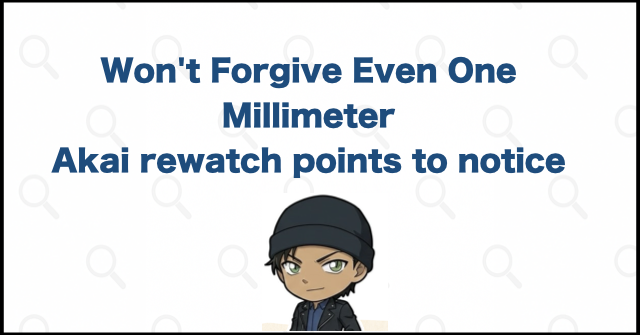
“Won’t Forgive Even One Millimeter (Part 1)” is Episode 727 (Japanese episode 675). “Won’t Forgive Even One Millimeter (Part 2)” is Episode 728 (Japanese episode 676). The manga story is in Volume 76, Files 801-803.
For an Akai-focused rewatch, follow two moments: Sera’s pursuit of the scarred man and Haibara’s movement from Okiya’s words to Moroboshi’s memory.
The Couple’s Case Has Its Own Clues
The phone, the knife, and circumstances that look like self-defense belong to the married couple’s case. They help explain the incident being investigated within these two episodes.
Scarred Akai and the Moroboshi recollection serve a different purpose. They point toward Akai’s fate, Okiya’s identity, and Bourbon’s activity.
Treating every striking moment as a clue to the same crime can make scarred Akai’s role confusing. Once the two layers are kept distinct, the structure comes into focus: the immediate case moves toward a solution while the longer mystery advances quietly around it.
How the Mystery Train and Scarlet Series Change the Earlier Scenes
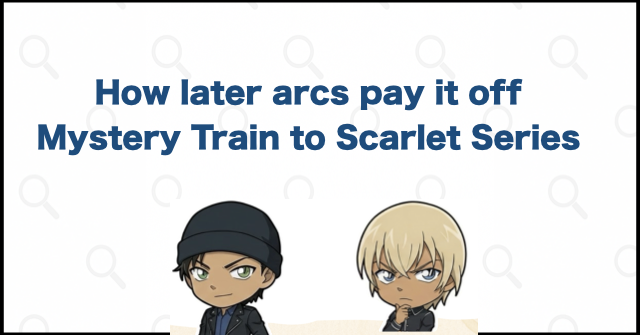
Later developments reveal that Tooru Amuro is Bourbon. With that knowledge, the scarred-Akai activity connects more clearly to his doubts about Akai’s supposed death. The earlier image takes on a different meaning once Amuro is known to have a Black Organization codename.
The Scarlet series later explains the deception surrounding Akai’s apparent death and survival. Raiha Pass, Okiya, and Amuro’s deductions become parts of the same larger explanation.
Haibara’s recollection changes in a similar way. With later context, it reads as a hint toward Okiya’s connection with Akai; it still does not prove Haibara had solved everything in this scene.
This is the satisfying part of revisiting the case. The unease remains understandable, but its source becomes clearer. Sera’s encounter and Haibara’s memory acquire meaning without needing to become complete revelations at the moment they occur.
What to Remember about Akai in This Case
Scarred Akai is not Shuichi Akai himself. His appearance is best read in the context of Bourbon’s investigation into Akai’s fate. Sera’s family connection makes her response significant, though it cannot tell us everything she knows.
Moroboshi is Akai’s undercover name. His memory connects Okiya to Haibara’s past through both words and emotional familiarity. The scene suggests recognition beginning to form, while leaving her certainty unresolved.
The married couple’s case stands on its own, but these two moments give it a lingering chill. A face interrupts Sera’s ordinary day; a phrase draws Haibara back toward her sister. Together, they make a seemingly quiet case an important step in the larger Akai story.



Comments