Full spoilers for Japanese Episodes 1214–1216, including the three deaths, Heiji and Kazuha’s confession, and the Toyama family reveal.
Heiji Hattori finally tells Kazuha Toyama that he loves her, and the two become a couple. The mystery has a more painful answer: Tenma Anzaka murders Ayari Kakiwaki and Nobuya Nagakubo, while Miku Narasawa’s earlier death is an accidental fall during a struggle with Yoka Kuraishi. Anzaka’s attempt to conceal that first death leads to the two killings.
The Crimson Closing Day covers Japanese Episodes 1214–1216 (international Episodes 1274–1276) and adapts manga chapters 1129–1133 in Volume 106. The theatre setting brings together a staged curse, a message hidden in the victims’ poses and a confession that succeeds when Heiji’s careful staging falls apart.
A theatre visit gives Heiji a new plan for his confession
Conan Edogawa, Ran Mouri, Kogoro Mouri, Heiji and Kazuha attend a play at Osaka’s Naniwa Art Theater. The production grew out of the project in Momiji Ooka’s Sweet Trap. Its characters echo people in their own circle, with names such as Daigoro Mouri and Heiichi Hattori; Momiji Ooka and her butler Muga Iori also belong to the circle reflected by the production. The familiar world has become material for a play within the series.
Backstage, actors Osamu Kenzaki and Hyouga Koumoto greet the visitors. Kenzaki is engaged to former Earth Ladies member Yuki Takeno, who proposed to him against the sunset at the Naniwa Harukas observation deck. The story gives Heiji a destination for the confession he has repeatedly struggled to make.
The rest of the company includes Kenzaki’s understudy Toshikata Yoshiura, Koumoto’s understudy Anzaka, Kuraishi, Narasawa, Kakiwaki and Nagakubo. Their production already has an unsettling history. Its original director, Kyousuke Kabumoto, was murdered, and its writer, Reisuke Inaba, was a killer. A replacement writer’s severe fever and the new director’s traffic accident have encouraged talk of a curse.
Kabumoto’s harsh directing earned him a reputation as a demonic puppeteer. When deaths begin to imitate puppets, that reputation gives the scene a ready-made supernatural explanation. The returning actors and troubled production make the curse feel rooted in a history the characters already know.
Three falls create the appearance of one curse
Narasawa is the first to die in a fall. Her body lies in an unnatural, puppetlike position, and a phone seems to fall from above nearby. Its message invokes the demonic puppeteer. The phone’s apparent movement encourages everyone to connect its words directly to the fall, although the body and the phone do not necessarily reach the ground as part of the same event.
Kakiwaki dies next. A scream seems to mark her fall, and another message indicates that two people remain. At a crucial point Anzaka appears to be asleep on a bed in the nap room, and he can be heard answering. Seeing a figure and hearing a voice seems to establish his location, just as the scream seems to establish the time of the death. Both connections will be challenged.
Nagakubo then falls from a balcony while Anzaka is down in the parking lot. This time the questions concern the condition of the railing, what Anzaka is doing from below and who can reach the body afterward. The repeated puppet poses make the deaths look alike, but they conceal different sequences of actions.
The first fall: a photograph limits Anzaka’s responsibility
A photograph of Anzaka with his mother captures Narasawa falling in the background. It rules out Anzaka personally pushing her at that moment. It does not clear him of staging the aftermath or committing the later murders, but it prevents all three falls from being explained in the same way.
After the fall, Anzaka puts the demonic message on Narasawa’s phone and makes the phone appear to drop from above near her body. He takes advantage of the position in which she has landed to begin the puppet motif. The apparent curse is added to a death that has already happened.
Anzaka’s reluctance to reveal the photograph is a particularly telling clue. It could help him, yet he hides it because clearing himself of the first fall would leave the detectives looking for someone else. His attempt to take the blame for everything begins to look less like a confession than an effort to protect Kuraishi.
The second death: the sleeper and the scream are separate deceptions
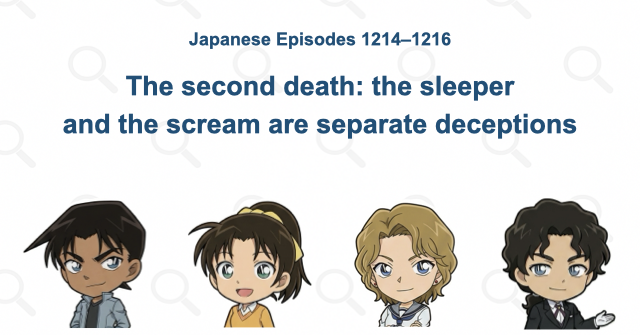
The figure on the bed is a reflected recording. Anzaka uses a tablet showing his sleeping pose and glass from a framed certificate to make the image appear where a resting person should be. He is actually outside the window, answering in his own voice. The witnesses combine a visible image and a live reply into the mistaken impression of one person lying inside the room.
A mole exposes the reflection: it appears on the opposite side from its real position. The glass missing from a certificate frame supplies a corresponding physical clue. Together, the misplaced feature and missing glass turn the supposed sighting of Anzaka into evidence of an arranged image.
The scream performs a different job. Kakiwaki has already been killed when the sound is heard. Anzaka drops a garbage bag containing a recorder that plays her scream from a stage performance. The sound creates an apparent moment of crisis after the actual killing, so the time people hear it cannot simply be treated as her time of death.
The reflected sleeper falsifies Anzaka’s location; the recorded scream falsifies the timing of Kakiwaki’s death. His reply from outside the window is live, even though the sleeping image and scream are recordings. Conan and Heiji break the alibi by separating what the witnesses saw from what they heard.
The third death: being below the balcony is not an alibi
Nagakubo’s fall is caused through a railing that Anzaka has tampered with; the story identifies liquid gallium as the means used to weaken it. Anzaka arranges for Nagakubo to go onto the balcony to smoke, then pretends to call up loudly from the parking lot. Trying to hear him, Nagakubo leans out and puts his weight on the compromised railing.
Anzaka is not quietly saying something that happens to be hard to hear. He is acting as though he is calling out, prompting the reaction the plan requires. Nor does he need to stand beside Nagakubo and push him. His distance from the balcony is compatible with having prepared the danger and induced the victim to lean on it.
Traces on the railing point to that preparation. After the fall, Anzaka also takes advantage of a police officer’s distraction to alter the body’s pose and handle the phone. The puppetlike scene is another arrangement imposed on the aftermath, not proof that Nagakubo fell in that position.
Protecting Kuraishi becomes a motive for two murders
Anzaka and Kuraishi are secretly dating. Eight years earlier, he fought men who were trying to abduct her, and their leader died. A video taken by Yoshiura established that Anzaka had acted in self-defense. That earlier death is separate from the murders he commits during this case.
Narasawa uses the couple’s past and hidden relationship to pressure Kuraishi into leaving Anzaka and giving up her role in the play. Their confrontation turns into a struggle over a phone, during which Narasawa falls. The first death is accidental; the cover-up that follows creates the opportunity for further blackmail.
Anzaka’s initial intervention is a cover-up intended to protect Kuraishi. Kakiwaki and Nagakubo discover suspicious behavior connected with that concealment and blackmail him; he then kills them. The motive is not a plan, formed from the beginning, to murder three people over his own past. It develops from concealing Kuraishi’s involvement into silencing people who can expose it.
Anzaka is also terminally ill with stomach cancer and had intended to leave acting. He plans to take responsibility for the whole sequence and die, believing he can leave Kuraishi free of it. His illness helps explain the final act he has planned, but it does not make the two murders unavoidable or erase his responsibility for them.
At Naniwa Harukas, Conan and Heiji unravel his plan. Kuraishi has already turned herself in, so the future he imagines for her is no longer possible. Inspector Otaki and the other officers stop Anzaka’s attempted jump. Three people die in the case; the intended fourth death is prevented.
Why the intended EVIL message also reads LIVE
The victims’ poses represent E, V and I in semaphore, the system that uses arm or flag positions to form letters. Anzaka intends his own death to supply the final L and complete EVIL. The last letter belongs to his plan, not to a fourth body found at the scene.
The direction matters. Reading from stage left as a performer faces the audience reverses the order used from the other viewpoint: EVIL becomes LIVE. Beneath the apparent demonic message is Anzaka’s wish that Kuraishi live. Theatre terminology makes the message double-sided, just as theatrical techniques make his alibi deceptive.
That wish explains his intended message without excusing his choices. His attempt to protect one person has cost two others their lives. Stopping his final act offers a measure of hope, but Kuraishi’s surrender and the murders mean that the pair cannot simply return to the life they had before.
Heiji’s confession succeeds when the planned scene does not
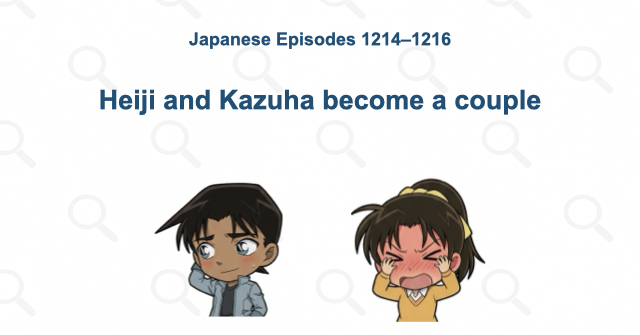
After the case, the sunset reminds Heiji of his original purpose. He calls Kazuha, but Ran answers and tells him Kazuha is downstairs. He assumes he has lost another chance. Disappointed, he lets slip the simple feeling behind all his elaborate arrangements: he only wants to tell Kazuha that he loves her.
The real Kazuha is on the observation deck and hears him. She asks whether he means it, and he confirms that he does. When they return downstairs holding hands, Ran notices. After so many failed opportunities, that simple gesture makes the result wonderfully clear: Heiji and Kazuha are now a couple.
The warmth comes from the difference between the setting he wants and the words that actually reach her. His chosen sunset matters to him, but the relationship moves forward because she hears his unguarded feelings. The wish established before the murders returns at the end, without pretending that the intervening deaths have lost their weight.
Why Kazuha seems to be in two places at once
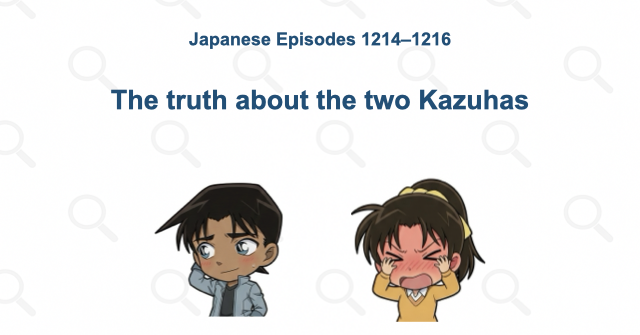
The masked woman beside Ran downstairs is actually Kazuha’s mother, Sakura Toyama. Mother and daughter have made a bet about whether Sakura can fool Ran into mistaking her for Kazuha. The disguise works, explaining why Ran’s answer on the phone makes Heiji think he has missed his chance.
The reveal does not undo the confession: it is Kazuha herself who hears Heiji upstairs. Instead, the mistaken identity gives his failed plan a playful final twist. The story also puts a face and name to Kazuha’s previously mentioned mother and reveals that Sakura formerly served in the Osaka Prefectural Police firearms unit.
Momiji’s tears and the two love stories behind the ending
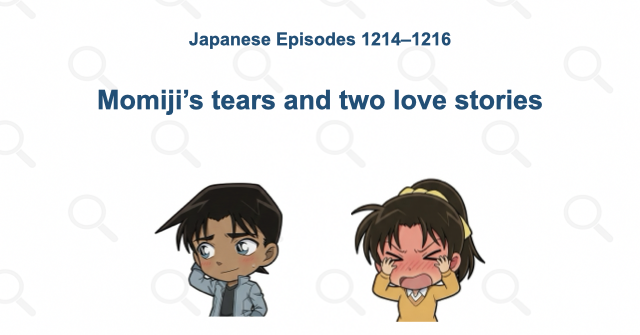
Momiji wins a high-school competitive karuta tournament, yet tears run down her face. The scene suggests that she senses a romantic defeat despite her victory in the tournament. Her tears give the ending a melancholy edge: Heiji and Kazuha’s happiness is also the loss of the future she wanted with him.
Anzaka’s wish that Kuraishi should live makes the EVIL/LIVE message bitterly sad. He wants to protect her, but the murders and cover-up destroy the future he is trying to preserve. Saving his life leaves room for accountability, not a clean escape for either of them.
Heiji’s confession offers a very different release. When he thinks his carefully planned moment has slipped away, his unguarded words reach Kazuha without him realizing she is there. The sunset is beautiful, but their joined hands are the detail that stays with me: after all that waiting, neither of them has to guess anymore.



Comments