Spoiler warning: Heiji’s discovery of Conan’s identity, his romance with Kazuha through File 1159, and separate movie-only stories are discussed below.
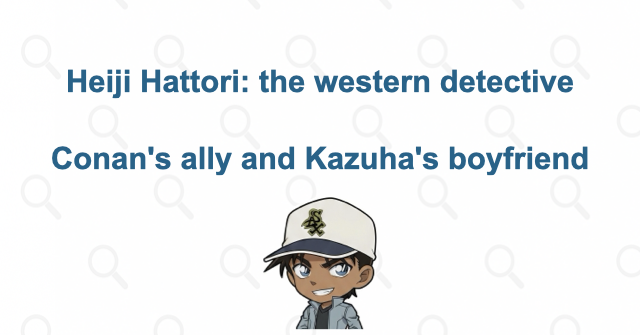
Heiji Hattori is a 17-year-old high-school detective from Osaka who knows that Conan Edogawa is Shinichi Kudo. Introduced as Shinichi’s rival, he becomes a close friend and partner who helps protect that secret. He is also a skilled kendo competitor and, after the Volume 106 confession, Kazuha Toyama’s boyfriend.
His appeal lies in the unevenness of those abilities. He can read a dangerous case quickly, accept a rival’s better deduction, and act decisively for a friend. Faced with admitting that he loves Kazuha, the same confident detective can make everything much harder than it needs to be.
Heiji’s profile: a detective of the west
Age, school, voice, and personality
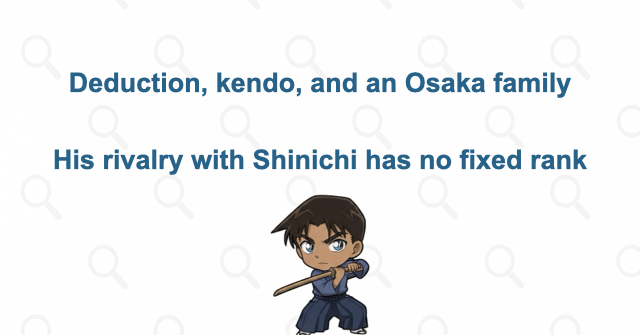
Heiji is a second-year student at Kaiho Academy. He speaks in a Kansai dialect, has dark skin and prominent eyebrows, and is strongly associated with his cap. His Japanese voice actor is Ryo Horikawa; Kumiko Higa voices him as a young child.
He is intensely competitive, especially where Shinichi is concerned. That pride does not prevent him from caring about the truth or the people caught up in a case. Danger to a friend or to Kazuha can bring his feelings to the surface more quickly than an ordinary conversation would.
Shinichi and Heiji are associated with the east and west respectively, but the comparison is not an official ranking of their intelligence. They can approach clues differently and challenge each other’s reasoning. Wanting to beat Shinichi and respecting his ability are compatible parts of Heiji’s character.
Kendo and the turn of his cap
Heiji competes in kendo and can hold his own in dangerous physical encounters. His swordsmanship gives him an avenue of action beyond deduction, with the films exploring it especially vividly.
The cap marked SAX provides a simpler visual sign of his concentration. Often worn backward in his casual moments, it turns forward when he gets serious about reasoning through a case. A small change in the way he wears it can make the scene feel newly focused.
His sporting ability should not be turned into a universal combat ranking. What matters is that he can reason under pressure and act physically when the situation demands it, rather than relying entirely on someone else to carry out the solution.
Heizo and Shizuka Hattori
Heiji’s father, Heizo Hattori, heads the Osaka Prefectural Police and has formidable deductive ability. Father and son can be guarded and tense with one another, but Heiji recognizes his father’s skill.
His mother, Shizuka Hattori, is also skilled at kendo, though her exact dan rank is not established. The movie-only story The Crimson Love Letter additionally presents her as a former karuta Queen. That film-specific achievement should remain distinct from her manga appearances.
It is tempting to see Heiji’s combination of deduction and swordsmanship as an echo of his parents’ different strengths. That is an affectionate reading of the family, not a claim that one skill belongs exclusively to one parent or that ability can be assigned a simple hereditary explanation.
His first case begins with a mistake
The diplomat case introduces a challenger
Heiji’s debut is in Volume 10, adapted as Episodes 49-50 (Japanese episodes 48-49), Diplomat Murder Case (Part 1) and Diplomat Murder Case (Part 2).
He comes to the Mouri Detective Agency hoping to compete with Shinichi. Instead, he finds Conan suffering from a cold. He gives Conan baijiu, and Conan subsequently undergoes a temporary return to Shinichi’s body.
A murder at a diplomat’s home gives Heiji the contest he wanted. He pursues a solution with confidence, but his conclusion contains a crucial flaw and identifies the wrong culprit. Shinichi exposes the error and reaches the truth.
The energetic arrival and the sudden gravity of the murder make a strong introduction. Heiji is capable enough to challenge Shinichi, yet the story does not protect him from being wrong. That leaves room for a more interesting relationship than two flawless geniuses trading victories.
Accepting defeat changes the rivalry
Heiji is frustrated, but accepts that Shinichi’s reasoning is better in that case. Shinichi’s point is that deduction is not fundamentally a contest with winners and losers: the purpose is to reach the truth.
That idea challenges Heiji’s initial goal of proving himself superior. He does not stop being competitive, but the opponent he wants to beat becomes someone whose approach deserves respect.
The attractive quality is not simply that Heiji learns a lesson. It is that he has enough strength to admit the mistake. His debut uses defeat as the beginning of growth, making his later reliability feel earned.
How Heiji learns that Conan is Shinichi
The Holmes tour: listening to the supposedly sleeping deduction
Heiji discovers Conan’s identity in Volumes 12-13, adapted as Episodes 59-60 (Japanese episodes 57-58), Holmes Freak Murder Case (Part 1) and Holmes Freak Murder Case (Part 2).
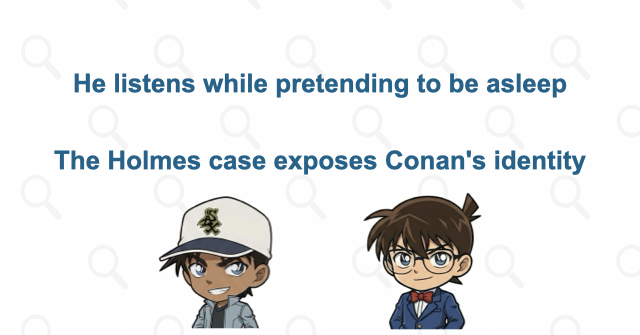
During the Holmes tour, Conan’s deductions and behavior make Heiji suspicious. When Conan believes Heiji is asleep and uses his voice to present the solution, Heiji pretends to remain unconscious and listens. The performance lets him connect the apparently ordinary child to the high-school detective he has met.
Heiji reaches the answer himself; he is not simply told the secret by another character. The detective who was trying to expose the mystery then changes roles and helps protect it.
There is tension in Conan being found out, but the scene also creates reassurance. Heiji’s knowledge becomes a source of help rather than a new enemy’s weapon. A dangerous discovery produces a stronger partnership.
What that knowledge allows him to do
Heiji can assist when Shinichi has only a limited time in his original body, or when Conan needs someone who understands why his identity must stay hidden. He occasionally slips and calls him Kudo, but in serious situations he takes the secret seriously.
The school-trip storyline is one example of his help. Its anime adaptation runs through Episodes 982-985 (Japanese episodes 927-928), The Scarlet School Trip (Bright Red Arc) (1 Hour Special) and The Scarlet School Trip (Red Love Arc) (1 Hour Special).
Being able to share the circumstances does not remove the danger surrounding Conan. It does mean Conan has a peer who can act on more than the incomplete explanation available to most people around him.
The Black Organization: an ally with limited information
Heiji knows that a dangerous organization is involved in Shinichi’s shrinking, but that does not establish knowledge of its complete structure or every secret. He helps deceive Vermouth by disguising himself as Shinichi during Episodes 371-375 (Japanese episode 345), Head-to-Head Match with the Black Organization: A Dual Mystery on a Full Moon Night (2.5 Hour Special).
That assignment is a concrete expression of trust. Heiji takes on a dangerous role precisely because he understands the identity that needs protecting. It is more than friendly concern offered at a distance.
A separate movie-only example comes in The Raven Chaser. Heiji calls Conan and invites him to visit a good okonomiyaki restaurant, insisting that he is expecting him. The invitation may be read as a way of asking his friend to return safely without saying the fear directly.
That reading gives the casual words their weight. Heiji turns worry into a promise of another meeting, which is very much in keeping with a friendship often expressed through teasing rather than an open speech about affection.
Rivalry, friendship, and a detective’s responsibility
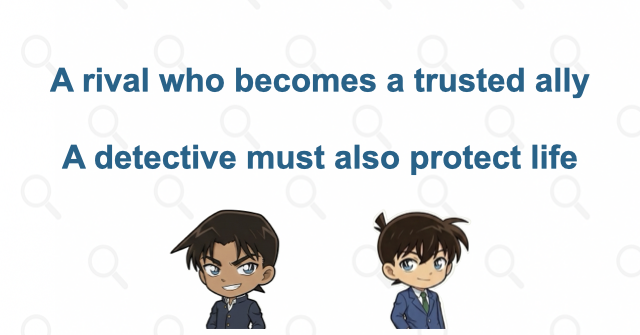
Heiji and Shinichi can compete during an investigation and immediately help each other when the stakes change. Their closeness is presented here as friendship, respect, and trust around a dangerous secret; it is not evidence that their rivalry is a confirmed romance.
A second important principle concerns the person exposed as the culprit. Conan argues that solving a case is not enough if the detective then lets the cornered culprit die by suicide. In his view, revealing the truth carries a responsibility toward the lives left in the room.
That belief adds a difficult obligation to the satisfaction of a correct deduction. Heiji’s development involves learning to look beyond identifying the offender and toward the consequences of the confrontation.
The two detectives remain fun to watch because this seriousness coexists with competition. Heiji respects Shinichi enough to want to beat him, and knows enough of his circumstances to want to protect him. Neither feeling cancels the other.
Heiji and Kazuha: from childhood friends to a couple
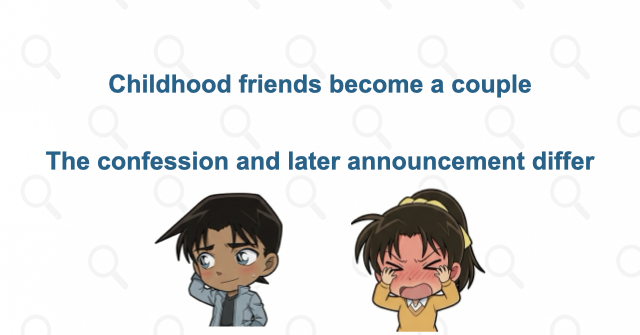
Close enough to misunderstand his own feelings
Heiji and Kazuha have known each other since childhood, with their families connected through the Osaka police. Kazuha’s affection is visible early. Heiji becomes jealous of other men and reacts fiercely when she is endangered, yet takes longer to express what she means to him.
After learning about Shinichi’s London confession to Ran, Heiji increasingly wants a setting and a performance that will compare favorably. What should be a conversation with Kazuha becomes entangled with his competitive instincts.
That is the enjoyable contradiction: he can sort through the conditions of a case at speed, yet keeps adding conditions to his own confession. He wants the moment to be special, and repeatedly makes it harder to reach.
File 1133: sincerity outlasts the plan
In Volume 106, Heiji hopes to confess against the sunset from Naniwa Harukas. A case derails the schedule. Believing he has failed again, he lets out the plain admission that all he wants is to tell Kazuha he loves her.
She hears him. File 1133, The Dark Red Closing Night, lets the feeling finally reach her without the grand performance he had planned. The sequence is moving because it uses his familiar awkwardness rather than temporarily giving him someone else’s elegance.
The event establishes their mutual feelings, but it should not be embellished with a precise agreed calendar date for beginning to date or a kiss that is not shown. Their subsequent announcement to friends in File 1159 provides further confirmation that they are a couple.
Files 1157-1159 explain the apparent distance
The Tokyo planetarium storyline initially makes the pair look unusually distant after Naniwa Harukas. File 1159 explains that they are deliberately keeping apart to preserve the surprise of announcing their relationship. Their friends already know, so the elaborate concealment has missed its audience.
That explanation does not mean they have become effortlessly smooth lovers. It means the specific distance in this case is not proof of a quarrel or merely an unexplained inability to act like a couple. They are trying, together, to manage what others know.
The Volume 106 story is adapted in Japanese episodes 1214-1216, following the theater investigation and Heiji’s attempt to confess at Naniwa Harukas through the finale. The later planetarium announcement belongs to Files 1157-1159, a separate manga case.
Other relationships reveal his limits as well as his strengths
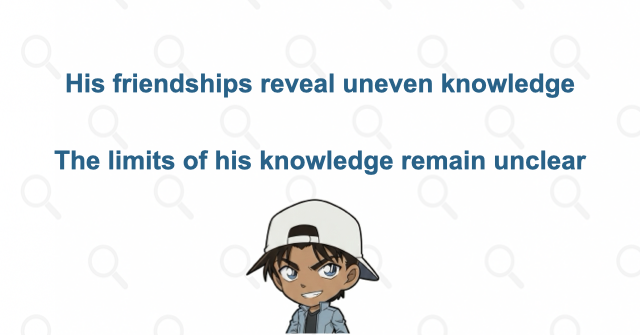
Ai Haibara: cooperation is not complete knowledge
Heiji and Ai Haibara cooperate through Conan, and she can tease him about Kazuha. That familiar interaction does not establish that he knows every part of Haibara’s history.
It remains unconfirmed here whether he knows that she is Shiho Miyano, that the Organization called her Sherry, and that APTX 4869 caused her shrinking. He may have heard some explanation from Conan, but being fellow allies is not proof that all those distinct secrets have been shared.
Kaito Kid: a disguise Heiji takes personally
In Volume 96, Kaito Kid disguises himself as Kazuha, and Heiji nearly kisses him without recognizing the substitution. It is an attempted kiss with a disguised thief, not a completed kiss between Heiji and Kazuha.
The anime version is Episodes 1040-1041 (Japanese episodes 983-984), Kid vs. Komei: The Targeted Lips (Part 1) and Kid vs. Komei: The Targeted Lips (Part 2). Heiji’s anger mixes the humiliation of being fooled with how important Kazuha is to him.
That personal edge returns in the movie-only story The Million-dollar Pentagram, where his clashes with Kid also give his swordsmanship a major role. The detective-thief rivalry carries an additional emotional history.
Momiji Ooka and Muga Iori
Momiji Ooka calls Heiji her future husband, but she is not his formally acknowledged fiancee. The movie-only story The Crimson Love Letter explains her supposed childhood promise as a misunderstanding, rather than an actual marriage agreement.
Her attachment remains real to her, and her butler Muga Iori supports her. Even so, his interference cannot explain every failed confession. Cases, unfortunate timing, and Heiji’s own insistence on a perfect setting all contribute.
The distinction keeps responsibility in proportion. Momiji and Iori can complicate the romance without becoming an explanation that excuses every way Heiji complicates it himself.
Soshi Okita and Inspector Goro Otaki
Soshi Okita is a serious kendo rival. Their contests can be disrupted by cases or other circumstances, and the relationship does not establish an unchanging ranking with Okita always above Heiji. The unresolved competition supplies a sporting counterpart to his rivalry with Shinichi.
Inspector Goro Otaki works in the Osaka Prefectural Police under Ginshiro Toyama. Heiji turns to him for information and investigative help, sometimes with requests that push the limits of an ordinary favor.
Otaki recognizes Heiji’s deductive ability. It is not established that he helps only because Heiji is the police chief’s son. Reading their cooperation as trust built across cases is more faithful to the relationship than reducing every favor to the family hierarchy.
Harsh words that reveal a determination to protect Kazuha
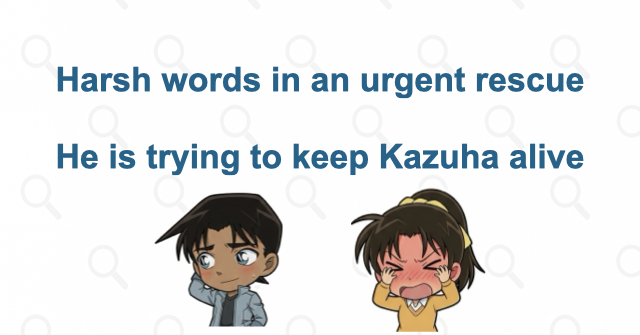
The cliff in the mermaid case
In the Volume 28 mermaid case, Heiji clings to a branch with one hand while holding Kazuha with the other. Fearing that he will fall too, she tries to make him release her. He orders her not to move in language that sounds threatening when removed from the scene.
Within the scene, the direction of his action is unmistakable: he is trying to keep her alive. He refuses to let go even when she is prepared to sacrifice herself for him. The rough wording carries panic and determination, not a wish for the outcome it literally threatens.
The case is adapted as Episodes 241-243 (Japanese episodes 222-224), from And Then There Were No Mermaids (The Case) to And Then There Were No Mermaids (The Resolution). They are not dating at this point. The rescue shows the depth of the bond before either can reliably articulate it.
A movie echo, and the outburst at Ebisubashi
The movie-only story The Crimson Love Letter echoes that rough insistence during a motorcycle escape with Kazuha. He demands that she hold on. The parallel is an emotional echo across stories, not evidence that the film is resolving a hidden clue planted by the earlier case.
Another revealing moment comes in Episodes 816-817 (Japanese episodes 763-764), Conan and Heiji, Code of Love (Part 1) and Conan and Heiji, Code of Love (Part 2). Heiji thinks Kazuha has been taken into danger and blurts out a possessive reference to her.
That outburst shows affection breaking through his usual defenses, but does not count as a formal confession or prove complete romantic self-awareness at that instant. Knowing the Volume 106 resolution makes the earlier slip more poignant without turning it into a different event.
Three films with Heiji in a leading role
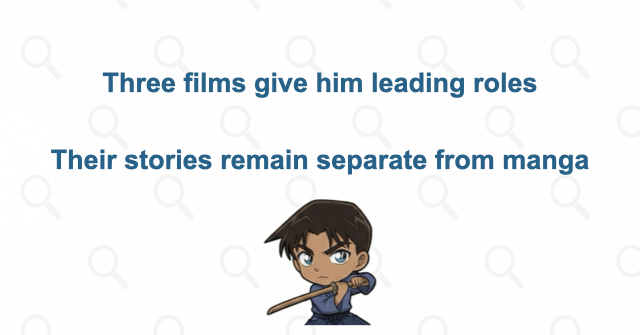
These are separate movie-only stories, each emphasizing a different combination of his investigation, swordsmanship, and feelings for Kazuha.
Crossroad in the Ancient Capital
The seventh film, Crossroad in the Ancient Capital, places Heiji in a Kyoto mystery connected with Yoshitsune. Its movie-only story combines sword action with a memory of his childhood first love.
The distant girl he remembers turns out to be Kazuha, who has stayed close to him all along. The reveal makes the past and present fit together, while his attempt to protect her in the case gives the bond immediate stakes. It is not their manga dating debut.
The Crimson Love Letter
The movie-only twenty-first film, The Crimson Love Letter, brings Momiji’s claim on Heiji into conflict with Kazuha’s feelings. Competitive karuta gives that rivalry a practical form, and Shizuka trains Kazuha for the challenge.
Heiji stands at the center of a romantic contest whose intensity he does not always seem to grasp, while the case demands deduction and motorcycle action. Momiji’s claim remains her belief, not a confirmed engagement.
The Million-dollar Pentagram
The movie-only twenty-seventh film, The Million-dollar Pentagram, takes Heiji to Hakodate, where his history with Kaito Kid feeds their conflict and sword action. He also plans to confess to Kazuha against the view from Mount Hakodate.
His declaration does not successfully reach her, so that movie scene does not establish dating. The manga’s Volume 106 confession is the separate event where the feeling finally reaches Kazuha. Distinguishing them preserves the emotional difference between saying something and having it heard.
Heiji’s best scenes let confidence and vulnerability coexist. His first wrong deduction, his decision to protect Conan’s identity, and his long struggle to reach Kazuha all give him room to change. He remains competitive and imperfect, which is exactly why the moments when he gets something right carry weight.

Comments