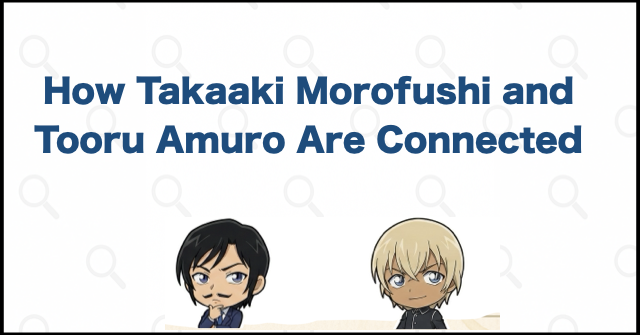
The person who most strongly connects them is Hiromitsu Morofushi. This article explains that connection, including the roles of Hyoue Kuroda and the events of The 36-Cell Perfect Game. Major spoilers follow.
Takaaki Morofushi is Hiromitsu’s older brother; Tooru Amuro, whose real name is Rei Furuya, was Hiromitsu’s childhood friend and police academy classmate. They are connected through the same person, but they knew different parts of his life.
They had also met before Rei began appearing as Amuro. In The 36-Cell Perfect Game, Takaaki’s memories and the clue attached to Hiromitsu’s phone strongly suggest that he recognizes him. What Takaaki learns beyond that recognition—and what Kuroda tells him—remains less certain.
The brother and the friend Hiromitsu left behind
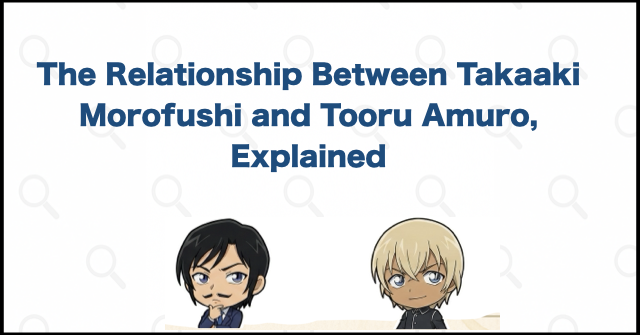
Takaaki works for the Nagano Prefectural Police. Amuro publicly works at Café Poirot and as a private detective, while Rei Furuya serves in Public Security and infiltrates the Black Organization as Bourbon. They are neither brothers nor direct colleagues.
Hiromitsu is the personal link. He was separated from Takaaki from an early age, while his friendship with Rei began in childhood. The familiar names “Hiro” and “Zero” belong to that friendship long before the two men took undercover assignments.
The police academy story places Rei and Hiromitsu alongside Jinpei Matsuda, Kenji Hagiwara, and Wataru Date. Rei and Hiromitsu later enter the Black Organization under different codenames: Bourbon and Scotch. Hiromitsu dies during that mission.
For Takaaki, that loss is the death of a younger brother. For Rei, it is the death of the friend who shared both his childhood and the dangers of undercover work. Neither perspective replaces the other. Being Hiromitsu’s brother does not automatically give Takaaki access to operational secrets, just as sharing a mission does not give Rei the same family memories.
That difference gives their meeting its weight. They have a deeply personal reason to speak, but recognizing the connection does not make an open conversation possible.
How Takaaki connects Amuro with the name Zero
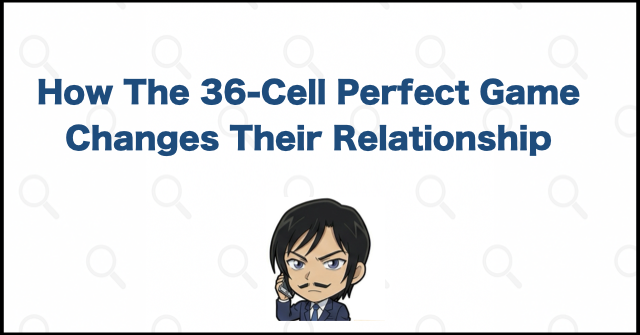
The 36-Cell Perfect Game appears in Volume 97 and international episodes 1060–1062, corresponding to Japanese episodes 1003–1005. Conan, Kogoro, Amuro, and Kanenori Wakita travel to Nagano, where the local detectives become involved in the case.
Alongside the mountain-lodge mystery, Takaaki follows a much more personal chain of clues.
| Clue | What it contributes |
|---|---|
| Amuro’s face in a video | Prompts a feeling that Takaaki has seen him before. |
| A memory from Takaaki’s university days | Hiromitsu once brought Rei to meet him. |
| The “0” connected with the sender of Hiromitsu’s phone | Matches the name “Zero” that Hiromitsu used for his friend. |
Together, these clues support the reading that Takaaki identifies Amuro as Rei Furuya. The force of the deduction comes from their convergence: a familiar face, a remembered friend, and a small sign accompanying a dead brother’s possession.
Recognizing Rei is not the same as knowing the full Bourbon operation. The scene does not establish how much Takaaki understands about Rei’s duties, the circumstances of Hiromitsu’s death, or the secrets still surrounding Public Security.
Why does he then act as though they are strangers?
When they meet face to face, Takaaki behaves as if he does not know Amuro. The preceding clues make that apparent formality conspicuous.
The strongest reading is that he is avoiding disclosure of Rei’s identity or police connection. Wakita is present, and later revelations about Rum make the danger of speaking carelessly particularly clear to the audience.
That does not prove Takaaki knows Wakita is Rum. Nor does the manga give us a complete statement of Takaaki’s motive. His behavior fits an effort to protect Amuro’s cover, but the exact warning he has received and the full extent of his knowledge remain open.
The restraint is what makes the encounter painful. Takaaki may have questions for his brother’s friend, yet the setting gives him a reason to leave them unasked. The scene lets recognition show through an exchange that outwardly denies it.
What Kuroda’s phone call adds—and leaves unanswered
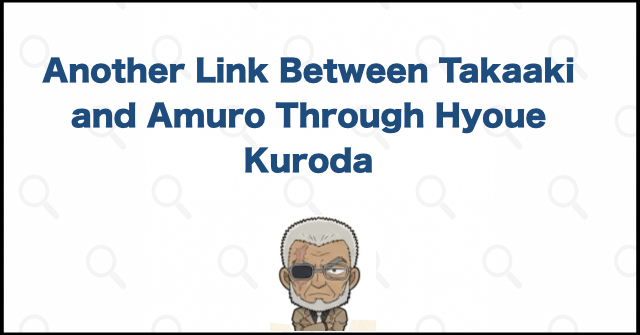
Hyoue Kuroda provides a second connection between the men. He formerly served as Takaaki’s superior in Nagano and also has contact with Rei on the Public Security side.
Kuroda calls Takaaki during The 36-Cell Perfect Game. Because the call precedes Takaaki’s formal encounter with Amuro, a warning or instruction concerning Amuro is a plausible explanation for its place in the story.
The contents of the call are not fully revealed. It cannot be used as proof that Kuroda explains every part of Rei’s mission, identifies Rum to Takaaki, or supplies the entire answer to Hiromitsu’s death.
Takaaki’s own memory and deductions may account for his recognition of Rei; Kuroda’s call may account for caution about how to act. Those possibilities work together without requiring an unseen, comprehensive briefing.
This is the difference between the two links: Hiromitsu connects Takaaki and Rei personally, while Kuroda connects their professional worlds. Their overlap brings the larger Organization story into an apparently self-contained Nagano case.
Which stories best explain this relationship?
For their encounter itself, start with The 36-Cell Perfect Game. The face, the memory, the phone, Kuroda’s call, and the decision to act like strangers all come together there.
Kid’s encounter with Takaaki develops the connection between Takaaki and Hiromitsu. The police academy story supplies Rei and Hiromitsu’s shared history. Those stories help explain why identifying “Zero” means more to Takaaki than solving an ordinary puzzle.
The movie One-eyed Flashback adds a separate layer to Takaaki’s grief as Hiromitsu’s brother. Its emotional context should be distinguished from what the manga establishes about Takaaki and Amuro’s direct relationship; it is not evidence that the two have now openly exchanged all their secrets.
What remains with me in the Nagano encounter is the gap between recognition and conversation. One man remembers a younger brother, the other a childhood friend. They share that loss, but for the moment the safest way to acknowledge the connection is to leave it largely unspoken.

Comments