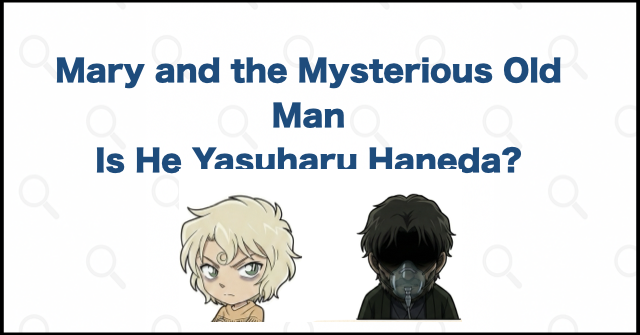
Manga spoilers through Volume 108, File 1153: Mary’s de-aging, the hotel bombing case, Rum, and the later photographs.
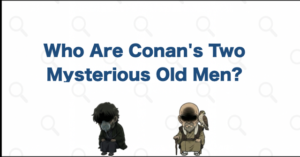
The elderly man with the breathing apparatus has not been identified in the events covered here. Yasuharu Haneda is a plausible theory, and his reaction suggests he may know Mary from her adult life. Neither point confirms his name, allegiance, or knowledge of APTX 4869.
What makes the encounter unnerving is its restraint. He sees Mary and reacts, but does not explain himself. Mary does not need to be attacked for the scene to become dangerous: being recognized in a child’s body could be enough to threaten the life she and Masumi have been hiding.
What does his reaction actually tell us?
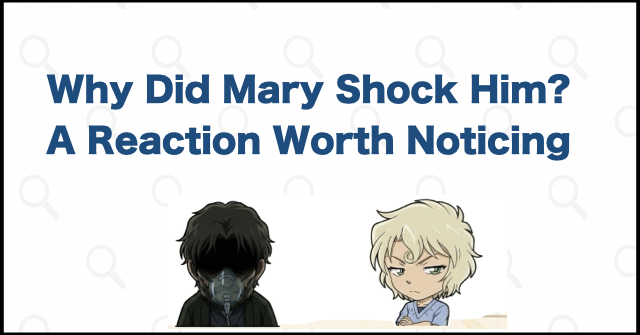
The clearest evidence is the old man’s response in the Volume 103 hotel case:
“It is almost as if I am dreaming…” (unofficial translation)
Mysterious Old Man
Mary is Masumi Sera’s mother, reduced to a child’s body by APTX 4869. If the observer remembers adult Mary, seeing the girl could explain that sense of unreality. It is a strong reading of the moment, but the scene does not tell us exactly what he recognizes.
He might be startled by her appearance, by the possibility that she is alive, or by something he had come to confirm. Recognition, prior knowledge of de-aging, and identification of the drug are three different claims. His reaction cannot establish all three at once.
Yasuharu Haneda becomes interesting because of his family’s connections to the Akai family. The appeal of that theory comes from how those connections fit the scene, not from an identity reveal hidden in the quoted line.
Where the old man’s appearances fit
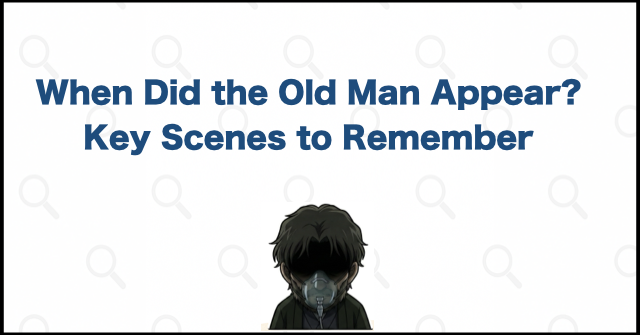
The man first appears in Volume 102, File 1090. The hotel case follows in Volume 103, Files 1094-1096, with his observation of Mary in File 1096. That order matters: the figure is introduced before the scene that makes his possible familiarity with Mary so important.
- Momiji Ooka’s Sweet Trap (Part 1) and Momiji Ooka’s Sweet Trap (Part 2): Episodes 1193-1194 (Japanese episodes 1135-1136), adapting the introductory storyline.
- The Hotel Serial Bombing Case (Part 1) and The Hotel Serial Bombing Case (Part 2): Episodes 1202-1203 (Japanese episodes 1144-1145), adapting the Mary encounter.
- Volume 108, Files 1151-1153: the later photograph storyline considered below. These are manga File numbers, not anime episode numbers.
The bombing is the immediate crisis, but the observer changes what survives the solution. The danger is no longer confined to a culprit and a device in the hotel. Someone outside Mary’s trusted circle has seen her, and the story leaves his interpretation unresolved.
Why knowing adult Mary is a persuasive theory
An ordinary unfamiliar girl would not obviously explain the old man’s dreamlike response. A familiar adult unexpectedly appearing as a child would. That is the strongest reason to consider a personal connection to Mary’s past.
Yet surprise does not prove that he understood the transformation before arriving. The opposite reading is possible: he may have encountered something he could not reconcile with what he remembered. Knowing a face and knowing what APTX 4869 can do are different kinds of knowledge.
There are other readings too. He could be reacting to Mary’s survival, observing her on behalf of someone else, or confirming a suspicion. His failure to attack does not establish friendship; his failure to introduce himself does not establish hostility.
That ambiguity gives the encounter its chill. A supporter could be a lifeline, a watcher could be a threat, and the same quiet act of looking is compatible with both. Mary cannot rely on the distinction merely because no violence follows.
Mary’s unnamed supporter and the Haneda connection
Mary’s concern for an unnamed person who could be harmed by their situation suggests outside support. Her hotel life with Masumi also raises a practical question about resources. The latter is an inference from their circumstances, not independent proof of who pays for anything.
Yasuharu is Koji Haneda’s father. Shukichi, born into the Akai family, was adopted by the Haneda family. Tsutomu Akai’s investigation of Koji’s death and subsequent disappearance connect the families through another loss.
Those ties give Yasuharu a plausible reason to help Mary. His son’s unresolved death could also make distrust of the police understandable if he were the old man. Both steps remain conditional: a motive that would fit is not evidence that he performed the action.
The theory has emotional force because it connects people living with the aftermath of the same case. A bereaved father helping the family of the man who investigated his son’s death would make sense. But Mary’s supporter being Yasuharu, and Yasuharu being the man with the apparatus, are still two unconfirmed identifications.
Comparing the identity theories
The clues extend beyond his reaction to Mary. He appears as an elderly man using breathing equipment, acts through a man in sunglasses, and seems distrustful of the police. These observations give the theories something to explain. They do not reveal whether that apparent distrust comes from a personal loss, an older case, or an organizational allegiance.
Yasuharu Haneda
This is a persuasive candidate because the family connections supply a reason to know Mary, a possible motive to support her, and a possible source of bitterness toward the police. It unites several clues without requiring them to be unrelated coincidences.
Its weakness is the missing identification. None of those connections places Yasuharu’s name on the elderly observer. The theory would become circular if we first assumed he supports Mary, then used that assumption to identify him, then treated the supposed identification as proof of the support.
Renya Karasuma
The Karasuma theory approaches the scene through the drug and the Black Organization. If a central organization figure were interested in Mary’s altered body, observation might be a way to investigate the effect.
That is a possible explanation, not evidence that Karasuma is present. The man’s relatively visible movements also feel difficult to reconcile with the remote image of the boss, although that impression alone cannot rule the theory out. A connection to APTX 4869 does not uniquely identify its observer.
Tsutomu Akai
Mary’s husband would have a powerful reason to react to her altered appearance. That makes the Tsutomu theory emotionally compelling, especially given his disappearance while investigating the Koji case.
But it requires several unanswered steps: his survival, his present appearance, and a reason to watch his wife without revealing himself. The distance is poignant to imagine, yet the poignancy cannot supply those missing facts. None of the three candidates is confirmed by the material discussed here.
What the Volume 108 photographs change
Files 1151-1153 revisit photographs connected to the hotel incident and bring the danger closer to Rum’s side. The earlier moment of observation can now be considered alongside something more portable: an image that may reveal Mary and Masumi beyond the people who were originally present.
That is the frightening shift. An observer must remember what he saw; a photograph can outlast the encounter and acquire new viewers. Resolving the bombing cannot make the visual record disappear.
The story also draws attention to Mary’s coughing. It adds unease around her altered condition, but it does not establish a complete explanation of the symptom or a specific prognosis.
The old man’s observation and the photograph’s later significance should not be collapsed into one proven scheme. The material connects both to Mary’s exposure; it does not establish that the man took, controlled, or delivered every relevant image to Rum.
Keep the man with the cane separate for now
The elderly man with the breathing apparatus is associated with Mary, Masumi, and the hotel storyline. The man with the cane appears in a different cluster of scenes involving Conan, Tooru Amuro, and Public Security Bureau connections.
Tracking them separately keeps a clue attached to the person who actually appears with it. It prevents a reaction to Mary from becoming evidence about another man’s instructions to Amuro, or vice versa.
This is not a definitive ruling on every possible disguise or connection. It is a way to preserve the uncertainty the story still leaves. The man who observed Mary could be linked to her past; the material has not yet told us how.
The Yasuharu theory remains appealing because it offers a human reason behind an ominous image. The photograph storyline keeps the stakes larger than the identity question, though. Whoever the old man is, Mary’s secret has become something other people can see, remember, and potentially pass on.



Comments