
Spoilers follow for the flower-bed incident and the continuing Wakasa, Rum and APTX 4869 storylines.
The Mystery of the Man-Eating Classroom, international episodes 1227–1228 (Japanese episodes 1169–1170), adapts Volume 104, Files 1110–1112. Haibara starts the flower-bed fire at Maria’s request, hoping to prevent Maria’s injured mother from attending parents’ day. Conan exposes the concealed device and its wet traces, while a separate threat continues around teacher Rumi Wakasa.
The rumor offers an explanation before anything happens
On the morning of parents’ day, the Detective Boys meet classmates Maria and Takuma and transfer student Kaisuke Danno while stopping at a convenience store. At Teitan Elementary School, Danno spreads a story about a classroom spirit that demands sweets and causes disturbances if it is not appeased.
His list includes broken vases, a cleaning cupboard opening and a burning flower bed. When Mitsuhiko later sees flames outside the classroom after lunch, the rumor seems to have predicted a real event. Haibara quickly puts the fire out with water from a vase.
Kobayashi and Wakasa consider canceling the visit. Conan promises to solve the incident within the ten-minute break. The immediate suspects are Danno, who spread the rumor; Takuma, who watched the flower bed during lunch service; and Maria, whose hospitalized mother might otherwise insist on attending despite back trouble.
The flower bed points to a device that has disappeared
A clematis pot knocked over during Haibara’s firefighting reveals potato chips beneath it. Its support is not scorched where the climbing plant would have surrounded it. Conan considers whether the support was holding something other than the plant, allowing the fire to begin without someone visibly lighting it at that moment.
The explanation is an ice lens positioned above the chips, with black paper also part of the arrangement. In the episode’s reconstruction, the lens concentrates sunlight and starts the small fire. Because the central object is ice, its disappearance can hide how the incident began.
Haibara recovers that ice after using the vase water to extinguish the flames. Coins warmed in her pocket help melt it. Her apparent role as the person who saves the flower bed has also allowed her to remove the object that would explain the fire.
Change, pencil lead and a wet pocket expose Haibara
Conan remembers that Haibara and Maria received ten-yen coins as change during the morning shopping trip. Their immediate denial that they have any of those coins does not fit that observation. The missing change matters because it has been put to a different use.
He also notices a mismatch in Haibara’s mechanical-pencil lead: she lends HB lead even though she bought B lead that morning. The lead and its storage materials are damp. That moisture suggests contact with the container used to carry the ice, linking an ordinary school supply to the vanished device.
Haibara’s left pocket is unusually wet, and numerous wet ten-yen coins are revealed when Conan takes her hand. The coins that she claimed not to have now connect the shopping trip, the melted ice and the concealment of the lens.
These clues turn the inquiry away from the three children who initially seemed suspicious. Danno’s rumor and Takuma’s attention are conspicuous, but the damp objects and false answer about the change connect Haibara to what happened at the flower bed.
Maria’s concern explains the plan without excusing it
Maria wanted parents’ day canceled so that her mother would not strain herself to attend. She could not arrange the trick alone, so Haibara helped. The motive is care for someone ill, but the method involves creating a fire at school.
Both girls apologize. The principal requires them to replace the burned flowers and water the bed for a month, making clear that a reason for their actions does not remove the consequences. Parents’ day goes ahead, with Maria’s mother and Professor Agasa taking part by tablet.
The remote visit supplies the practical answer that the attempted cancellation missed. Maria can include her mother without forcing her to come physically, while Haibara’s quick thinking is shown as something that needs judgment as well as technical skill. Her compassion and her risky method remain visible together.
A familiar disguise and a question about Conan’s growth
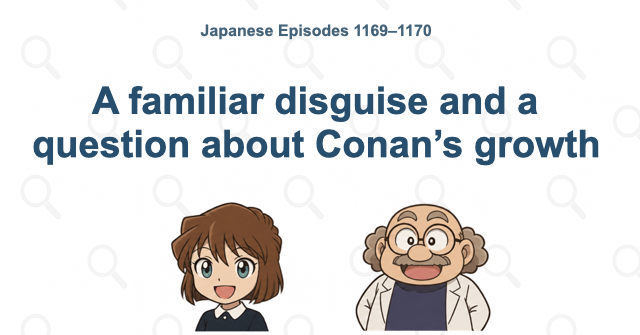
Yukiko Kudo attends as Fumiyo Edogawa, the identity she uses when posing as Conan’s mother. The disguise brings his family into the ordinary school event while preserving the cover story surrounding him. Yusaku warns Yukiko to be careful of Wakasa, adding unease to the visit.
A conversation about height measurements reveals that Conan has recorded no increase while the other children are growing. This raises the possibility that the drug has affected continued growth as well as reducing his size. It does not establish a universal rule that everyone exposed to APTX 4869 stops aging.
Vermouth’s unchanged appearance invites comparison with that question, including the earlier attention to her age. But whether she took APTX 4869, and whether the same mechanism explains her appearance, remain unconfirmed here. The height discussion is a clue to consider, not a completed explanation of her history.
Wakasa’s reason for approaching Conan comes into view
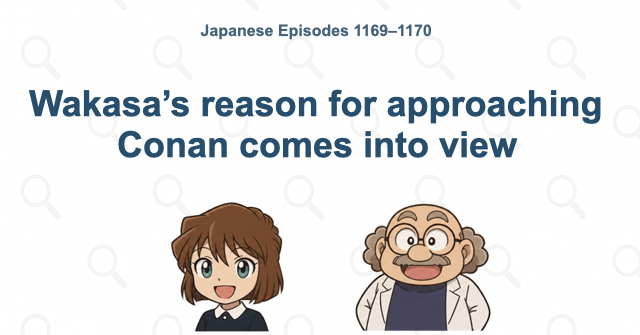
The opening news report at Agasa’s home concerns the gun-shop break-in in Toriya, whose perpetrator has not been caught. Wakasa’s involvement belongs to the surrounding storyline, giving the school setting a connection to danger outside the children’s immediate case.
Yusaku and Shuichi Akai identify Wakasa, the former Asaka, as the person putting information about the Haneda case online. She has been trying to draw out people connected to the Black Organization by looking for those repeatedly accessing that material.
Frequent access from Agasa’s computer draws her attention to Conan. Her arrival as a teacher at his school follows that interest, making the position part of an effort to get close to him rather than an unrelated change of profession.
At the end, Wakasa sees a black car outside the school gate. Rum, operating as Kanenori Wakita, is still pursuing her and treating her as Asaka. His conversation concerns finding an opportunity to shoot her, while her use of several homes and ability to lose surveillance make that difficult.
Wakasa’s final attention to Haibara raises another possibility: her reason for remaining at the school may now extend beyond Conan. That look does not establish exactly what she knows about Haibara or prove that Haibara alone is the reason she stays.
The contrast gives the two-part story its distinctive ending. The flower-bed case has consequences and a workable family solution, but the adults’ concealed identities and surveillance continue around it. Haibara’s school life can feel warm and ordinary while the danger from the larger story remains close.







Comments