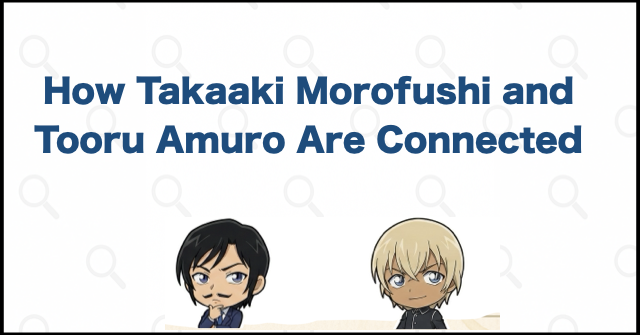
What is the relationship between Takaaki Morofushi and Tooru Amuro?
Have Takaaki and Rei Furuya ever met?
At first glance, Takaaki Morofushi and Tooru Amuro do not seem especially close. Takaaki is an inspector with the Nagano Prefectural Police, while Amuro presents himself as a private detective who works at Café Poirot. Amuro’s true identity, however, is Rei Furuya of the Public Security Bureau.
The person who most strongly connects them is Hiromitsu Morofushi. This article explains that connection, including the roles of Hyoue Kuroda and the events of The 36-Cell Perfect Game. Major spoilers follow.
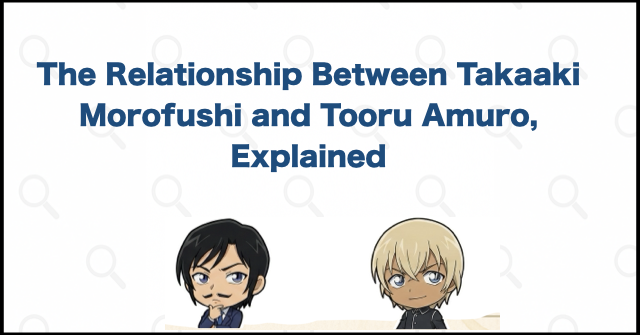
The Relationship Between Takaaki Morofushi and Tooru Amuro, Explained

In short, Takaaki Morofushi and Tooru Amuro are connected through Hiromitsu Morofushi.
Takaaki is Hiromitsu’s older brother. Rei Furuya, the man using the name Tooru Amuro, was Hiromitsu’s childhood friend and classmate at the police academy. From Takaaki’s perspective, Rei is his younger brother’s closest friend; from Rei’s perspective, Takaaki is Hiro’s older brother.
They are not coworkers in the same organization, and they are not relatives. Yet Hiromitsu makes their emotional distance far smaller than their official positions suggest. Both men carry a different part of the same loss: one lost a brother, while the other lost a lifelong friend.
Takaaki and Rei had also met in the past. During The 36-Cell Perfect Game, the story strongly indicates that Takaaki connects Amuro with the young man Hiromitsu once called Zero. The scene is restrained, but that restraint gives it weight. Neither man openly discusses Hiromitsu, and both continue to behave calmly despite what their meeting may mean to them.
They Are Neither Brothers nor Coworkers
Takaaki Morofushi and Tooru Amuro are neither brothers nor direct colleagues.
Takaaki is a Nagano Prefectural Police detective, known for calm deductions and distinctive turns of phrase. Amuro publicly works at Café Poirot and operates as a private detective, but he is actually Rei Furuya of the Public Security Bureau. Their assignments therefore belong to different branches of law enforcement.
Hiromitsu changes the picture. To Takaaki, Hiromitsu is his younger brother. To Rei, Hiromitsu was a childhood friend, a police academy classmate, and a fellow undercover operative inside the Black Organization.
Takaaki and Rei are linked as a brother and a best friend who both lost Hiromitsu. The family bond and the friendship are distinct, but their grief points toward the same person. That is why their relationship carries much more emotional weight than a simple organizational chart would show.
Their Connection Through Hiromitsu Morofushi
Hiromitsu Morofushi is the central link between Takaaki Morofushi and Tooru Amuro.
Hiromitsu is Takaaki’s younger brother and Rei Furuya’s childhood friend. He later infiltrated the Black Organization as an agent from the Public Security Bureau and used the codename Scotch.
Takaaki and Hiromitsu lived apart from an early age. Rei, meanwhile, knew Hiromitsu from childhood and later followed the same path with him at the police academy. These two perspectives do not contain the same memories: Takaaki knew Hiromitsu as a brother, while Rei knew him as Hiro, a friend and partner who shared extraordinary danger.
Their separate bonds with Hiromitsu overlap without becoming interchangeable. Takaaki’s knowledge as a brother does not automatically include the details of Hiromitsu’s undercover work, and Rei’s shared mission does not replace Takaaki’s family history. Keeping those layers separate is essential to understanding the quiet tension between them.
Tooru Amuro and Hiromitsu Were Childhood Friends and Police Academy Classmates
Rei Furuya and Hiromitsu Morofushi were childhood friends as well as classmates at the police academy.
Rei called Hiromitsu “Hiro,” and Hiromitsu called Rei “Zero.” Those familiar names reflect a friendship that began long before their undercover assignments.
The police academy story follows Rei Furuya, Hiromitsu Morofushi, Jinpei Matsuda, Kenji Hagiwara, and Wataru Date as five classmates. Rei and Hiromitsu nevertheless share the additional bond of having known each other since childhood.
Both later infiltrated the Black Organization. Rei operated under the codename Bourbon, and Hiromitsu under the codename Scotch. Hiromitsu died during that mission, leaving a lasting wound in Rei’s story.
This shared history is why Hiromitsu cannot be removed from any serious discussion of Takaaki and Amuro. Takaaki lost his younger brother; Rei lost the friend he had known since childhood. The two have not yet had a direct, open conversation about Hiromitsu in the material described here, leaving a powerful silence between them.
How The 36-Cell Perfect Game Changes Their Relationship

The 36-Cell Perfect Game is the case in which the connection between Takaaki and Amuro visibly begins to move forward.
The case appears in Volume 97 and in Episodes 1060-1062 (Japanese episodes 1003-1005). Tooru Amuro, Kanenori Wakita, Kogoro Mouri, and Conan travel to Nagano, where Kansuke Yamato, Yui Uehara, and Takaaki Morofushi become involved in the case.
The mystery at the mountain lodge is only one layer of the story. Another layer develops as Takaaki sees Amuro and connects him with Rei Furuya, whom he had encountered years before. On the surface, the detectives are solving a case. Underneath, Hiromitsu’s brother and Hiromitsu’s closest friend are quietly approaching recognition.
Takaaki Recognizes Amuro as Rei Furuya in The 36-Cell Perfect Game
The article’s conclusion is that Takaaki realizes Tooru Amuro is Rei Furuya, the friend known as Zero. The manga does not state that conclusion in dialogue, but the evidence supports it.
Takaaki recalls a meeting from his university days, when Hiromitsu arrived with a friend. That friend was Rei. Later, when Takaaki sees Amuro in a video, the face gives him the feeling that they have met before.
There is another clue: the “0” associated with the person who sent Hiromitsu’s phone. Takaaki can place that clue beside the friend Hiromitsu called Zero and the face of Amuro. Together, those pieces support the conclusion that Takaaki identifies Amuro as Rei and understands that he had a deep connection to Hiromitsu.
That recognition must not be stretched into complete knowledge of Rei’s circumstances. The source supports Takaaki connecting Amuro with Rei and Hiromitsu, but it does not establish that Takaaki knows every detail of Rei’s Public Security Bureau duties, his Bourbon identity, the full undercover operation, or everything surrounding Hiromitsu’s death.
The distinction matters. Recognizing a person and understanding his relationship with Hiromitsu is not the same as possessing the complete operational picture. Takaaki is perceptive, but the scene’s power comes partly from what remains unspoken.
Why Takaaki Pretended to Meet Amuro for the First Time
The most natural interpretation is that Takaaki acts like a stranger to avoid exposing Amuro in front of Kanenori Wakita.
At the end of The 36-Cell Perfect Game, Takaaki meets Amuro face to face but behaves as though they have no prior connection. The choice is conspicuous because the preceding clues indicate that Takaaki has already linked Amuro to Rei.
Wakita is present, and the source identifies him as a dangerous figure connected to RUM and the Black Organization. Openly calling Amuro “Rei Furuya” in that setting could reveal information that Amuro needs to protect.
Takaaki therefore pretends not to know Amuro in order to protect his identity and avoid exposing a Public Security Bureau connection in front of Wakita. The manga does not state Takaaki’s thoughts directly, but the timing and setting support this conclusion.
That restraint suits him. Even if he recognizes his brother’s friend and has questions about Hiromitsu, he reads the danger in the room and does not let emotion overtake judgment. The scene becomes more poignant because the conversation he might want cannot safely happen there.
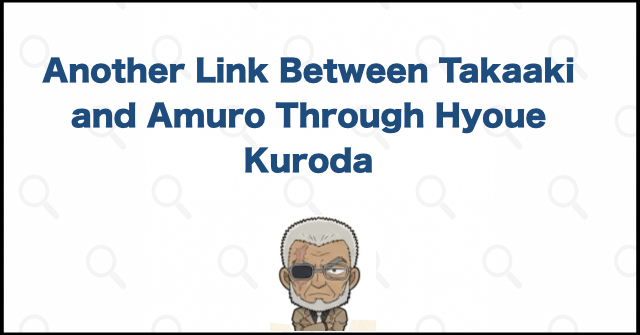
Another Link Between Takaaki and Amuro Through Hyoue Kuroda

Hiromitsu is not their only connection: Hyoue Kuroda also links Takaaki and Amuro.
Kuroda previously served with the Nagano Prefectural Police and was Takaaki’s superior. He also has a connection with Rei Furuya. This creates a second line between Nagano law enforcement and Public Security alongside the personal bond that runs through Hiromitsu.
The two lines should remain distinct. Hiromitsu provides the family and friendship connection; Kuroda provides an institutional and information-related connection. Their overlap brings the Nagano case into the larger atmosphere surrounding Public Security, the Black Organization, RUM, and Scotch’s death.
How Hyoue Kuroda Connects Public Security and the Nagano Police
Hyoue Kuroda is another important figure connecting Takaaki Morofushi with Rei Furuya.
For Takaaki, Kuroda is a former superior from the Nagano Prefectural Police. For Rei, Kuroda is a special contact on the Public Security side. During The 36-Cell Perfect Game, Kuroda calls Takaaki, adding another suggestive detail before Takaaki behaves as though Amuro is a stranger.
The exact words of that call have not been revealed. Given its timing, this article treats it as likely that Kuroda warned or instructed Takaaki regarding Amuro, although the manga does not confirm how much information he shared.
Takaaki may have identified Rei through his own deductions, yet that still does not prove he understands the entire Public Security operation. Kuroda’s involvement shows a quiet point of contact between Nagano and Public Security without resolving every secret behind it.
This uncertainty strengthens the case’s double atmosphere. Nagano detectives handle the visible crime, while the hidden concerns of Public Security and the Black Organization remain just beneath the surface.
Key Stories for Understanding Takaaki Morofushi and Tooru Amuro
Four especially useful stories are Kiddo vs. Komei Nerawareta Kuchibiru (tentative title), Keisatsu Gakko Hen (tentative title), The 36-Cell Perfect Game, and One-Eyed Flashback.
Each has a different role. Kiddo vs. Komei Nerawareta Kuchibiru (tentative title) develops the brotherly relationship between Takaaki and Hiromitsu. Keisatsu Gakko Hen (tentative title) shows Rei and Hiromitsu as childhood friends and police academy classmates.
The 36-Cell Perfect Game depicts the moment when the connection between Takaaki and Amuro comes into focus through Hiromitsu. One-Eyed Flashback adds to Takaaki’s feelings as a brother by showing him confronting Hiromitsu’s death; in the package’s account, it deepens the emotional context rather than establishing a major new direct relationship between Takaaki and Amuro.
Seen in that order, their connection becomes more than a character relationship chart. It becomes the story of Hiromitsu’s brother and closest friend, each carrying different memories of the same person.
Start With The 36-Cell Perfect Game
The best starting point for this relationship is The 36-Cell Perfect Game.
The case brings the essential clues together:
- Takaaki sees Amuro’s face and searches his memory.
- He connects the “0” associated with Hiromitsu’s phone to Zero.
- The story strongly indicates that he identifies Amuro as Rei Furuya.
- He acts like a stranger to Amuro while Kanenori Wakita is present.
- A call from Hyoue Kuroda adds another unresolved layer.
The case is effective both as a mystery and as a piece of longer-running character development. What does Takaaki know, and what does he deliberately leave unsaid? Why do the two men keep their distance in front of Wakita? The package supports cautious answers, but it does not close every gap.
The apparent formality of the meeting conceals Hiromitsu, Public Security, RUM, and Kuroda. The more closely the scene is read, the more important its silences become.
Summary of Takaaki Morofushi and Tooru Amuro’s Relationship
Takaaki Morofushi and Tooru Amuro, or Rei Furuya, are deeply connected through Hiromitsu Morofushi.
Takaaki is Hiromitsu’s older brother. Rei was Hiromitsu’s childhood friend and police academy classmate. Takaaki and Rei are neither relatives nor direct coworkers, but they share an important connection to Hiromitsu and had met before the Nagano case.
In The 36-Cell Perfect Game, Takaaki sees Amuro and recalls the friend Hiromitsu brought to meet him years earlier. Combined with the “0” connected to the person who sent Hiromitsu’s phone, the scene strongly indicates that Takaaki recognizes Amuro as Rei Furuya.
What Takaaki knows beyond that recognition remains limited and partly unclear. The package does not confirm that he understands the full scope of Rei’s Public Security duties, his work as Bourbon, or all the circumstances surrounding the undercover operation.
Takaaki then behaves as though he is meeting Amuro for the first time. This article concludes that he does so to avoid exposing Amuro or his Public Security connection in front of Wakita. The manga does not state his motive in dialogue, but the situation strongly supports that reading.
The moment is painful precisely because both men may have much to discuss but cannot safely do so. One is the brother who lost Hiromitsu; the other is the childhood friend who lost Hiro. Their formal exchange leaves all of that emotion beneath the surface.
One-Eyed Flashback further develops Takaaki’s grief as Hiromitsu’s brother, making the emotional weight of his connection with Rei easier to see. It does not, in the package’s description, confirm a major new direct development between the two men.
For readers tracing this relationship, The 36-Cell Perfect Game is the essential case. Reading it alongside Kiddo vs. Komei Nerawareta Kuchibiru (tentative title), Keisatsu Gakko Hen (tentative title), and One-Eyed Flashback reveals how Hiromitsu’s family bond and closest friendship meet in one restrained, memorable encounter.

Comments