Major manga spoilers for Rum’s identity, the murders seventeen years earlier, and File 1150. This discussion follows the manga through File 1150.
Rum’s left eye is prosthetic. His covered eye helps connect him to Kanenori Wakita, while the account of his past shows why losing it matters beyond his appearance: Rum once combined exceptional visual memory with ruthless observation.
The circumstances of the injury are less settled. File 1150 strengthens the connection with Tsutomu Akai, but the evidence discussed here does not fully depict how Rum lost the eye. The idea that APTX 4869 might restore it also remains a theory.
Rum was initially known through a single striking clue: one of his eyes was artificial. Once Kanenori Wakita was revealed as Rum, that clue aligned with the left eye Wakita keeps covered. This article examines how the clue worked, what Rum could do seventeen years ago, and what remains uncertain about the injury.
How the prosthetic-eye clue points to Wakita
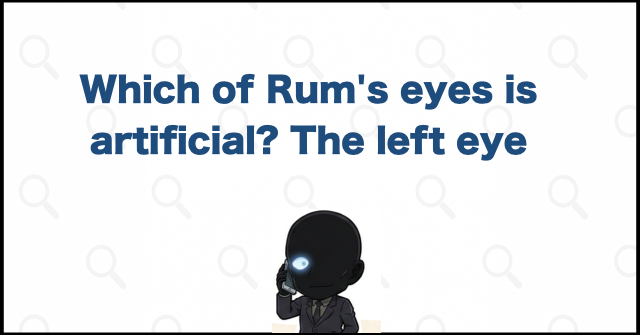
Haibara’s information about Rum initially produces conflicting descriptions: a large, strongly built man, a feminine-looking man, and an elderly man. Those accounts make physical appearance difficult to use as a reliable guide.
The recurring detail is that one eye is artificial. It gives Conan and the reader something more concrete to look for without immediately revealing which person fits it.
Wakita’s left-eye covering is conspicuous from his introduction, but Rumi Wakasa and Hyoue Kuroda also have problems involving an eye. With several plausible candidates, the clue directs attention while still allowing doubt.
Once Wakita is identified as Rum, his eye covering takes on a different significance. What first seems like one suspicious feature among several becomes a visible part of the answer.
The clue works because it is useful without being sufficient by itself. An eye injury can make someone a candidate; the character’s identity requires more than that resemblance.
What Rum’s photographic memory could do
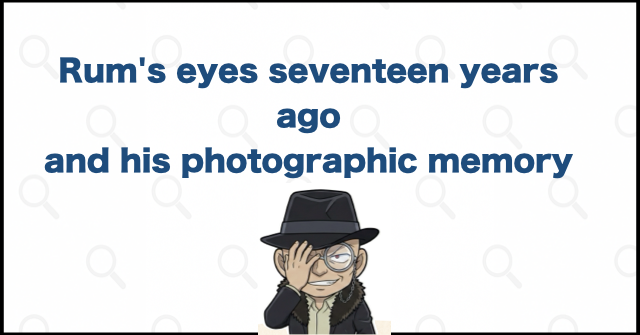
Seventeen years ago, Rum still had both eyes. During the Koji Haneda murder case, he used his sight together with exceptional observation and memory in a deeply intimidating way.
In the account of the events seventeen years earlier, Rum observes Amanda Hughes’s bodyguards and retains information about them. He uses what he notices to identify vulnerabilities and move against them. His attention also extends to discrepancies in Koji Haneda’s room.
“Photographic memory” is a helpful description of that extraordinary ability to retain visual information. The frightening element is not simply that he has good eyesight. It is that details he sees can remain available for later comparison and action.
A face, a position, or something slightly out of place can become useful long after an ordinary observer would have forgotten it. Rum turns observation into a weapon.
That makes the loss of his left eye significant as a possible loss of an advantage. It does not make him harmless. Intelligence, experience, and authority within the Organization do not disappear with an injured eye.
The contrast with his earlier self is what gives the subject weight: the present-day eye covering marks both an identifying feature and a history of damage to someone who once seemed frighteningly difficult to evade.
Did Tsutomu Akai injure Rum’s left eye?
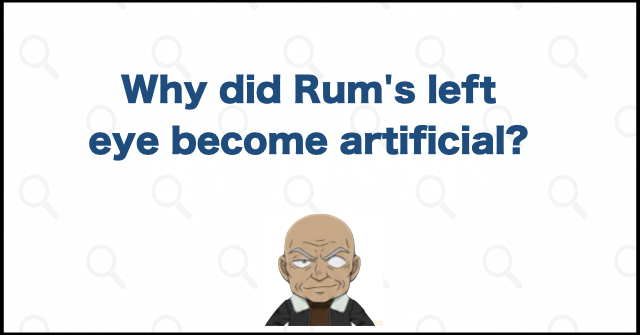
File 1150 makes Tsutomu especially important to that question. Seeing Subaru Okiya prompts a recollection of Tsutomu in Rum, bringing the Akai family back into the unresolved history surrounding his eye.
Rum regards Tsutomu as dead. The association is therefore unsettling in two ways: it recalls an old adversary, and it places that memory beside someone whose own identity is concealed.
The connection supports the theory that Tsutomu played a decisive part in the injury. But a strong association is not the same as a complete account of the event. The precise action, timing, and circumstances should not be filled in as facts.
There is also a separate question about what Rum understands when he sees Okiya. Remembering Tsutomu does not, by itself, prove that Rum has solved Okiya’s identity as Shuichi Akai.
The supported conclusion is that File 1150 strengthens the Rum–Tsutomu connection; it does not settle every link in the chain. That leaves the eye as a clue to the past without pretending the whole confrontation has been shown.
Why Asaka and Kuroda also entered the discussion
The murders seventeen years earlier involve several people whose stories remain connected to Rum: Koji, Amanda, Asaka, Kuroda, and Tsutomu. That makes it understandable that more than one person has been considered in theories about the injury.
Their involvement in the same history is a starting point for a theory, not evidence that they all took part in damaging Rum’s eye. File 1150 gives Tsutomu a more specific connection than simple proximity to the old case.
Could APTX 4869 restore the eye or its ability?
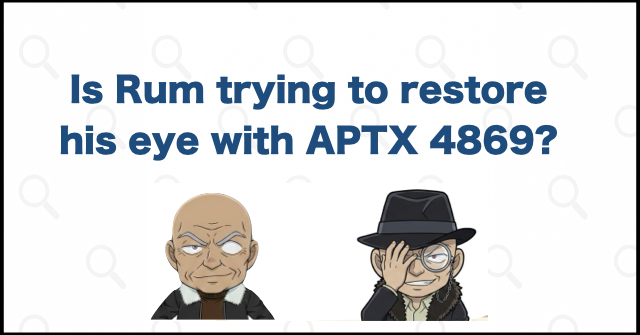
One possible explanation for Rum’s interest in the drug is that he wants to recover what he has lost. Conan and Haibara’s younger bodies make it tempting to imagine a similar reversal applied to Rum’s damaged eye.
The appeal of that theory is clear. It connects his earlier visual ability, his present injury, and the Organization’s drug research through a personal motive: restoration rather than youth for its own sake.
The missing step is whether the drug could actually repair an eye or restore the ability associated with it. APTX 4869 changing a person’s apparent age does not demonstrate that it can regenerate lost tissue. Nor does a plausible motive prove that Rum has a workable method.
Even if restoration is his aim, wanting an outcome and being able to achieve it are different questions. The theory is useful because it gives the eye a possible role in his future actions, but it should remain conditional.
That possibility is disturbing enough without declaring it inevitable. An observer who could once retain so much might become more dangerous if a lost advantage returned; the story has not established that such a recovery will occur.
How Rum’s eye differs from Wakasa’s and Kuroda’s
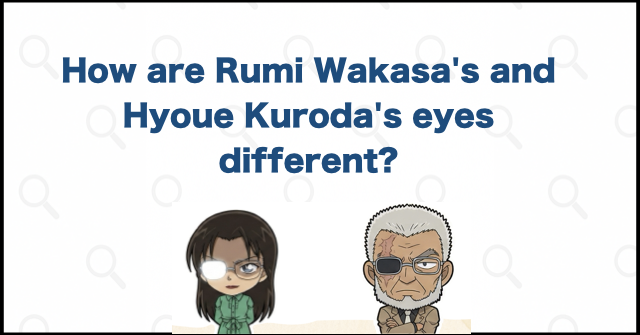
| Character | Eye-related clue | How to read it |
|---|---|---|
| Rum / Kanenori Wakita | The covered left eye is prosthetic. | Connects directly to the original clue about Rum and to his own past. |
| Rumi Wakasa / Asaka | Shows difficulty with her vision. | Belongs to her separate history and role in the case seventeen years earlier. |
| Hyoue Kuroda | An injured right eye. | Belongs to Kuroda’s history; it is not Rum’s prosthetic left eye. |
During the identity mystery, these overlapping features spread suspicion across three characters. After the reveal, they still matter, but they no longer explain the same thing.
Wakasa’s difficulties should not be treated as evidence that she is Rum, and Kuroda’s injured eye should not be used to reconstruct Rum’s injury. Similar clues can point toward different histories.
Where to follow the eye mystery
Start with Haibara’s early information about Rum, which establishes the prosthetic eye as a recurring clue. Wakita’s introduction then gives that clue a specific visual form.
Next, the account of the murders seventeen years earlier shows Rum with both eyes and explains the threat posed by his memory and observation. File 1150 adds the more specific association with Tsutomu Akai.
That sequence separates four questions that are easy to collapse into one: who Rum is, which eye is artificial, what he could do before losing it, and how the injury happened. The identity reveal answers the first two much more firmly than the final question.
What makes the clue satisfying is the way its meaning grows. A covered eye first helps identify a suspect; later it carries the trace of an old conflict and a possible reason for wanting something back.

Comments