Spoiler warning: Spoilers for Hiromitsu Morofushi’s death, the Morofushi family’s past, and the related movie discussion below.
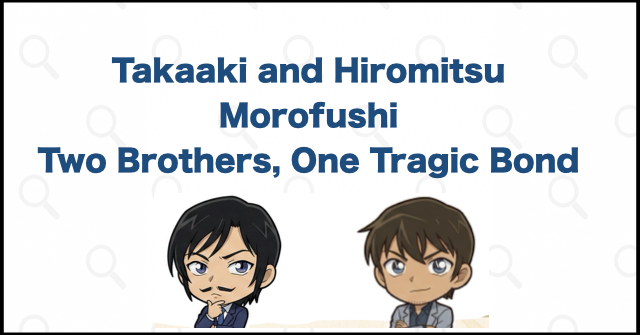
Takaaki Morofushi and Hiromitsu Morofushi are brothers. Takaaki infers Hiromitsu’s death from the bullet-damaged phone returned to him. That discovery brings two police storylines together, but its force comes from their shared childhood: their parents were murdered, and the brothers grew up apart. Below, the family history and the evidence Takaaki receives are kept separate from the additional scenes in the films.
The Morofushi brothers are Takaaki Morofushi of the Nagano Prefectural Police and his younger brother Hiromitsu Morofushi, the Public Security Bureau officer who infiltrated the Black Organization under the codename Scotch. Hiromitsu was also Rei Furuya’s childhood friend.
This article follows the brothers’ relationship, the manga Files and anime episodes that reveal it, their parents’ case, and their ties to Tooru Amuro, Rei Furuya, and Misao Yamamura.
Who Are the Morofushi Brothers? Takaaki and Hiromitsu’s Relationship
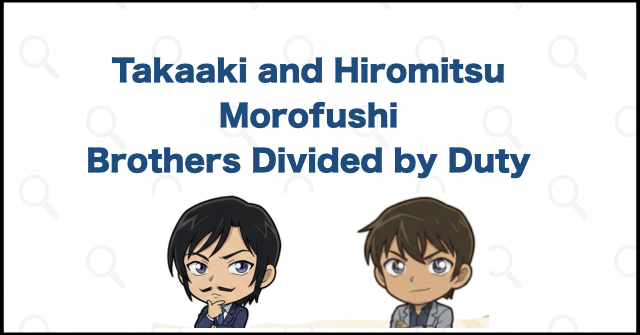
The phone carries information Takaaki was not told directly. Its bullet hole and bloodstain let him infer a death during undercover work; his remembered conversations with Hiromitsu give that inference its personal weight. The tragedy is not simply that a brother died. Takaaki has to reconstruct what happened from an object that has returned in his brother’s place.
The Morofushi brothers are the older brother Takaaki Morofushi and the younger brother Hiromitsu Morofushi.
Takaaki is an inspector with the Nagano Prefectural Police. Hiromitsu served in the Public Security Bureau of the Tokyo Metropolitan Police Department and infiltrated the Black Organization under the codename Scotch. That basic contrast connects the Nagano police stories, Public Security, and the central Black Organization plot.
Takaaki is portrayed as an exceptionally perceptive investigator whose calm strategy recalls the famous tactician Kong Ming. Hiromitsu, by contrast, trained alongside Rei Furuya, Jinpei Matsuda, Kenji Hagiwara, and Wataru Date before going undercover.
Their family connection is not decorative background: it links the Nagano Prefectural Police, the Public Security Bureau, and the Black Organization storyline. Information revealed in one part of the series changes the emotional meaning of scenes in another.
The decisive tragedy is that Hiromitsu is already dead. Takaaki did not know all along that his brother was conducting an undercover Public Security operation. When Hiromitsu’s phone reached him as a memento, the bullet hole and bloodstain allowed Takaaki to infer both the nature of the assignment and its fatal end.
The story does not establish that Takaaki learned every detail of Hiromitsu’s mission, disguise, contacts, or final moments. What it shows is narrower and more painful: a brilliant investigator can read the physical traces well enough to understand that his younger brother served in Public Security and died during an infiltration.
The brothers could not openly share everything. Hiromitsu may have kept silent because of the secrecy and danger surrounding his work, but the story does not confirm his precise reason. Takaaki is left to reconstruct the truth from what remains rather than hear it from Hiromitsu himself.
The power of their relationship lies in mementos, memories, silences, and the reactions of the people who knew Hiromitsu. There is no joyful reunion. Instead, the series gradually reveals a bond that can no longer be restored, which is why the Morofushi brothers leave such a lasting impression.
Does Takaaki Know Hiromitsu Is Dead? The Phone Memento
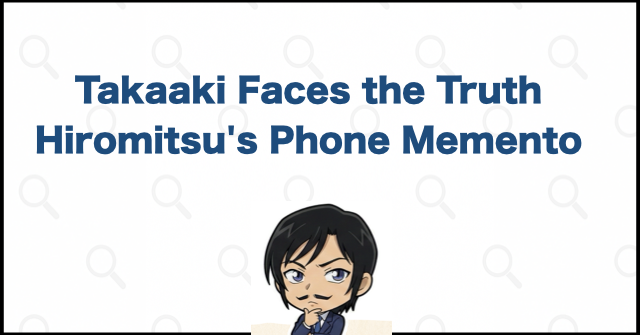
Takaaki infers that Hiromitsu is dead, but the series does not show that he knows the full circumstances of the mission.
Before receiving the phone, Takaaki had been told that Hiromitsu had left the police and taken another job. The memento overturns that understanding. Its damage gives him evidence that his brother’s disappearance was connected to dangerous police work rather than an ordinary change of career.
“He was probably assigned to Public Security and lost his life while infiltrating somewhere… The hole must be a bullet hole, and the dark stain must be blood…”
Takaaki Morofushi, unofficial translation
“Isn’t that right, Hiromitsu…?”
Takaaki Morofushi’s inner thought, unofficial translation
The wording matters: Takaaki presents an inference from physical evidence, not a detailed official account delivered by another character. His conclusion about Hiromitsu’s Public Security assignment and death is clear, while the broader operation remains outside what the scene explicitly establishes.
That distinction keeps several layers of knowledge separate. Takaaki understands that Hiromitsu died during an infiltration. It does not automatically follow that he knows Hiromitsu’s codename, every person involved, the precise sequence of his death, or Rei Furuya’s full position within Public Security.
His intelligence feels almost cruel in this scene: the same observational skill that normally solves crimes forces him to recognize what happened to his brother. There is no opportunity to look away from the evidence or preserve the comforting story that Hiromitsu merely chose another life.
Takaaki does not respond with an extended emotional outburst. His composure is consistent with his characterization, and that restraint gives the moment its weight. He quietly accepts what the evidence says, even though it means there can be no reunion.
It remains unclear how much Takaaki has inferred about Rei Furuya’s Public Security role or the complete scope of Hiromitsu’s assignment. The safe conclusion is that he recognizes Hiromitsu’s service in Public Security and his death; anything beyond that should remain a possibility rather than a confirmed fact.
When Is Their Relationship Revealed? Manga Files and Anime Episodes
The key manga chapters are Volume 96, Files 1020-1021, while the corresponding anime installments are Episodes 1040-1041 (Japanese episodes 983-984).
- File 1020, “Messing Around”
- File 1021, “Memento”
- Episode 1040 (Japanese episode 983), “Kid vs. Komei: The Targeted Lips (Part 1)”
- Episode 1041 (Japanese episode 984), “Kid vs. Komei: The Targeted Lips (Part 2)”
File 1021, “Memento,” is especially important. On the surface, the case concerns Kaitou Kid and the Fairy Lip. Yet the case also advances the larger story by placing an envelope in Takaaki’s hands. Inside is the phone once used by Hiromitsu.
The phone bears a bullet hole and a dark bloodstain, and Takaaki uses those traces to infer that Hiromitsu had not simply left the police for another career. He concludes that his brother likely entered Public Security, went undercover, and lost his life.
No one gives Takaaki a complete briefing. The revelation works because he reaches the conclusion himself. As a deduction, the clues form a clear line; emotionally, however, there is no satisfaction in solving it. His ability to understand the evidence only makes the scene harsher.
This is more than confirmation of a family connection: it is the moment when Hiromitsu’s death finally reaches Takaaki’s own story. The envelope, ruined phone, and Takaaki’s restraint quietly move the main narrative forward inside what initially looks like a Kaitou Kid case.
The Brothers’ Past: Their Parents’ Case and Their Separation
The Morofushi brothers’ parents were murdered when the boys were young, after which different relatives took them in. Hiromitsu went to Tokyo, while Takaaki remained in Nagano. The crime split their lives geographically even though the brothers had not chosen to part.
The murder of his parents became a profound childhood trauma for Hiromitsu. The police academy story explores that past and shows how losing his family continued to affect him.
The brothers have a six-year age gap. That made Takaaki not only Hiromitsu’s older brother but likely an especially reassuring presence in childhood. They remained connected through calls and letters after their separation.
They did not separate because of hostility; a violent case forced them into different homes and different futures. That context makes the later silence around Hiromitsu’s work more tragic. A brother once separated from his family by murder is eventually separated from Takaaki again by the secrecy and danger of undercover service.
Hiromitsu’s past adds depth to his decision to become a police officer, although the story does not reduce that choice to one confirmed motive. His trauma, his bond with Takaaki, and his life with the police academy group all contribute to how readers understand him.
The family tragedy echoes through the later Scotch storyline, Takaaki’s deductions, and the renewed connection with Misao Yamamura. What first looks like background information becomes a thread linking several eras and groups within the series.
Knowing this history also changes how both brothers appear in retrospect. Takaaki’s calm work in Nagano and Hiromitsu’s time among his academy friends both sit against the loss of their parents and the long physical distance between them.
The Morofushi Brothers and Tooru Amuro/Rei Furuya
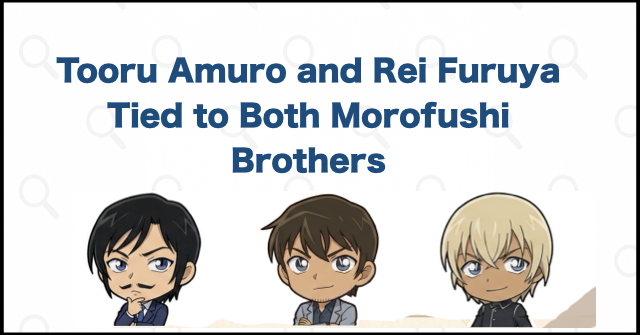
To understand the Morofushi brothers, it is essential to consider Tooru Amuro, whose real identity is Rei Furuya. Rei and Hiromitsu were childhood friends and later trained together at the police academy.
Hiromitsu was close enough to call Rei “Zero,” while Rei’s connection to him also makes Rei an important figure in Takaaki’s unresolved understanding of his brother’s past.
At the academy, Hiromitsu and Rei were part of the same group as Jinpei Matsuda, Kenji Hagiwara, and Wataru Date. Because Rei had known Hiromitsu since childhood, Scotch’s death was not merely the loss of a fellow operative. It was the loss of someone whose life had been intertwined with his for years.
An important development occurs around the case known as the “36-Cell Perfect Game.” Takaaki reacts as though Amuro’s face is familiar, a moment that can be read as connecting him to memories or images from Hiromitsu’s earlier life.
That reaction strongly implies recognition of some kind, but it does not confirm that Takaaki knows every aspect of Rei Furuya’s Public Security identity. Takaaki does not openly demand a complete explanation, and the story preserves distance between what he may suspect and what has been stated outright.
Rei lost a cherished childhood friend whom he could not save. Takaaki lost a younger brother whose fate he learned through a damaged phone. Both men cared deeply about Hiromitsu, yet the story does not show them fully discussing that shared grief face to face.
The unspoken space between Takaaki and Rei creates a quiet tension that changes the atmosphere of both Nagano police cases and Public Security stories. Hiromitsu remains the point where friendship, family, professional secrecy, and loss intersect.
The Morofushi Brothers and Misao Yamamura
Misao Yamamura is another important link to the Morofushi brothers because he knew Hiromitsu as “Hiro” in childhood. His memories connect Hiromitsu’s early life to a circle outside both Public Security and the police academy group.
This connection appears in international Episodes 1181-1182 (Japanese episodes 1123-1124), “The Body on the Gunma-Nagano Border (Part 1)” and “The Body on the Gunma-Nagano Border (Part 2),” adapted from Volume 102, Files 1082-1084.
Yamamura’s recollection shows that Hiromitsu left memories not only with Takaaki and Rei Furuya but also in another part of his childhood world. That broader network prevents Hiromitsu’s role from being confined to the circumstances of his death.
Takaaki’s response is especially affecting. He tells Yamamura that Hiromitsu became a police officer but does not directly tell him that Hiromitsu died. The scene can be read as Takaaki choosing not to destroy Yamamura’s childhood image of “Hiro,” although that interpretation should not be treated as an explicitly confirmed motive.
Takaaki withholds the fact of Hiromitsu’s death from Yamamura, but the story does not explicitly confirm why he makes that choice. It feels gentle rather than cold because he allows Yamamura to hold on to the memory he already has.
Yamamura is often used for comedy, so the link to Hiromitsu creates a striking change in tone. A character associated with lighter moments becomes another bearer of the Morofushi family’s painful history.
Hiromitsu continues to matter through the people who remember him: Takaaki, Rei, the police academy group, and Yamamura. His death is confirmed, but his presence in the narrative persists through those overlapping memories.
Summary of the Morofushi Brothers
The Morofushi brothers are Takaaki Morofushi, an inspector with the Nagano Prefectural Police, and Hiromitsu Morofushi, the former Public Security Bureau officer who infiltrated the Black Organization as Scotch.
Their relationship comes into focus in Volume 96, Files 1020-1021, and Episodes 1040-1041 (Japanese episodes 983-984), “Kid vs. Komei: The Targeted Lips (Part 1)” and “Kid vs. Komei: The Targeted Lips (Part 2).”
The central tragedy is that Hiromitsu is dead and Takaaki learns enough from the phone memento to infer what happened. The brothers never receive a final reunion in which every secret can be explained. Their relationship instead survives through evidence, memories, and things left unsaid.
Hiromitsu’s story reaches outward to Rei Furuya, the police academy group, Misao Yamamura, and the Nagano Prefectural Police narrative. Each connection reveals a different part of his life without granting any one character complete knowledge of every layer.
The 2025 movie Detective Conan: One-Eyed Flashback deepens the audience’s view of Takaaki as Hiromitsu’s surviving brother. Its additional scenes belong to the film and should be distinguished from the manga and television storyline.
The Morofushi brothers are memorable precisely because their bond is revealed after it can no longer lead to an ordinary reunion. The phone, childhood memories, restrained conversations, and the words of those who knew Hiromitsu give their story its lingering emotional force.


Comments