MENU

What Did Shuichi Akai Mean by ‘I Never Thought You Would Go This Far’? | Case Closed

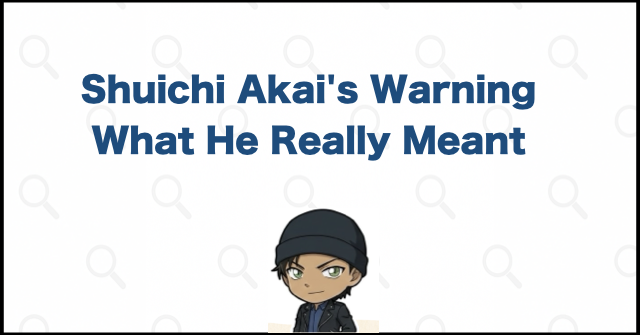
What Did Shuichi Akai Mean by 'I Never Thought You Would Go This Far'?

Shuichi Akai expresses surprise that Kir has gone so far.

Kir replies that she is also surprised by how well it has gone.

Akai’s brief remark immediately before Kir appears to shoot him at Raiha Pass initially sounds like a final acknowledgment that his life has reached its end. For a first-time viewer, that reading fits the grim staging perfectly.

Once the apparent death, Kir’s cooperation, Conan’s plan, and the later Scarlet arc are considered together, however, the line takes on a very different meaning. This article explains that reversal while keeping the scene’s uncertainties distinct from what is later revealed.

TOC

What Shuichi Akai’s “I Never Thought You Would Go This Far” Means

What Shuichi Akai's "I Never Thought You Would Go This Far" Means

The line is not simply Akai lamenting his own death; its later meaning is that he never expected Bourbon to read so far ahead.

In other words, Akai appears to be expressing surprise at the depth of Conan’s prediction and plan. Seen only at Raiha Pass, Akai looks cornered and resigned. Seen after the deception is exposed, both Akai and Kir are participants in an operation built around making the Black Organization believe that Akai has died.

That is what makes the line so effective: it first functions like Akai’s last words, then becomes an acknowledgment of Conan’s foresight. The mood of the scene changes completely on a rewatch.

It Sounds Like Resignation but Points to Praise for Conan

On the surface, Akai’s words sound like an honest reaction from a man facing death, but the later explanation points toward Conan’s ability to anticipate the situation. Kir has shot him, and Gin is observing the confrontation, so an expression of resignation is the natural first interpretation.

The plan had to account for Kir being ordered to kill Akai, Gin monitoring the act, and Gin demanding a decisive shot to the head. The article’s central reading is that Akai recognizes how far Conan had anticipated Gin’s behavior.

That response carries particular weight because Akai is himself an exceptionally capable strategist. His understated reaction suggests both surprise and trust without breaking the performance taking place under Gin’s eyes.

Kir’s “I Am Surprised Too” Changes with It

Kir’s reply works with Akai’s line: after the truth is known, their exchange can be read as shared surprise that the deception has proceeded so successfully. Her response conveys surprise at how well the plan has worked.

Kir appears to be Akai’s executioner, but she is actually cooperating in the staged death. She must make Gin believe that she has genuinely killed Akai, because any visible hesitation could expose her.

From the outside, this is a cold exchange between a victim and his killer; with the hidden plan in view, it is also dialogue between two people carrying out an extraordinarily dangerous deception. The contrast between those two readings gives the scene its lasting tension.

The Raiha Pass Scene Where Akai Says the Line

The Raiha Pass Scene Where Akai Says the Line

Akai says the line at Raiha Pass while Rena Mizunashi, operating under the codename Kir, appears to shoot him under orders from the Black Organization.

Kir needs to return to the organization after being held by the FBI, and Gin suspects that her loyalty may have been compromised. Killing Akai, a major threat to the organization, is presented as the test that will remove that suspicion.

Akai, Kir, and Conan are nevertheless working within a staged-death plan. Because Gin is watching, the performance cannot contain an obvious mistake. The scene is therefore not merely an ambush; it is a life-or-death act performed under hostile surveillance.

Why Kir Had to Shoot Akai

Kir is ordered to shoot Akai to dispel the Black Organization’s suspicions and prove that she can return to its ranks. Although she holds an organization codename, she is in fact a CIA operative.

Her time in FBI custody leaves the organization with reason to doubt her. Gin therefore orders her to kill Akai, whose removal would be valuable to the organization and would serve as convincing evidence of her loyalty.

Conan’s side turns that demand into an opportunity: clear suspicion from Kir while convincing the organization that Akai is dead. If successful, Akai can disappear from public view. If the performance fails, both he and Kir face immediate danger.

A Dangerous Performance Under Gin’s Surveillance

The danger at Raiha Pass comes from Gin watching the encounter and demanding a head shot to make Akai’s death appear certain. Kir’s first shot is not enough to satisfy him.

That demand makes the scene look inescapable. It also explains why Akai’s remark initially sounds like a genuine final statement. The staged shooting uses blanks and a blood effect concealed in Akai’s knit cap, with the plan anticipating Gin’s demand.

The deception succeeds by turning Gin’s ruthlessness into a predictable part of the performance. The account of the trick centers on that planned response from Gin.

What Conan Had Anticipated

What Conan Had Anticipated

Conan’s prediction went beyond Kir merely calling Akai to Raiha Pass: the plan accounted for suspicion falling on Kir, the order to kill Akai, Gin’s surveillance, and the demand for a final shot.

The operation depends on more than a physical trick. It also depends on predicting how Gin responds to doubt. Gin would not accept an ambiguous death, so the performance had to survive his insistence on certainty.

Within the article’s interpretation, this is why Akai is so impressed: Conan has read both the situation and the people inside it. His deductions are being used not only to solve a case but also to keep allies alive.

Anticipating Gin’s Demand for a Head Shot

The key prediction was that Gin would insist on a shot to Akai’s head rather than accept the first apparent wound as proof of death. His suspicious and uncompromising nature makes that response plausible within the plan.

That prediction works together with the blood effect placed in Akai’s knit cap. When Kir appears to follow Gin’s instruction, the visual result makes the shot seem fatal.

Conan’s plan therefore uses Gin’s determination to eliminate every possibility of survival against him. The more thoroughly Gin demands the death be demonstrated, the more convincing the staged evidence becomes.

Blanks, the Blood Effect, and the Switched Body

The apparent death combines Kir’s blanks, a blood effect in Akai’s cap, and the later use of Rikumichi Kusuda’s body. These elements explain how the deception could withstand the Black Organization’s scrutiny.

The burned vehicle, the body left inside, and the fingerprint match create a set of mutually reinforcing signs that Akai has died. Those signs are intended to persuade both the organization and most of the FBI.

On a first viewing, the pieces primarily create shock; after the reveal, they can be seen as connected components of the same deception. That change in perspective is a major part of the payoff.

Why Conan’s Foresight Frightens Even Akai

Akai’s reaction makes sense because Conan appears to have anticipated not just an operation but the decisions each participant would make under pressure.

Kir would come under suspicion. Gin would order Akai’s death. Kir would have to perform the shooting, and Gin would demand a decisive final shot. The plan then had to preserve Akai’s life while restoring Kir’s position.

Failure at any stage could have exposed the deception and endangered both Akai and Kir. Their willingness to proceed shows the extraordinary degree of trust placed in Conan’s reading of the situation.

How the Scarlet Arc Pays Off the Foreshadowing

How the Scarlet Arc Pays Off the Foreshadowing

The later Scarlet arc reframes Akai’s words by revealing that he never expected Bourbon to read so far ahead.

At Raiha Pass, the remark sounds like something spoken at the brink of death. Later, Tooru Amuro, also known by the codename Bourbon, considers the omitted meaning and connects it to the person at the center of the plan.

The reinterpretation turns a seeming statement of defeat into praise for Conan and makes the earlier death scene part of a much longer piece of foreshadowing. The shock of Raiha Pass is not erased; it is given a second function.

Why Tooru Amuro, or Bourbon, Saw the Hidden Meaning

Amuro approaches the hidden meaning because he suspects that Akai’s death contains inconsistencies and investigates the possibility of a staged death.

He questions whether a man like Akai would die so easily, whether the body and fingerprint evidence leave room for a substitution, and what connection Subaru Okiya may have to the case. Step by step, those doubts bring him closer to the deception.

Vermouth treats Akai’s words as a candid final reaction, while Amuro considers whether something has been left unsaid. By supplying the idea of “reading ahead,” he identifies Conan as the boy behind the operation.

Vermouth’s Reading as Akai’s True Feelings

The contrast is that Vermouth accepts the line as Akai’s genuine feeling at the moment of death, whereas Bourbon looks for an omitted object behind “this far.”

Vermouth’s reading helps preserve the initial illusion for the audience. Akai and Kir’s performance appears natural enough to make resignation seem more likely than a coded acknowledgment of success.

Bourbon’s different approach does not merely read emotion; it tests the words against the suspicious evidence surrounding the death. The two interpretations deepen the line without requiring the original scene to reveal its secret early.

The Link to Akai’s Survival and Subaru Okiya

The line ultimately connects Akai’s survival, the staged death, and his subsequent activity as Subaru Okiya. Surviving Raiha Pass is distinct from the disguise itself, but the later reveal joins those layers of the plan.

Akai disappears publicly after the apparent death, allowing him to move outside the Black Organization’s immediate expectations. Amuro’s doubts about both the death and Okiya bring him closer to the truth during the Scarlet arc.

The short remark becomes a bridge among Akai’s apparent death, Okiya’s identity, Amuro’s investigation, and Conan’s strategy. Its significance grows because the later story does not discard the first reading; it reveals another layer beneath it.

Where the Line Appears in the Manga and Anime

Where the Line Appears in the Manga and Anime

The line appears in manga Volume 59, File 1, and in international Episode 551 (Japanese episode 504), “Clash of Red and Black (Killed in the Line of Duty).”

The anime installment is International Episode 551 (Japanese episode 504), “Clash of Red and Black (Killed in the Line of Duty).” The manga chapter is identified by volume and File number because an official English chapter title is not established here.

To experience both the apparent death and its later reversal, it is best to follow the Clash of Red and Black storyline and then the Scarlet arc. The first creates the shock; the later episodes expose the structure beneath it.

Reading the Manga: Volume 59, File 1

The Raiha Pass scene is in Volume 59, File 1, while its setup runs through the longer Clash of Red and Black storyline across Volumes 56 to 59. This placement distinguishes the pivotal scene from the broader storyline that builds toward it.

Beginning only with the final File delivers the immediate shock, but following Kir’s time with the FBI, her return to the organization, and the order against Akai gives the confrontation its full pressure.

The extended setup matters because Akai’s remark carries the weight of Kir’s divided position and Gin’s surveillance. The scene is the endpoint of a chain of risks rather than an isolated shooting.

Watching the Anime: Episode 551 and the Scarlet Arc

For the line itself, watch international Episode 551 (Japanese episode 504), “Clash of Red and Black (Killed in the Line of Duty).”

The larger anime storyline begins with international Episode 538 (Japanese episode 491), “Clash of Red and Black – The Beginning.” It continues through the apparent death. The later payoff comes in international Episode 835 (Japanese episode 782), “The Scarlet Return,” and international Episode 836 (Japanese episode 783), “The Scarlet Truth.”

Episode 551 asks the audience to believe Akai is dead; the Scarlet arc reveals why the same brief line can carry an entirely different meaning. That controlled reversal is one of the storyline’s strongest rewards.

Summary of Shuichi Akai’s “I Never Thought You Would Go This Far”

Akai’s line is best understood not as resignation before death, but as surprise at how far Conan had anticipated the actions of Kir and Gin. The precise English quotation used here is unofficial, but the later interpretation is the core of the scene’s reversal.

At Raiha Pass, Kir appears to kill Akai while Gin watches. Blanks, a blood effect, a substituted body, and fingerprint evidence support the staged death, allowing Akai to disappear and later operate as Subaru Okiya.

During the Scarlet arc, Amuro questions the death and supplies the missing idea behind Akai’s remark. Vermouth’s emotional reading and Bourbon’s investigative reading let the same words function first as misdirection and later as foreshadowing.

The result is a compact line that brings together Akai, Kir, Conan, Gin, Vermouth, and Amuro without revealing the plan when it is first spoken. Its meaning becomes richer, not simpler, once the truth is known.

Let's share this post !

Author of this article

Comments

To comment

CAPTCHA

TOC