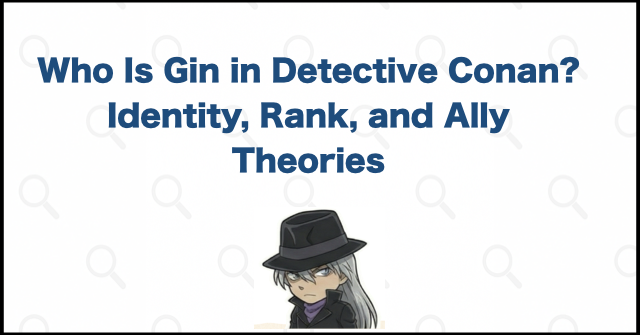
This article contains major spoilers involving the Black Organization, Rum, Sherry, Vermouth, Shuichi Akai, and the movies Black Iron Submarine and The Darkest Nightmare.
Gin is a senior Black Organization operative and Conan’s enemy, not a revealed secret ally. He forced Shinichi Kudo (Jimmy Kudo) to take APTX 4869, causing the transformation that began Shinichi’s life as Conan Edogawa.
His role is much clearer than his biography. His legal name, age, and personal history remain uncertain, while theories about his rank and relationships go beyond what has been revealed. The useful question is not simply who Gin might be, but what his actions already tell us about him.
What We Know About Gin
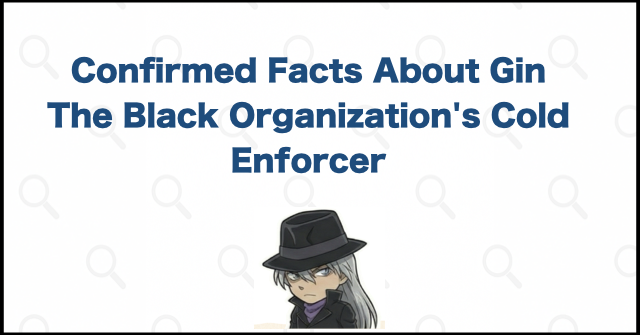
Gin usually works alongside Vodka, drives a Porsche 356A, and is left-handed. Those familiar details make him instantly recognizable, but they tell us little about the man behind the codename.
What defines him is his willingness to kill anyone who threatens the Organization, including its own members. He combines authority in the field with an almost complete absence of personal disclosure. We know what he can do without knowing where he came from. That imbalance is a large part of his menace.
The attack that made Shinichi into Conan
At Tropical Land, Shinichi witnesses an illegal transaction and Gin attacks him from behind. Gin then forces him to swallow APTX 4869, expecting a lethal drug that leaves little evidence. Shinichi survives, but his body shrinks into that of a child.
That makes Gin more than a recurring obstacle. His decision creates the central situation of Detective Conan: Shinichi must investigate the Organization while concealing his survival and new identity.
The dramatic irony is chilling. Gin believes he has disposed of Shinichi, while his victim is still close enough to pursue him. The danger comes from that gap in knowledge, not from Gin secretly arranging to help him.
Is Jin Kurosawa really his name?
Jin Kurosawa is the name most closely associated with theories about Gin’s real identity. In the mermaid case, that name appears on the Juru festival register alongside names including Shiho Miyano, the scientist known within the Organization as Sherry.
The theory is also associated with a reported behind-the-scenes remark by Gosho Aoyama. Yet the register does not settle whether the name is a genuine identity, an alias, or something with another explanation. Jin Kurosawa remains a possible name for Gin, not a conclusively established legal name.
The festival entry has also prompted speculation about the Organization investigating immortality. That is a possible reading of the clue, not proof of why those names were entered or of the Organization’s ultimate purpose. The entry is intriguing precisely because it opens questions without answering all of them.
Where Gin Stands in the Black Organization
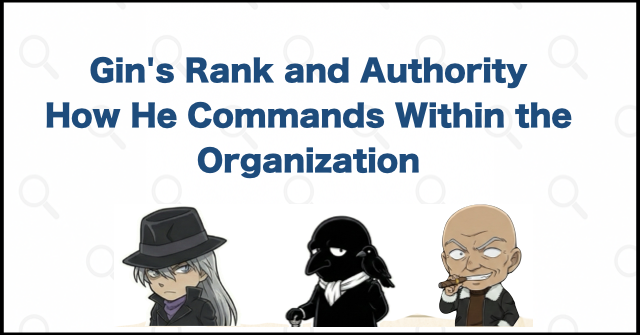
Gin commands operations in the field and gives orders to Vodka, Chianti, and Korn. He is a central enforcer, but his prominence does not make him the Organization’s highest-ranking operative.
Below Rum, but not a confirmed number three
Rum is the Black Organization’s second-in-command and ranks above Gin. Rum’s identity is Kanenori Wakita; that revelation helps separate the Organization’s hierarchy from the impression created by Gin’s imposing presence.
They appear to play different roles. Rum is associated with strategy and information, while Gin handles threats, punishment, and control on the ground. That contrast is a useful way to read their roles, not a complete organizational chart.
Gin’s exact numerical rank below Rum is not confirmed, so calling him number three or number four goes too far. His importance lies in the power he actually exercises: making decisions in dangerous situations and enforcing the Organization’s demands.
Loyalty to the boss does not mean loyalty to colleagues
Gin carries out the boss’s orders and puts the Organization’s secrecy ahead of personal attachment. His execution of Pisco, a long-serving member, shows how little protection years of service offer when secrecy is at risk.
This is more frightening than indiscriminate violence. Gin gives the Organization’s rules a human face: betrayal, suspicion, or failure can turn a colleague into a target. Being on his side is no guarantee of being safe around him.
Vodka regularly acts as his assistant and addresses him as an older-brother figure. Gin entrusts him with tasks, which suggests practical confidence, but their partnership does not make Gin indulgent.
Bourbon and Kir draw a different kind of attention. Independent activity and doubts about loyalty make Gin wary; sharing an Organization codename is not enough to earn his trust. Kir’s covert CIA affiliation makes that question of loyalty particularly important. Gin is both an enforcer against outsiders and a watchdog within the group.
Is Gin an Ally, or Is He Simply Incompetent?
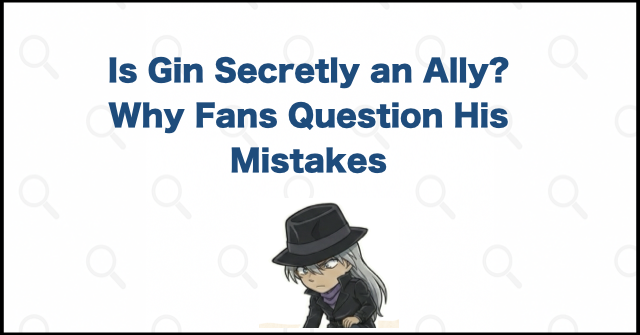
Repeated escapes make both theories easy to understand. Gin believes Shinichi died, fails to recognize Conan, and comes close to discovering him in a coin locker without catching him. If we look only at the outcome, his reputation can seem larger than his results.
Those failures do not show that he intends to spare Conan or Sherry. He tried to eliminate Shinichi and pursues Sherry as a defector. A victim surviving an attack is not evidence that the attacker wanted that survival.
Why he has not connected Conan with Shinichi
Gin treats Shinichi as dead after the APTX 4869 attack and does not work from the assumption that the drug can turn a person into a child. He also does not dwell on the names and faces of people he believes he has killed.
Together, those habits help explain the blind spot. Recognizing an elementary-school child as the high-school detective he attacked requires a possibility Gin has not accepted. That is different from proving he could never discover the truth.
Rum, by contrast, questions whether Shinichi is really dead. Suspecting that Shinichi survived is not the same as knowing that Conan is Shinichi. Keeping those two discoveries separate matters when judging how close the Organization is to exposing him.
A mistake does not make him harmless
Gin’s reaction to a single strand of Sherry’s hair in his Porsche is the counterweight to those failures. A tiny trace is enough to alert him to her presence. The coin-locker near miss likewise depends on Conan escaping a very close threat, not on Gin offering him protection.
His strength is not the tidy, step-by-step deduction associated with Conan or Shuichi Akai. It is an acute sense that something is wrong, followed by a readiness to act. That gives his scenes a different, almost predatory kind of suspense.
The frustration with his missed chances is understandable. But reducing him to an incompetent villain erases why those escapes are tense in the first place: Conan and Haibara repeatedly survive by narrow margins. Gin can be wrong without becoming safe.
What His Relationships with Sherry and Vermouth Suggest
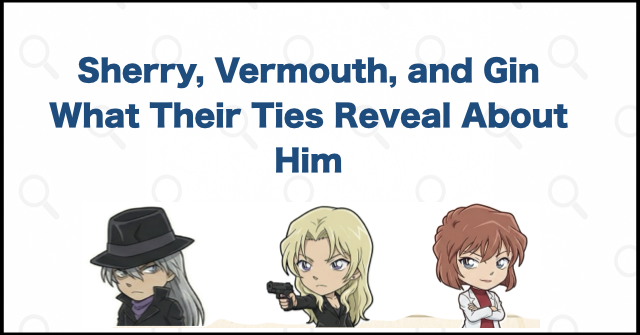
Sherry: a personal fixation, but no confirmed romance
Sherry is Shiho Miyano, who lives as Ai Haibara after leaving the Organization. Gin’s pursuit of her is unusually intense. His recognition of her hair, his anticipation of confronting her, and his apparent understanding of her behavior all make their history feel personal.
Those details may suggest that they once worked at close quarters. They do not tell us exactly what that history was. A former romantic relationship between Gin and Sherry is not confirmed.
His eagerness to see her can be read as personal feeling, but it also fits a hunter determined to catch a traitor. Sherry knows the Organization’s secrets; Gin’s determination to silence her does not require a romantic explanation.
That alternative reading is important. The unsettling intimacy of the pursuit remains, without turning it into an established love story. The fear comes partly from how much he seems to understand about her, and partly from how little we know about their past.
Vermouth: suggestive banter mixed with distrust
The martini-related exchange between Gin and Vermouth is another reason to wonder about past intimacy. Their banter has a familiarity that stands out against Gin’s colder dealings with other members.
Vermouth is the boss’s favorite and has unusual freedom to act independently. Gin appears not to trust her completely, even though their exchanges suggest a distinctive closeness. The result is neither simple friendship nor straightforward hostility.
That dialogue may suggest past intimacy, but it does not confirm that Gin and Vermouth are lovers or sexual partners. Leaving the relationship open preserves what makes it compelling: the lightness of the banter and the mistrust beneath it exist at the same time.
The Stories That Show Different Sides of Gin
Gin’s appearances build on one another. His debut explains Conan’s predicament; later confrontations reveal his instincts, his place in the Organization, and the people capable of unsettling him.
The debut: The Tropical Land attack establishes Gin as the man responsible for Shinichi’s transformation and gives Conan a direct reason to pursue the Organization.
The reunion with the Organization: International Episodes 190-192 (Japanese episodes 176-178) comprise Reunion with the Black Organization (Haibara), Reunion with the Black Organization (Conan), and Reunion with the Black Organization (The Resolution). This sequence brings his pursuit of Sherry into focus.
The contact with the Organization: International Episodes 334-336 (Japanese episodes 309-311) comprise Contact with the Black Organization (The Negotiation), Contact with the Black Organization (The Pursuit), and Contact with the Black Organization (Desperation). Conan’s dangerous proximity to Gin makes this a useful sequence for judging his field instincts rather than only his results.
The confrontation with Akai: Black Impact! The Moment the Black Organization Reaches Out (2.5 Hour Special) makes the Gin-Akai rivalry tangible. The subsequent Clash of Red and Black arc develops the tension around the FBI and the Organization.
The later operations: International Episodes 1135-1137 (Japanese episodes 1077-1079) comprise The Black Organization’s Scheme (Hunt), The Black Organization’s Scheme (Landing), and The Black Organization’s Scheme (Identity). These stories place Gin’s field presence alongside developments involving Rum.
The movie perspective: Black Iron Submarine adds Pinga’s rivalry with Gin. Its movie-only characterization needs to remain separate from manga and television evidence about Gin’s identity.
Akai’s shot and the scar on Gin’s left cheek
In the Black Impact confrontation, Shuichi Akai fires from long range, hits Gin’s scope, and leaves a wound on Gin’s left cheek. The scar does not reveal Gin’s identity; it shows that he, too, can be reached.
That reversal is thrilling. Gin is so often the person closing in on someone else that seeing Akai turn him into the target changes the balance of the scene. Akai is not just another opponent to dismiss: he can threaten both the Organization and Gin personally.
The mark on Gin’s cheek keeps that encounter visible. It adds weight to their hostility without supplying an answer to his name or background. The hunter has met someone capable of hunting him.
Pinga’s rivalry is movie-only evidence
In the movie Black Iron Submarine, Pinga is an operative close to Rum who strongly resents Gin. This is movie-only evidence, not a manga revelation about Gin’s background.
Pinga’s hostility suggests that Gin’s authority can provoke rivalry inside the Organization, not just fear outside it. Gin, meanwhile, judges other members through usefulness, interference, and suspicion rather than treating them as friends.
The film adds another angle to that cold position. It does not conclusively reveal Gin’s real name, age, or past, and Pinga’s resentment cannot establish an exact numerical rank for him.
Three Memorable Lines, and What They Tell Us
Gin’s dialogue returns to the same themes as his actions: anticipation, suspicion, and betrayal. Three memorable remarks help explain why his threat feels personal as well as organizational.
His eagerness to confront Sherry
When Gin corners Sherry, he expresses how much he has wanted to see her. The manga reference is Volume 24, File 242, A World in White, within the reunion material adapted in international Episodes 190-192 (Japanese episodes 176-178).
The remark may sound intimate, but anticipation of killing a defector offers another explanation. It is the collision of those readings, not proof of a former romance, that gives the confrontation its disturbing force.
Suspicion is enough to bring punishment
In The Darkest Nightmare, Gin’s remarks about suspected infiltrators Bourbon and Kir make his principle clear: suspicion itself is enough for him to punish someone. This is a movie-only example of his attitude, not a new manga confirmation.
For the Organization’s members, that is an especially bleak rule. Innocence is not reassuring if Gin decides the risk of leaving someone alive is too great.
A traitor cannot erase the traces of betrayal
Another remark about Sherry compares betrayal to a scent that cannot be erased. Gin sees a defector as someone whose presence will eventually betray them, however carefully they try to hide.
The image fits his pursuit of her: a strand of hair becomes a sign that he is close. It also shows why their encounters are so unnerving. He is not merely searching for her; he speaks as though escape can never be complete.
Gin’s Role Is Clear; His Personal Identity Is Not
Gin is an enemy and a powerful Black Organization enforcer. His full biography remains uncertain. The Tropical Land attack, Pisco’s execution, and his pursuit of Sherry establish his hostility far more firmly than missed chances support a secret-ally theory.
Rum’s superior position puts a limit on his rank, while Sherry, Vermouth, and Akai reveal different kinds of tension around him. None of those relationships supplies a complete answer to his real name, age, or past.
That is what makes him more than a straightforward villain. His actions are frighteningly clear, but the person behind them remains obscured. The mystery is worth exploring without turning every suggestive clue into a settled fact.

Comments