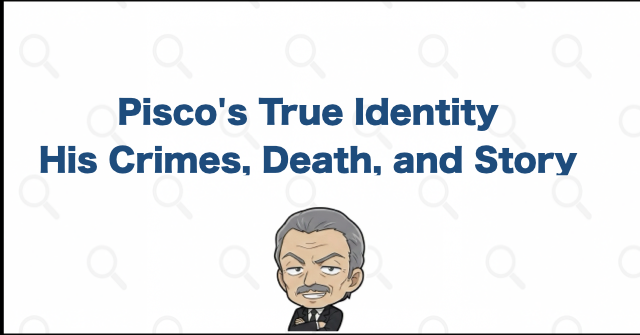
Spoiler warning: This article reveals Pisco’s death, Haibara’s exposed identity, the Black Organization’s Boss, and a relationship introduced in The Raven Chaser.
Pisco is the codename of Kenzo Masuyama, a veteran Black Organization member and the chairman of a major automobile manufacturer. Gin kills him on the Boss’s orders after a photograph exposes his assassination.
The assignment itself succeeds: Shigehiko Nomiguchi dies. Pisco’s fatal failure is leaving evidence that can connect a respected public figure to the crime and, potentially, to the organization behind it.
He also recognizes Ai Haibara, now attending Teitan Elementary School alongside the Detective Boys, as Shiho Miyano and sees her body change. His death interrupts that dangerous disclosure, preserving one of the secrets she and Conan, originally Shinichi Kudo, must protect.
His main story belongs to Volume 24 and Reunion with the Black Organization. The later Irish relationship is movie-only material and should be read separately from the manga and television case.
Pisco’s public position and hidden allegiance
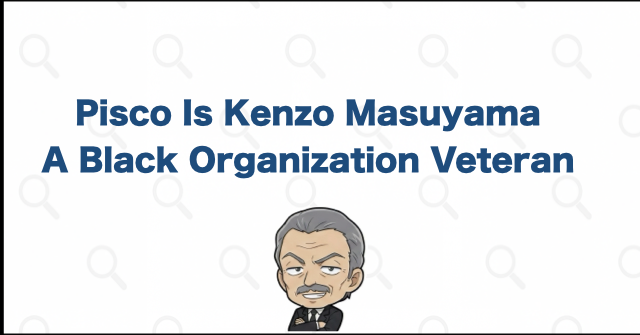
Pisco is the codename of Kenzo Masuyama, the 71-year-old chairman of a major automobile manufacturer who has served the Boss for years. His respectable position and his willingness to carry out an assassination make a disturbing combination.
- Organization codename: Pisco.
- Civilian identity: Kenzo Masuyama.
- Age at the time of the case: 71.
- Public occupation: chairman of a major automobile manufacturer.
- Organizational position: a long-serving, codenamed member; his formal rank is unconfirmed.
- Japanese voice actor: Yasuo Muramatsu.
- Outcome of the case: killed by Gin.
His short appearance reaches far into the wider story. It shows the organization’s presence in respectable society, connects Haibara to her parents’ generation, and demonstrates how little protection long service provides after a dangerous mistake.
A chairman can enter places an obvious criminal cannot
Pisco attends the memorial gathering for film director Akira Sakamaki among prominent guests from politics, business, and entertainment. His public standing makes his presence seem ordinary.
That position may make it easier to approach a target at an elite gathering. It does not establish how his company, money, or business activities were used in other organizational operations.
The confirmed contrast is enough: a man who belongs comfortably in the business establishment can also kill on the organization’s orders. The threat does not announce itself through an obviously criminal appearance.
His service reaches back to the Miyanos
Pisco knew Atsushi Miyano and Elena Miyano and had heard about their developing drug. Those relationships place him near an older generation of the organization’s research.
His knowledge later becomes dangerous to their daughter. The connection is personal as well as organizational: someone familiar with the parents can recognize a resemblance that others might miss.
He may have known more about the earlier research, but its full extent remains unclear. His death removes a possible source of that history without supplying the answers he might have held.
Long service does not establish a formal rank
Pisco has a codename and is trusted with a significant assassination. Those facts establish his importance as a veteran operative.
His formal rank relative to Gin is unconfirmed. Being older or having served longer does not prove that Pisco was Gin’s superior or equal.
The supported chain of action is narrower: the Boss orders Pisco’s elimination and Gin carries it out. How Pisco otherwise communicated with the Boss remains unknown.
The assassination and Haibara’s confinement
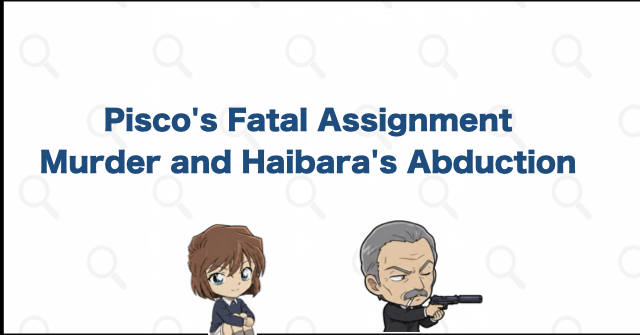
Pisco’s assignment is to kill Shigehiko Nomiguchi, whose potential arrest threatens to lead investigators toward the Black Organization. The memorial provides the setting for silencing him.
At the same gathering, Pisco becomes suspicious of the child Haibara and confines her in a wine cellar. A murder investigation and a threat to her identity begin running together.
The chandelier makes the killing resemble an accident
When the room darkens, Pisco fires at the chandelier and brings it down onto Nomiguchi. The falling fixture kills the target.
The method conceals a shooting behind an apparent accident. Successfully making that shot shows practical firearms skill, but it does not establish that Pisco regularly worked as a sniper.
The mission reaches its immediate objective. What destroys Pisco is the evidence of how he accomplished it, rather than a failure to kill Nomiguchi.
Haibara is trapped in the wine cellar
Haibara senses the organization’s presence and becomes frightened. Pisco catches her and shuts her in the cellar after noticing a resemblance to Sherry.
She communicates with Conan and Professor Agasa while trying to escape. Drinking baijiu temporarily restores her adult body as Shiho Miyano.
The restoration gives her a possible route out of confinement, but it also returns the face the organization recognizes. An apparent escape from one danger creates exposure to another.
Old family knowledge helps him recognize Sherry
Pisco’s acquaintance with Atsushi and Elena, his knowledge of their developing drug, and his familiarity with Shiho give him reasons to look beyond Haibara’s apparent age.
He then witnesses Shiho’s body return to its child form. That observation gives him direct evidence of the physical change during this case.
It does not prove he already understood APTX4869’s shrinking effect before the incident. Hearing about research, suspecting a resemblance, and witnessing the change are distinct stages of knowledge.
Why the organization kills its successful assassin
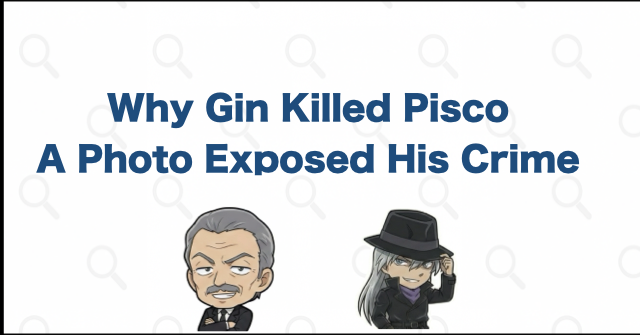
A camera catches Pisco firing at the chandelier. If the photograph becomes public, the supposed accident can become evidence against him and a route toward the people behind the killing.
The irony is severe: he removes someone who could expose the organization, then creates a new exposure risk himself. His own successful mission makes him disposable once its concealment fails.
One photograph turns success into a liability
The darkened room does not keep the firing moment invisible. A camera flash records Pisco with the gun, undermining the apparent-accident explanation.
Public evidence against a prominent chairman could invite scrutiny of his connections as well as his individual actions. That wider risk is what makes the mistake dangerous to the organization.
The killing has already succeeded, but its success no longer protects the killer. The organization treats evidence control as a condition of survival, not a secondary concern.
The Boss gives the order; Gin executes it
Gin shoots Pisco after the Boss decides he must be eliminated. The death should not be explained simply as Gin losing his temper or acting on a personal grievance.
Gin also frames Pisco’s public success as something achieved with organizational help. That statement links his respectable position to the group whose secrecy he has now endangered.
It does not disclose the exact means by which the organization helped him rise. The point of the confrontation is that the benefit creates no entitlement to mercy.
The cellar is subsequently engulfed by fire. The execution and the chaotic setting leave an ending in which solving the original crime provides little sense of safety.
Loyalty cannot protect a dangerous liability
Pisco has served for years and carries connections to an earlier generation. None of that prevents his elimination after the photograph threatens the group’s secrecy.
A conventional murder case might end with the culprit exposed and arrested. Here the culprit is killed by his own side, leaving the larger organization beyond the ordinary resolution.
That is what I find chilling about his exit. The investigation can reach the truth and still finish with an internal execution that makes the wider threat feel stronger.
Skill and failure belong in the same assessment
Calling Pisco simply incompetent loses the contrast. His assassination succeeds, and his recognition of Haibara creates a serious threat. The problem lies in controlling the consequences.
- He hits the chandelier during the blackout.
- The falling fixture initially gives the murder the appearance of an accident.
- He notices the resemblance between Haibara and Sherry.
- His knowledge of the Miyanos supplies context for that resemblance.
Against those abilities stand the mistakes and reversals that follow:
- A camera captures his use of the gun.
- The photograph threatens to become public evidence.
- Conan and Haibara resist the situation he has created.
- Fire overtakes the wine-cellar confrontation.
- His death comes before a completed report of Haibara’s child identity is shown.
Competence at carrying out an assignment and control of every resulting risk are different things. Pisco demonstrates the former and fails disastrously at the latter.
Why Haibara’s exposure is so dangerous
Pisco identifies Ai Haibara as Shiho Miyano, the researcher known as Sherry. He also sees the return to her child body.
If that information reached Gin or the Boss, it could place her present life in immediate danger. That consequence is hypothetical, but it explains why Pisco’s personal discovery is such an urgent threat.
A witnessed change is more than a resemblance
The Miyano connection helps Pisco form a suspicion. Seeing the body change then gives that suspicion a basis beyond noticing a similar face.
He can recognize that the phenomenon involves a change in physical age or size. It does not follow that he knows the drug’s complete mechanism or the conditions under which it occurs.
Those limits do not make his knowledge harmless. Even a partial understanding can connect Haibara’s present appearance to the organization researcher she is trying to leave behind.
His discovery does not become a completed report
The events discussed here do not show Pisco successfully reporting Haibara’s child identity to Gin, Vodka, or the Boss before he dies.
That is a limit on the demonstrated transmission of information, rather than proof that no other organization member can hold related knowledge independently.
It is not a case of Conan or the FBI erasing what Pisco knows; his own organization silences him. I find the reprieve bitter: the same cruelty that threatens Haibara also stops an enemy from passing on what he has learned.
A witness to the Miyano family’s earlier history
Atsushi and Elena worked on drug research connected to the organization. Shiho later becomes a researcher herself, with the codename Sherry.
Pisco’s familiarity with the parents makes their past active in their daughter’s present. An old acquaintance becomes someone capable of recognizing her despite a radically changed body.
He may have held further information about that research, but his death does not reveal it. A possible witness disappears while much of the older history remains unresolved.
Different relationships inside the organization
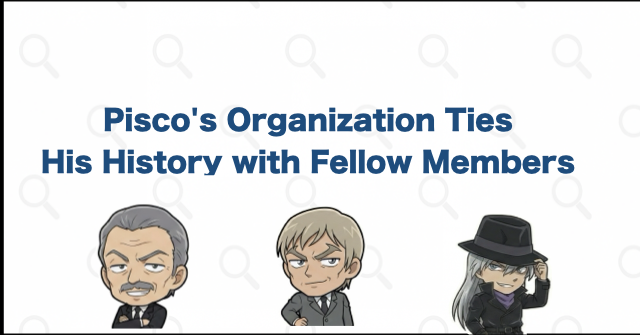
Pisco’s connections include long service to the Boss, operational cooperation with Vermouth, and an execution carried out by Gin. Those are different kinds of relationship.
The Raven Chaser adds Irish‘s personal attachment in movie-only material. It broadens the emotional picture without establishing an equivalent relationship in the manga.
Gin’s role is execution on the Boss’s order
Gin is the person who shoots Pisco. The decisive authority behind that action is the Boss’s elimination order.
The case does not establish that Gin and Pisco were personal enemies, close friends, or formally equal in rank. The execution should not be used to invent one of those histories.
What the scene does show is Gin’s willingness to act without mercy once organizational secrecy takes precedence. Age and years of service do not slow that decision.
Vermouth helps with the Nomiguchi operation
Vermouth attends the memorial as Chris Vineyard and assists the operation. Her use of the handkerchief situation helps disrupt the investigation and Pisco’s exposure within it.
Their cooperation establishes a shared assignment, rather than a complete account of what they knew about one another. Pisco’s awareness of secrets about Vermouth’s age or the Boss remains unconfirmed.
The contrast in their outcomes is striking. Pisco is removed, while Vermouth continues as an organizational threat beyond the case.
Irish’s attachment is movie-only
In the movie-only story The Raven Chaser, Irish regards Pisco as a father figure. That relationship is not presented as a biological father-son connection.
In that movie-only context, Irish resents Gin for killing Pisco. Personal attachment gives the death consequences that go beyond an operative being eliminated for a mistake.
For the organization, Pisco is a liability; for Irish, he is someone important. That emotional contrast belongs to the movie and should not be silently carried into manga claims.
Long service to the Boss does not earn mercy
The Boss is identified as Renya Karasuma. Pisco has served him for years and benefited from the organization’s influence in his public life.
Once the photograph creates a threat, that service does not save him. His exact position in the chain of command and any direct-contact method with the Boss remain unknown.
The confirmed elimination order is enough to establish the priority: secrecy outranks loyalty when the Boss decides a veteran has become dangerous.
Where Pisco’s story appears
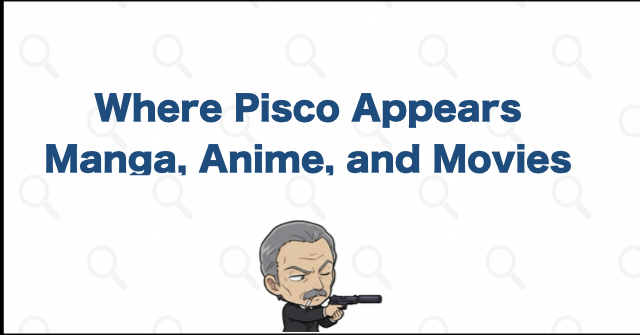
His main appearance while alive is in Volume 24 and Episodes 190-192 (Japanese episodes 176-178), the Reunion with the Black Organization story.
The Raven Chaser later refers to him through Irish’s history. It is not a new assignment undertaken by a living Pisco, and its relationship evidence is movie-only.
Volume 24 and the three anime episodes
The five manga chapters are the seventh through eleventh chapters of Volume 24, or Files 238-242 in continuous numbering. The English chapter names below are established secondary titles.
- File 238, Volume 24 chapter 7: The Street Corner of Betrayal.
- File 239, Volume 24 chapter 8: The Black Funeral.
- File 240, Volume 24 chapter 9: A Sudden Farewell.
- File 241, Volume 24 chapter 10: A Bullet from the Past.
- File 242, Volume 24 chapter 11: A World in White.
- Episode 190 (Japanese episode 176): Reunion with the Black Organization (Haibara).
- Episode 191 (Japanese episode 177): Reunion with the Black Organization (Conan).
- Episode 192 (Japanese episode 178): Reunion with the Black Organization (The Resolution).
The anime names are display titles for the three corresponding episodes. Within this single story, the murder investigation, Haibara’s confinement, the body change, and Pisco’s execution intersect.
His brief presence therefore does considerable work. He connects the public crime to the organization’s reach and Haibara’s current danger to an older family history.
Vermouth and the temporary adult transformation
Chris Vineyard’s participation introduces the figure associated with Vermouth into the operation. Pisco leaves the story, but another organizational danger remains.
Haibara’s temporary return to Shiho after drinking baijiu shows that the physical change can be reversed in this situation. It does not establish a general, reliable cure for APTX4869.
Her adult appearance also lets Gin recognize and target her on the rooftop. What offers hope of restoration can simultaneously make her more vulnerable to the people pursuing Sherry.
The Raven Chaser gives the death a different perspective
Pisco does not return alive in The Raven Chaser. The movie-only connection comes through Irish’s memory and the importance Pisco held for him.
Irish’s resentment toward Gin gives the earlier execution a personal consequence within the movie-only story. It should not be treated as evidence that their manga relationship has been established in the same way.
I find the distinction poignant: the organization disposes of an operative, while another character remembers a person. The film adds that perspective without undoing the original death.
Why a brief appearance has lasting weight
Pisco combines a respected public role with a long history inside the Black Organization. His age and standing do not prevent him from personally carrying out an assassination.
Nomiguchi’s death completes his assignment, but the photograph of the firing exposes a fatal weakness in concealment. The Boss orders his elimination and Gin shoots him.
His recognition of Haibara and witnessed body change create another danger, yet the case shows no completed transfer of that child-identity information before his death. That is a specific interruption, not a guarantee about every other member’s knowledge.
His connections to the Miyanos give the past continuing force. His cooperation with Vermouth and his disposal by the Boss reveal different parts of the organization’s operation; Irish adds a separate, movie-only emotional consequence.
What stays with me is the absence of a comforting ending. The mystery can be solved while the organization removes its own culprit, preserving its secrecy and leaving Haibara safe only through a precarious turn of events.
Further reading (contains spoilers): Black Organization codenames and allegiances.

Comments