MENU

Andre Camel and Rum: The Encounter Two Years Ago Explained | Case Closed

Andre Camel and Rum: The Encounter Two Years Ago Explained

What exactly connects Andre Camel and Rum?

And who was the elderly figure Camel approached two years earlier?

Andre Camel and Rum are linked by a single disastrous encounter: Camel warned a seemingly harmless elderly person near an FBI ambush, and that person was Rum.

This article follows that connection through Volume 100 and Episodes 1135-1137 (Japanese episodes 1077-1079), then into the manga material associated with Volume 108. It also separates what the story establishes from the dangers that remain possibilities, including what Camel’s survival could mean for Shuichi Akai and Kir.

The discussion contains spoilers for Rum’s identity, Camel’s escape, and later manga developments.

TOC

What Is the Connection Between Camel and Rum? Their Encounter Two Years Ago

What Is the Connection Between Camel and Rum? Their Encounter Two Years Ago

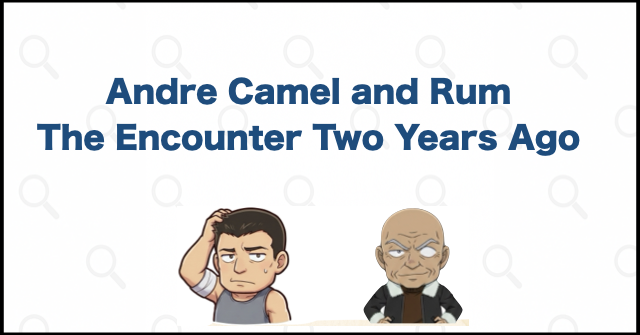
In short, Camel and Rum crossed paths two years earlier, when Camel spoke to an elderly figure who was actually Rum. That moment explains why an old FBI failure remains dangerous in the present.

At the time, Shuichi Akai had infiltrated the Black Organization under the code name Rye. The FBI was waiting to capture Gin, but an elderly person appeared near the operation. Camel, intending to protect a civilian from danger, called out a warning.

The warning was compassionate in ordinary terms, but disastrous in an undercover operation. The person was not an uninvolved bystander, and Camel’s intervention alerted the Black Organization to the FBI’s presence. Suspicion then fell on Akai’s position inside the organization.

The later revelation that this elderly figure was Rum changes how the flashback reads. It is not merely the story of Camel making a painful mistake. It becomes a direct link between the failed infiltration and the central conflict surrounding the Black Organization’s second-in-command.

Camel’s Warning Ruined the Plan to Capture Gin

Camel’s warning became the event that compromised the FBI’s plan to capture Gin. The tragedy is that he did not act with malice or carelessness toward another person’s safety.

The FBI was lying in wait at a warehouse when the elderly figure appeared. Camel told the person that the area was dangerous. In almost any normal situation, that would have been a decent and responsible thing to do. Here, however, the warning revealed that something was happening at the site.

That contrast gives the scene its bitterness. Camel was not wrong as a person, yet his decision compromised the operation. The Black Organization recognized the ambush, and Akai’s infiltration could no longer continue as planned.

The consequences extended far beyond the warehouse, affecting Akai’s position and forming part of the chain of events surrounding Akemi Miyano. Camel’s mistake contributed to those outcomes, but it did not necessarily determine every later event by itself.

The Elderly Figure Was Rum

The elderly figure Camel warned was Rum, the second-in-command of the Black Organization. This is the central answer behind Camel’s connection to Rum.

Rum occupied a position close to the organization’s leadership and was present during an operation involving Akai’s loyalty. That makes the failed ambush more dangerous than Camel could have understood at the time: Gin was not the only major organization figure involved.

The story later identifies Rum as Kanenori Wakita. From the reader’s perspective, the chain is therefore clear: the elderly figure was Rum, and Rum is Wakita. Camel and the other characters do not necessarily possess every part of that chain at the same moment.

Keeping those viewpoints separate is essential. Readers can understand the disguise and identity while Camel is still responding to fragments of memory. The revelation transforms what first looked like an isolated failure into a threat that remains active in the Rum storyline.

Rum Ordered Korn to Shoot and Kill Camel

Rum ordered Korn to shoot and kill Camel after Camel’s warning exposed the FBI ambush and revealed Akai as an FBI agent. Korn’s later recollection of Camel’s face preserves the connection to that order.

From the organization’s viewpoint, Camel was an FBI agent connected to Akai’s exposed infiltration. He was therefore more than a random investigator who happened to appear at one scene. His face could connect the past ambush, the FBI, and the organization members who remembered that failure.

This is what gives Camel an unusually important role. He is not the lead detective, yet his history intersects with Akai, Gin, Rum, Korn, and the FBI. His continued presence keeps a two-year-old failure relevant.

If Rum learns that Camel survived a later operation, Camel could become both a target and a path toward the FBI’s other secrets. That broader danger is a reasonable possibility, not a confirmed account of everything Rum already knows.

Camel and Rum’s Connection Returns in the Black Organization Scheme

Camel and Rum's Connection Returns in the Black Organization Scheme

Volume 100 brings the old encounter, Korn’s memory, Camel’s staged death, and new clues about Rum into the same conflict. The anime correspondence includes The Black Organization’s Scheme (Hunt), Episode 1135 (Japanese episode 1077), and The Black Organization’s Scheme (Identity), Episode 1137 (Japanese episode 1079).

During this conflict, Black Organization members hunt FBI agents and corner Camel. Escaping is not enough: he must also make the organization believe that he died. As long as the deception holds, the FBI preserves an important layer of protection around its other operations.

If Camel’s survival becomes known, Rum may question more than Camel’s escape. Suspicion could spread toward Akai’s supposed death and Kir’s allegiance, although there is no indication that Rum has already reached either conclusion.

Camel also returns with information related to Rum. He is simultaneously the person being hunted and a carrier of clues that may help Conan’s side understand the enemy.

Why Exposure of Camel’s Staged Death Would Be Dangerous

If Rum discovers that Camel’s death was staged, the danger could spread from Camel himself to the credibility of the FBI’s other deceptions.

Camel appears to die during the Volume 100 conflict, and the organization is meant to accept that result. While it does, Camel cannot easily be used to trace the FBI’s continuing activity. His apparent death therefore functions as more than a way to escape one attack.

Once that deception fails, Rum could ask whether other apparent deaths or loyalties were also staged. That might place new pressure on the story surrounding Shuichi Akai at Raiha Pass and on Kir’s position inside the Black Organization.

This is a potential chain of suspicion, not a confirmed conclusion Rum has already drawn. The risk remains serious precisely because Camel’s survival could invite further investigation.

Camel Heard the Clue About Rum’s Absurd Name

Camel heard that Rum had changed his face and was using an absurd name, giving Conan’s side an important clue. The point is paraphrased rather than presented as exact English dialogue.

The story identifies Rum as Kanenori Wakita. Wakita’s name is connected to a rearrangement based on the idea that time is money. Camel does not personally solve that wordplay, but he carries a piece of information that can be combined with other clues.

That role suits Camel. He does not need to deliver a grand deduction to affect the central mystery. By surviving and reporting what he heard, he helps move the investigation toward Rum’s identity.

Camel is therefore both a target of Rum and a source of information that threatens Rum. The two sides of that position make every later encounter more dangerous.

Camel and Rum Meet Again in the Volume 108 Era

Camel and Rum Meet Again in the Volume 108 Era

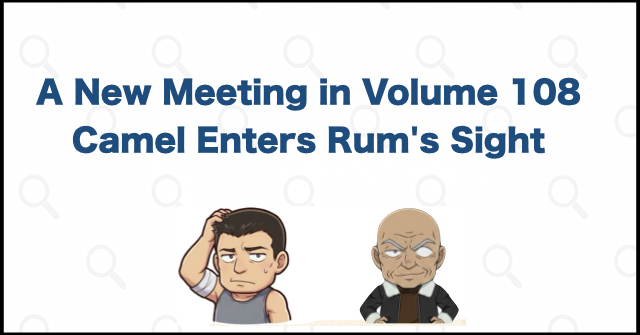
In the manga material associated with Volume 108, Camel encounters Kanenori Wakita, who is Rum, bringing the two-year-old meeting back into the present.

Camel now has shorter hair, so his appearance does not provide an immediate and simple match to the FBI agent from the earlier operation. Even so, familiar language and circumstances begin to activate the old memory.

The tension comes from the gap between what readers know and what each character can recognize in the scene. Readers know that Wakita is Rum. Camel has memories of the elderly figure, while Rum has reasons to examine the man in front of him.

Recognition develops on both sides, but the precise moment when each separate fact becomes certain is unclear. The safest reading is that the encounter brings their memories dangerously close to alignment.

A Familiar Warning Connects the Memory from Two Years Ago

A warning conveying danger becomes the trigger connecting the present encounter to Camel’s words two years earlier. Its significance lies in how the phrase revives that earlier memory.

Two years ago, Camel warned the elderly figure away from danger. In the later encounter, a similar, characteristically considerate expression catches Rum’s attention. An ordinary phrase becomes evidence because it reflects the same habit of speech and the same instinct to warn another person.

The payoff works without a conspicuous object or a newly discovered document. Camel’s personality itself supplies the bridge between the two scenes. His kindness contributed to the old failure, and the same quality now risks exposing him.

The phrase acts as a decisive memory trigger, while what Rum recognizes at that instant remains separate from his knowledge of Camel’s full situation.

Rum Moves to Abduct Camel

The later conflict presents Rum as attempting to abduct Camel rather than simply dispose of him. That raises the danger from an attack on one FBI agent to a threat against the information Camel may possess.

Camel was supposed to have died during the earlier Black Organization operation. If he is alive, Rum has obvious questions: how did he survive, and who helped him? The answers could expose FBI methods and reopen questions about other deceptions.

It would be reasonable for Rum to investigate Akai and the FBI through Camel, but his complete motive and any interrogation plan remain unconfirmed. The shown abduction attempt is distinct from predictions about every secret Rum might hope to obtain.

Even with that limitation, capture would be catastrophic for the FBI. The danger lies not only in whether Camel would talk, but in the access and leverage the Black Organization could gain by holding him.

The Latest Manga Expands the Crisis Around Camel and Rum

The Latest Manga Expands the Crisis Around Camel and Rum

The later manga material broadens Camel’s crisis to include Rumi Wakasa, Shuichi Akai, and Conan’s side of the conflict. What begins as Rum hunting one FBI agent becomes part of the larger struggle surrounding Rum.

Camel becomes constrained by the immediate case while Rum looks for an opening. The pressure of being treated as a suspect overlaps with the far greater danger posed by the Black Organization’s second-in-command.

Rumi Wakasa’s involvement prevents the situation from remaining entirely under Rum’s control. Her presence evokes the history surrounding Koji Haneda and Asaka, adding an older conflict to Camel’s present danger.

Camel is not the story’s central detective, but his survival, memory, and testimony make him a key route through the scene. His importance comes from the information connecting several conflicts, not from a claim that he alone resolves Rum’s identity.

Camel Becomes a Suspect Under Rum’s Watch

When Camel is placed among the suspects in the immediate case, he cannot move freely while Rum is watching for an opportunity.

As an FBI agent, Camel would normally want to contact allies and act quickly. Being under suspicion limits those choices, delays outside help, and makes leaving the area more difficult. The ordinary case therefore becomes a trap inside the larger Black Organization conflict.

Solving the local mystery may clear Camel of suspicion, but it does not automatically remove Rum. The moment that should bring relief could instead expose Camel to the person waiting beyond the case itself.

For Camel, being unable to leave may be more dangerous than the accusation itself. The overlapping threats give the sequence a very different tension from a self-contained mystery.

Rumi Wakasa’s Intervention Puts Pressure on Rum

Rumi Wakasa’s intervention shifts some pressure back onto Rum and connects Camel’s danger to the Koji Haneda case and Asaka.

Wakasa has a deep connection to Rum. Her arrival means that Rum cannot focus only on taking Camel. The hunter is forced to account for another person who has her own history with him.

This does not mean every detail of Wakasa’s identity, knowledge, or plan should be treated as interchangeable. An interpretation equating Wakasa with Asaka remains separate from the confirmed character names and does not by itself settle her full identity.

For that reason, the article can state that the conflicts converge while remaining cautious about what each participant has conclusively recognized. Camel provides the route by which a present pursuit opens onto a much older mystery.

Conan’s Side Moves Closer to Wakita as Rum

Camel’s memories and reports give Conan’s side additional pieces linking the elderly figure, the absurd-name clue, and Kanenori Wakita.

Camel encountered the disguised figure two years earlier and later heard information about Rum’s changed face and assumed name. Meeting Wakita brings those once-separate pieces into the same line of inquiry.

Camel does not have to solve the identity himself for his evidence to matter. By surviving and returning with information, he allows Conan and Akai to compare his memories with what they already know.

Ai Haibara’s reaction and growing caution around Wakita support the sense that suspicion is tightening, but they do not prove that every character has reached the same final conclusion at the same time.

Why Exposure of Camel’s Survival Could Endanger Shuichi Akai and Kir

Why Exposure of Camel's Survival Could Endanger Shuichi Akai and Kir

If Rum learns that Camel survived, the discovery could endanger not only Camel but also the deceptions protecting Shuichi Akai and Kir. The word “could” matters: this is a risk, not a completed chain of discovery.

Akai appeared to die at Raiha Pass but is alive under the identity Subaru Okiya. Kir, also known as Rena Mizunashi, is a CIA operative inside the Black Organization. Both positions depend on the organization accepting a carefully maintained version of events.

If Camel’s staged death is exposed, Rum may wonder whether the FBI used comparable deception elsewhere. That question could lead toward Akai’s supposed death or toward renewed scrutiny of Kir. It does not automatically reveal either secret.

Rum’s effort to capture Camel can therefore be read as a threat to the wider intelligence struggle. Camel’s value lies in the people, operations, and memories to which he may provide access.

The connection between Camel and Rum began with a well-intentioned warning and developed into an information war. Camel now has to protect more than his own life, even though the exact consequences of his capture remain unresolved.

Summary

Camel and Rum first crossed paths two years earlier, when Camel warned an elderly figure who was actually Rum and inadvertently compromised the FBI ambush.

Volume 100 returns that mistake to the main conflict. Camel stages his death while carrying information about Rum, including the clue that Rum changed his face and adopted an absurd name. His survival protects the FBI only while the Black Organization continues to believe the deception.

In the Volume 108 era, Camel meets Wakita and a familiar warning connects the encounter to the past. Rum’s attempt to abduct him makes the threat about information as well as survival, while Rumi Wakasa’s intervention widens the conflict.

Camel’s exposure could raise questions about Akai and Kir, but those secrets have not been shown to be uncovered. That uncertainty is precisely why Camel remains so important: a supporting FBI agent has become one of the most sensitive links in the Rum storyline.

Let's share this post !

Author of this article

Comments

To comment

CAPTCHA

TOC