Spoilers for Kenji Hagiwara and the police academy group, the bombing case, manga material through Volume 108, and the films discussed below.
Kenji Hagiwara was a bomb-disposal officer, Jinpei Matsuda’s childhood friend, and Chihaya Hagiwara’s younger brother. He died in a bombing seven years before the main story’s present. His warmth, mechanical skill, and relationships continue to shape the people who survived him.
His death explains Matsuda’s pursuit of the bomber, but it is only one part of his character. The police academy story shows a sociable young man who can read people well, worries about his future, and chooses a dangerous career despite those doubts.
His job, family, and police academy friends
Hagiwara served in the Tokyo Metropolitan Police Department’s bomb-disposal unit. Matsuda followed the same professional path. At the academy, their close circle also included Rei Furuya, Hiromitsu Morofushi, and Wataru Date. In the Japanese anime, Hagiwara is voiced by Shin-ichiro Miki.
His older sister Chihaya is a motorcycle officer with the Kanagawa Prefectural Police. Their skill with vehicles has a family background: they grew up around an automobile repair shop. For Kenji, familiarity with mechanisms becomes both an approachable hobby and a foundation for technical work.
The person who keeps a difficult group talking
Hagiwara is comfortable joining a conversation and adjusting to the person in front of him. That helps connect an academy group whose members can be competitive, blunt, forceful, or guarded. He understands Matsuda’s intentions beneath the abrasive delivery and can soften a confrontation without dismissing his friend.
His sociability is not just comic relief or a way of charming people. He notices what someone is trying to protect. When Date kneels during a dangerous incident, Hagiwara reads the action as a determination to keep others from being hurt rather than simple pleading for his own life.
That reading is revealing because it describes the values Hagiwara himself admires. His easy tone can carry a serious understanding of police work.
Cars, the repair shop, and choosing bomb disposal
Hagiwara and Matsuda spent time around the Hagiwara family’s repair shop as children. Their interest in taking machines apart and understanding them precedes their police careers. The academy story also uses the RX-7 to show Hagiwara’s enthusiasm and driving ability.
He does not immediately accept the invitation to join bomb disposal. The closure of the family business has made him wary of assuming that a promising path will stay safe. He describes that hesitation through a driving metaphor: when everything seems to be going well, an inner brake warns him about what might follow.
He eventually chooses to press forward. The decision matters because he has doubts, not because danger never occurs to him. Matsuda’s presence may encourage him, but the choice remains Hagiwara’s. Knowing his later fate makes that ordinary career decision particularly painful to revisit.
How did Kenji Hagiwara die?
Hagiwara died when a bomb in an apartment building exploded during a disposal operation. In the manga’s chronology, his death anniversary is November 7, seven years before the present-day bombing case.
Two bombs had been placed. Matsuda’s side dealt with one, while the timer on Hagiwara’s device appeared to have stopped. News that one of the perpetrators had died in an accident contributed to the impression that the immediate danger had passed.
The timer then restarted, leaving too little time to dismantle the bomb or escape. Hagiwara told the people around him to evacuate, but he did not get clear before the explosion.
Why the scene is so unsettling
Hagiwara is not wearing his protective suit during the apparent lull. His relaxed phone conversation with Matsuda makes the situation seem briefly manageable. The restarting timer abruptly removes that sense of safety.
The important causal point is the returning threat and the lack of time. His clothing is part of the scene, but the story does not establish that a protective suit would have guaranteed survival. His final action is to warn those nearby.
The contrast with his usual manner makes the loss sharper: the man who lightens a room is suddenly the person trying to get everyone out of it. His technical confidence and humanity are both present, even though neither can give him the time he needs.
Seven years of consequences
Four years after Hagiwara’s death, the same bomber causes Matsuda’s death. Three years after that, Conan, Wataru Takagi, and Miwako Sato confront the renewed bombing threat and bring the culprit to justice.
This sequence is easy to confuse: Hagiwara dies seven years before the present; Matsuda dies four years later, three years before the present. Conan’s involvement brings resolution to a case that began long before he entered it.
Hagiwara is the first of the five academy friends to die. Morofushi and Date also die, leaving Furuya as the group’s survivor. The central contrast is between the five young men together and the memories carried by the one who remains.
Hagiwara and Matsuda: friendship before and after the loss
Their bond begins in childhood, continues through the academy, and leads them into the same specialist unit. Their temperaments differ: Hagiwara is approachable and tactful, while Matsuda is blunt and easily misunderstood. Shared mechanical interests give them common ground, but familiarity with each other’s character gives the friendship its depth.
During the final phone call, Hagiwara jokes that Matsuda should avenge him if something happens. That casual remark is not proof that he seriously intended to impose a lifelong demand for revenge. His death changes the weight of the words for the friend left listening.
What Matsuda carries into the next bombing case
Matsuda keeps pursuing the bomber and moves into the investigation division in connection with that pursuit. Four years after Hagiwara’s death, he faces a bomb on a Ferris wheel. To learn the location of another bomb and save more people, he remains until the crucial information is revealed and sends it to Sato.
He dies while choosing other people’s lives over his own chance to escape. The case therefore cannot be reduced to revenge. Hagiwara’s warning to his colleagues and Matsuda’s final message both show officers trying to protect others under impossible time pressure.
The connection continues through Sato and eventually Conan. Hagiwara’s last conversation affects Matsuda; Matsuda’s actions leave Sato information and grief; the present case forces those memories into another urgent decision.
Chihaya Hagiwara: the family side of his story
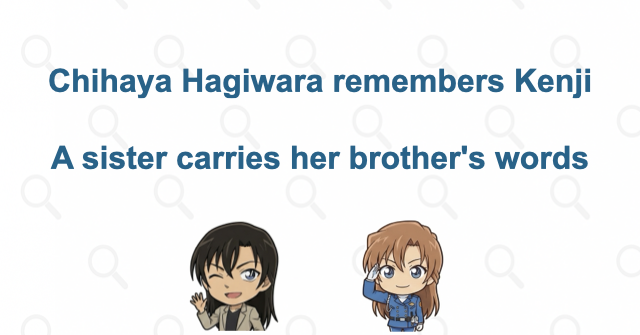
Chihaya knew both her brother and his childhood friend. As a highly skilled motorcycle officer, she carries the family’s affinity for vehicles into her own police work. Her memories reveal Kenji as a younger brother, not only Matsuda’s partner.
When she loses confidence, Kenji’s encouragement rests on his belief that she can continue. He does not simply solve everything for her. His light manner makes it easier for her to take another step herself, and those remembered words retain their force after his death.
Why she trusts Conan
Conan helps end the bombing case that killed Kenji and Matsuda. Chihaya’s gratitude is therefore connected to a concrete action rather than an unexplained fondness for an unusually capable child.
Her present-day reactions also show how both men remain connected in her memory. Matsuda belongs to the history she shared with her brother. Remembering the two together adds a family perspective to a friendship usually seen through the men themselves.
The episodes that explain his character
The bombing case provides the essential chronology. The academy material then fills in the life that chronology cannot convey: the repair shop, his doubts about his career, his ability to read his friends, and the ordinary pleasure of their company.
The Trembling Police Headquarters: 12 Million Hostages
The case in Volumes 36-37 is adapted as international Episodes 326-329 (Japanese episode 304). It links Hagiwara’s death, Matsuda’s death four years later, and the present-day investigation three years after that.
Hagiwara’s screen time is brief, but the final call and Matsuda’s memories give it lasting significance. This is the key story for understanding the bomber’s impact on the group. The expanded depiction of Hagiwara’s final moments should be read with the anime adaptation in mind rather than assumed to have identical detail in every version.
Police Academy Arc Wild Police Story CASE. Kenji Hagiwara
International episode 1099 (Japanese episode 1042) focuses on Hagiwara while he is alive. It explores the family repair shop, his knowledge of cars, recruitment into bomb disposal, and his reluctance to trust a path that appears too promising.
It also makes the five friends feel like people sharing a stage of life, not merely names in a tragic backstory. The jokes and uncertainty make their later losses more affecting because there was a future they were still deciding how to build.
Later recollections through friends and family
Kid vs. Komei: The Targeted Lips, international Episodes 1040-1041 (Japanese episodes 983-984), connects material about Morofushi and the academy group with the main series.
Chihaya Hagiwara, Goddess of the Wind, international Episodes 1156-1157 (Japanese episodes 1098-1099), introduces Chihaya and gives her memories of Kenji and Matsuda a place in her present story. Chihaya and Jugo’s Matchmaking Party, international Episodes 1173-1174 (Japanese episodes 1115-1116), continues that connection through her current life.
What Volumes 107-108 add
Volume 107 reveals that the young Shinichi Kudo and Ran Mouri encountered the five academy friends. This adds a direct childhood meeting to the later connection created by Conan solving the bombing case.
Neither side knows what those relationships will mean in the future. The encounter gains significance retrospectively: a child they met goes on to help resolve the case that took two of their lives.
In Volume 108, Chihaya’s recollections again bring Kenji and Matsuda together. These scenes expand what the living characters remember; they do not reverse either man’s death. The additional perspective explains more of Chihaya’s feelings and decisions.
How the films use Hagiwara’s legacy
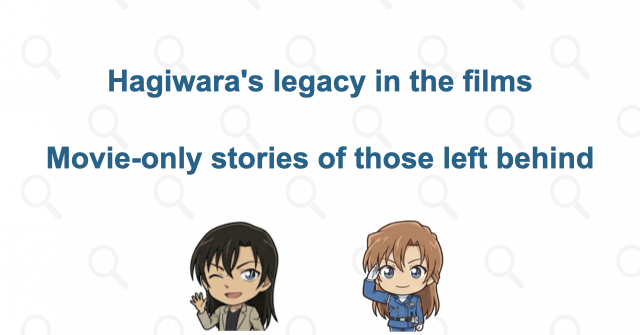
The Bride of Halloween connects the academy friends’ past with a present-day case. In this separate movie story, memories and practical knowledge continue to help Furuya and Conan after the four friends are gone. Hagiwara’s interest in vehicles and machinery belongs to a life whose influence extends beyond a character profile.
Fallen Angel of the Highway places Chihaya at the center of its story and brings Kenji and Matsuda into the memories surrounding her. Their movie appearances do not mean that they have returned to life. The film explores how what they left behind can still shape her actions.
These movie-only plots should remain separate from the manga’s precise sequence of events. Their emotional connection is clear: Hagiwara’s story continues through people who remember his warmth, his judgment, and the encouragement he gave them.
His death is the beginning of a long chain of loss and resolution. His life explains why the people in that chain care so deeply.

Comments