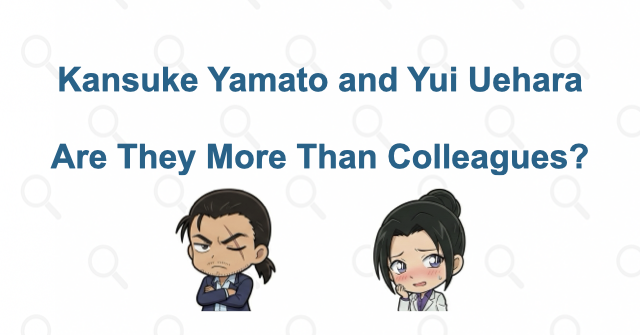
Spoilers: This article discusses Kansuke Yamato and Yui Uehara’s history through manga Volume 107, including a death in their backstory, and major relationship scenes in the 2025 film One-eyed Flashback.
Kansuke Yamato and Yui Uehara are not confirmed to be dating, engaged, or married in the stories covered here. Yui’s feelings are clear. Kansuke’s behavior strongly suggests that he returns them, but he has not explicitly confessed his love. The film brings them closer without establishing a relationship, and its scenes should be kept separate from developments in the manga.
Their appeal lies in that gap. They can argue with the ease of a married couple, yet the missing words matter: these are two people whose shared childhood was interrupted by disappearance, bereavement, and a return to police work. The question is less whether they care about each other than how far the story lets us name that care.
Where their relationship stands
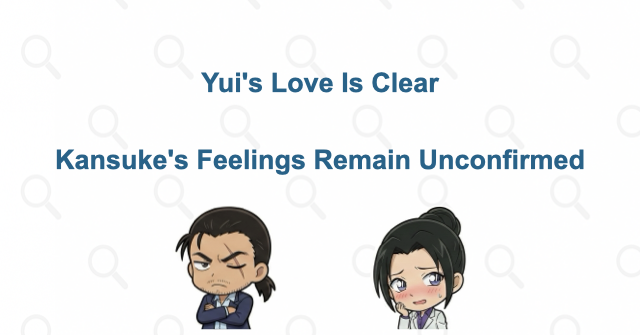
Kansuke is a 35-year-old inspector in the Nagano Prefectural Police; Yui is a 29-year-old detective and his subordinate. Their six-year age difference and workplace hierarchy do not explain their entire relationship. They knew each other long before either became a police officer.
Yui still sometimes calls him Kan-chan, a childhood nickname that slips through the formality of police work. She also argues back when she disagrees with him. Kansuke trusts her judgment and ability, so their partnership is not simply a stern superior protecting a helpless subordinate.
Yui loves Kansuke; Kansuke’s romantic feelings remain strongly implied rather than explicitly confirmed. His encouragement when she returns to work, his response to her marriage history, and his concern for her safety make a romantic reading persuasive. Longstanding friendship and professional responsibility are still relevant alternative explanations for individual acts.
From childhood friends to a painful reunion
A shared childhood and a shared model of police work
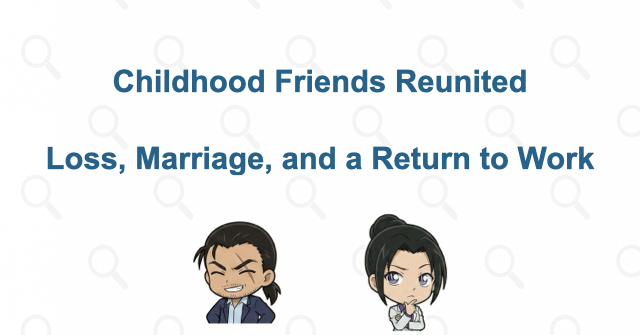
Yui, Kansuke, and Takaaki Morofushi grew up in the same area. When Yui was in her first year of elementary school, Kansuke and Takaaki were in their sixth year. To the younger Yui, the boys were older figures she could look up to rather than classmates of her own age.
They admired a local police officer, Kai. His example forms part of the background to Kansuke and Yui choosing police work themselves. Their connection therefore includes a shared ambition as well as childhood affection: the girl who once looked up to Kansuke eventually stands beside him at a crime scene.
Kai’s death, the avalanche, and Yui’s marriage
Kansuke investigated the circumstances of Kai’s death. During that investigation he was caught in an avalanche, seriously injured, and missing for a prolonged period. Yui believed he had died before she could tell him how she felt.
During his absence, Yui married into the Torada family. At her introduction she uses the name Yui Torada, having married a man from that family. Finding the truth about Kai’s death was an important reason for entering that family, while believing Kansuke would not return also shaped her decision.
An investigative motive does not establish that Yui had no affection for her husband. Her feelings for Kansuke and the purpose behind her marriage are known parts of the story; reducing the marriage to a wholly loveless deception would go beyond them.
Her husband dies in the Furinkazan case. Yui is therefore a widow, not a divorcee. The distinction matters when later dialogue uses language associated with having a failed marriage: the actual event was her husband’s death.
There is no simple romantic reset when Kansuke returns. Yui has lived through the belief that one important person was gone and then the death of another. The relief of seeing Kansuke alive cannot erase the time when she built a different life.
Furinkazan restores a place for Yui
Their introduction comes in Volume 59. Kansuke investigates as a Nagano detective while Yui appears as a member of the Torada household. Kai’s death, Kansuke’s disappearance, and Yui’s marriage become connected within the case, giving their reunion a weight beyond the usual childhood-friends romance.
After the case is solved, Kansuke urges Yui to return to the police when she has had time to recover. He does not demand an immediate decision or rebuke her for marrying someone else. Instead, he makes it clear that she has somewhere to go.
His remark about the others waiting for her bad coffee turns that invitation into familiar teasing. The kindness is in the ordinary tone: she can come back as herself, without having to perform gratitude or pretend the intervening period did not happen.
Yui returns to detective work and resumes using Uehara, her maiden name. Before there can be any romantic resolution, the story gives her a profession and a place alongside Kansuke again. That practical act of care is one of the warmest parts of their relationship.
Why Yui’s feelings are clear
Her advice to Ran Mouri and Kazuha Toyama comes from regret
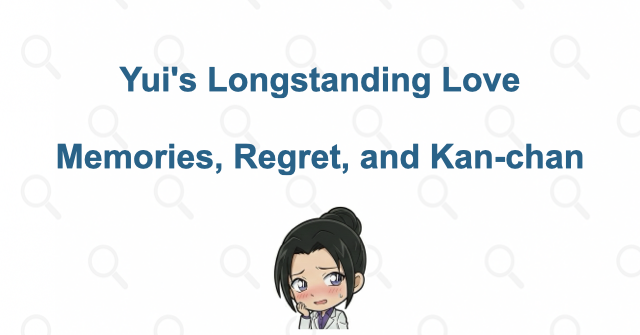
Yui’s advice to Ran and Kazuha is about acting while one’s feelings can still be expressed. She warns that someone can disappear before a confession is made, leaving no chance to undo the delay. Her own belief that Kansuke had died gives the advice its force.
This is more than an older woman encouraging two teenagers to be brave. She knows what it means to think the opportunity has vanished forever. Kansuke’s survival does not cancel that experience, which is why Yui finally speaking to him in the film feels like an answer to her earlier advice.
A nickname can reveal more than formal conversation
Yui’s use of Kan-chan preserves their childhood closeness. By contrast, when Kansuke addresses her as another man’s wife rather than calling her by name, she feels the distance between them. She misses being spoken to as the person he has known all his life.
By this reunion, Yui is already widowed, but his formal address recalls her marriage and the distance she feels between them. She is not merely asking a colleague to be less formal. The contrast between the detective who can argue with him fearlessly and the woman hurt by a change in address makes this small exchange particularly poignant.
Volume 107 gives that affection a childhood setting
Volume 107, Files 1137-1140, returns to the elementary-school years of Yui, Kansuke, and Takaaki. The memories include a sports day, with Yui in first grade and the boys in sixth grade.
As Yui recalls those events, Ai Haibara and Ayumi Yoshida recognize the romantic connection to Kansuke. The scene ties her present feelings to a very early memory, rather than portraying the attraction as something that suddenly began in adulthood.
The precise instant when Yui fell in love is not established. The memory supports a long history of affection without requiring a single definitive starting point. Knowing what later happens to her makes the childhood scene both sweet and painful: the person whose back she once followed is now the colleague at her side.
What Kansuke’s actions suggest, and what they do not prove
He refuses to treat her past as a mark against her
The closing conversation in the case spanning Volumes 86-87 is especially revealing. Yui worries about Kansuke, becomes irritated by his response, and brings up her marriage history as though it makes her concern unwelcome.
She uses the Japanese expression batsuichi, normally associated with divorce. Kansuke answers by connecting the idea of a cross or mark with the large scar on his own face. His point is that she need not be troubled by her past any more than he should be defined by his injury.
Yui’s wording should not be mistaken for a change in her biography: her husband died. Kansuke’s reply may suggest romantic acceptance, but it is not a confession. What it plainly offers is reassurance that her history does not disqualify her from being close to him.
The awkwardness makes the exchange work. He cannot suddenly become a smooth romantic speaker, so concern comes out through a joke about his own face. His embarrassed reaction lends itself to a romantic reading, while the actual words leave that interpretation unconfirmed.
Familiarity and professional trust create the married-couple impression
Yui is willing to challenge Kansuke, and he relies on her reasoning and initiative. Their arguments can look sharp from outside, but neither seems to regard ordinary disagreement as a threat to the relationship.
That combination explains the impression of a long-married couple. They have shared habits, an understanding of each other’s temper, and confidence in how the other will act under pressure. The comfort is visible without a stream of sweet declarations.
What the 2025 film adds
The following scenes belong to the movie One-eyed Flashback. They deepen the romantic reading of Kansuke and Yui, but movie-only developments do not by themselves establish that the manga couple has begun dating.
Her marriage brings an old wound back into the conversation
In this movie-only scene, Kansuke brings up Yui’s marriage during his disappearance, and she reacts angrily. From his side, she chose another life while he was missing. From hers, she thought he was dead and was trying to carry on while pursuing the truth about Kai.
Jealousy may be part of Kansuke’s reaction, but he does not identify it as such. Hurt, awkwardness, and unresolved feelings about the lost time are also possible elements. The scene matters because two people who usually work so well together cannot discuss this part of their history comfortably.
It would be unfair to turn his hurt into an accusation that Yui should somehow have known he was alive. The bitterness comes from what neither could control, and from the way that absence changed both their lives.
Calling her Yui, then trusting each other with their lives
In a movie-only rescue scene, Kansuke calls Yui by her first name as she is in danger. She leaps toward him, trusting him to catch her, and he risks his life to receive her.
The change in address carries the emotional weight. A name restores the childhood closeness that formal titles and surnames can conceal. It appears to expose his feelings at a moment when there is no time to choose guarded words.
The action also belongs to both of them. Yui commits to the jump, and Kansuke commits to catching her. Her trust and judgment are as important as his physical rescue, which is why the scene feels like the culmination of a partnership rather than a one-sided act of protection.
Yui finally says he is more than a colleague
At the end of the movie, Yui refers to how she felt when she heard Kansuke might have died and tells him that he is more than an ordinary colleague to her. It is close to a confession, though the movie does not show an agreed romantic relationship.
The echo of her advice to Ran and Kazuha makes the scene moving. Once she could only warn others about leaving feelings unspoken. Here she can finally direct that lesson toward the person she feared losing.
Kansuke asks her to repeat what she said; the film does not give him an explicit romantic answer or a proposal to start dating. Yui’s feelings may have reached him, but exactly how he understands and will respond to them remains open.
Where to follow their story
Volume 59: the reunion and Yui’s return
Read the Furinkazan case for their first appearances, Yui’s marriage, Kansuke’s disappearance, and the invitation back to police work. Its anime adaptation is Furinkazan – The Mysterious Armored Warrior (1 Hour Special), Episodes 564-565 (Japanese episode 516), followed by Furinkazan – Shadow and Lightning Conclusion, Episode 566 (Japanese episode 517).
Volumes 86-87: accepting Yui’s history
The exchange about Yui’s marriage and Kansuke’s scar occurs in the case adapted as The Darkness of the Prefectural Police (Part 1) through The Darkness of the Prefectural Police (Part 3), Episodes 865-867 (Japanese episodes 810-812). The manga case spans Files 913-917.
Volume 102: the partnership at work
Files 1082-1084 become The Body on the Gunma-Nagano Border (Part 1) and The Body on the Gunma-Nagano Border (Part 2), Episodes 1181-1182 (Japanese episodes 1123-1124). Kansuke, Yui, and Takaaki work with Gunma inspector Misao Yamamura.
The attraction here is their ordinary investigative rhythm. There is no major romantic breakthrough, but their confidence in each other’s abilities shows why the relationship already feels settled in some respects. This is a useful later example of their teamwork.
Volume 107: childhood memories change the present
Files 1137-1140, the fourth through seventh chapters within Volume 107, revisit the school sports-day memories. They supply background for Yui’s longstanding affection rather than bringing the adults into an official relationship.
Mutual affection is a strong reading; a relationship still needs an answer
Yui’s love is clear, and Kansuke’s mixture of trust, reassurance, and protective action strongly suggests that it may be returned. Their childhood connection, her widowhood, and their work together explain why they can feel so much closer than the label of colleagues implies.
The movie lets Yui say more directly what has long been visible. It leaves Kansuke’s answer unresolved, and the stories covered here do not establish dating or marriage. That final distinction preserves the tension that makes them compelling: two people can already understand each other deeply and still have something essential left to say.
Further reading (contains spoilers): Kansuke Yamato's left-eye injury and Takaaki and Hiromitsu Morofushi's brotherhood.

Comments