Spoiler warning: Shizuka Hattori’s debut mystery, her family connection revealed in Volume 106, and separate movie-only events in The Crimson Love Letter are discussed below.
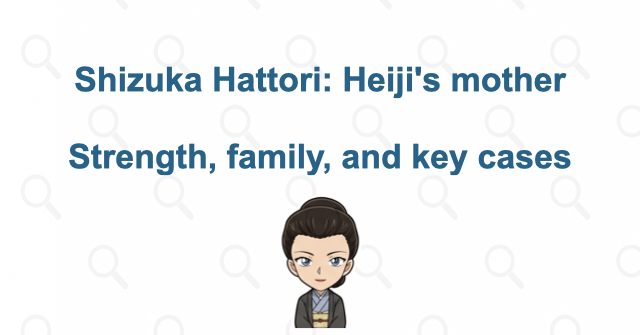
Shizuka Hattori is Heiji Hattori’s mother and Heizo Hattori’s wife: a formidable swordswoman whose quiet manner conceals both strength and fierce concern for other people. She is 42, her maiden name is Shizuka Ikenami, and her Japanese voice actor is Masako Katsuki. The Crimson Love Letter also gives her a separate movie role as a former competitive karuta Queen and Kazuha Toyama’s instructor.
Her appearances are relatively few, but they do different things: introduce an unnerving client, reveal a mother secretly collecting memories of her son, and show someone who will protect even a culprit’s life. The contrast makes her far more than background to Heiji’s family.
Shizuka’s place in the Hattori family
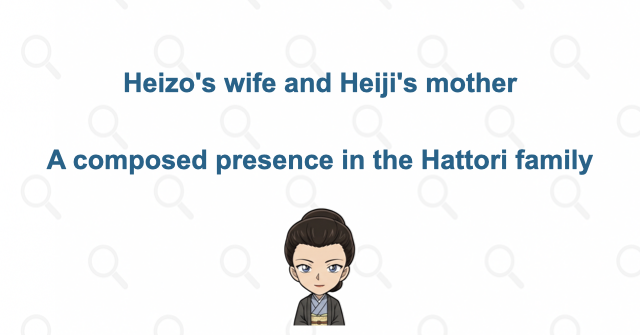
Heizo Hattori is the head of the Osaka Prefectural Police. His police position does not belong to Shizuka by association: she has no established police affiliation or rank of her own. Heiji is their son.
Her composed appearance in traditional clothing can make her seem reserved, but that impression changes when someone’s life is in danger. She does not need to advertise her ability in every conversation; a sudden intervention can reveal how much strength was there all along.
Heizo and Heiji are both associated with deduction and kendo, yet Shizuka makes it clear that the family’s formidable abilities are not confined to father and son. Reading Heiji’s strengths as an echo of both parents is part of the pleasure of getting to know her.
How strong is Shizuka at kendo?
Shizuka was the runner-up in a kendo tournament during junior high school. Her specific dan rank is not established, so her tournament achievement should not be turned into a named qualification the story has never supplied.
The memorable demonstration comes in her debut case, when she stops a sword with her folding fan. She does so without losing her composure and brings the armed culprit under control. The calm client suddenly commanding that dangerous moment is a startling reversal.
The meaning of the action matters as much as the feat itself. At the end of the case, the culprit tries to take their own life, and Shizuka intervenes. She uses her skill to prevent another death, rather than simply prove that she is stronger than the person holding the blade.
That is why the moment stays with me: the apparent gentleness and the physical force are not competing versions of her. The strength allows the concern for life to become an action.
A severe speech about protecting life
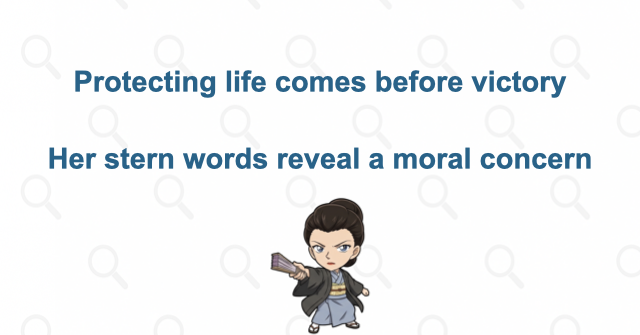
After stopping the culprit, Shizuka rejects the idea that a person may take a life merely because it is their own. Her words are severe, but their immediate purpose is to stop the person in front of her from dying.
For Shizuka, responsibility for a crime and the need to keep the culprit alive are separate issues. The culprit must face what they have done; that does not make their life disposable. Her intervention combines the force of the fan stopping the blade with a refusal to let the case end in another death.
There is a thematic parallel with Shinichi Kudo’s belief that saving someone needs no logical justification, and with Ran Mouri’s insistence that one’s own life is precious too. It is not established that Shinichi or Ran learned those beliefs from Shizuka. They express them in different situations, in their own voices.
The connection is therefore a shared theme, not a chain of influence between the characters. Different people reach the same moral boundary: discovering wrongdoing does not cancel the obligation to save a life. Seeing Shizuka within that pattern gives her outburst more weight than a striking line delivered by an unexpectedly tough mother.
The three main manga cases to read
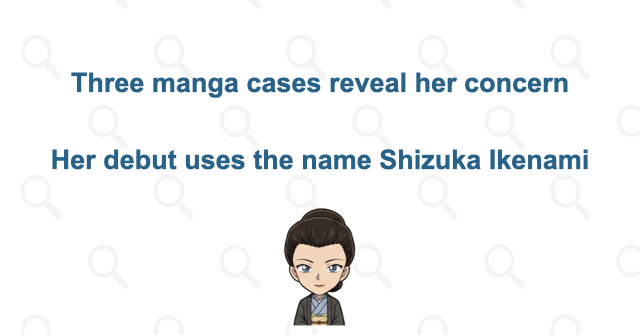
Volume 28: the client hiding her identity
Shizuka first appears in Volume 28, its third through fifth chapters, corresponding to Files 276-278. The anime adaptation is Episodes 239-240 (Japanese episodes 220-221), The Client Full of Lies (Part 1) and The Client Full of Lies (Part 2).
She arrives at the Mouri Detective Agency under her maiden name, Shizuka Ikenami, carrying a photograph from a kendo tournament thirty years earlier. She asks for help finding a person in it, while concealing her connection to Heiji and her real purpose in making the visit.
Conan notices inconsistencies and becomes wary. That suspicion does not mean Shizuka is secretly a villain: it is the effect of a client deliberately withholding important information. When a murder occurs during the visit, however, the uncertainty around her becomes part of the case’s tension.
The sword-and-fan intervention changes the picture again. Heiji’s eventual appearance finally identifies the mysterious woman as his mother. In one short case, the elegant client, the person telling lies, the skilled swordswoman, and Heiji’s mother turn out to be the same person. The reveal makes the earlier impressions fall into place without making any one of them the whole story.
Volumes 31-32: watching Heiji at the kendo tournament
Shizuka’s next major appearance belongs to the Osaka cases across Volumes 31-32. Their anime adaptation is Episodes 282-285 (Japanese episode 263), The Osaka Double Mystery – The Naniwa Swordsman and Toyotomi’s Castle (2 Hour Special).
The kendo portion covers chapters eight through ten of Volume 31; the following case runs from its eleventh chapter through the fourth chapter of Volume 32. Shizuka comes to support Heiji at the Kinki tournament, bringing her own experience as a former tournament runner-up to the role of spectator.
Heiji’s expected contest with Soshi Okita and a murder at the venue pull the story away from a simple sporting event. The wider sequence includes a meal with the Hattori family and the Osaka Castle case, bringing Heizo and Ginshiro Toyama into the same network of relationships.
Shizuka is not the central detective in this story. Her contribution is the natural presence of a knowledgeable mother watching her son pursue something she understands. An appearance can deepen the family without requiring her to deliver the solution herself.
Volumes 50-51: the mother behind the camera
The ski-slope flashback in Volumes 50-51 is adapted as Episodes 536-537 (Japanese episode 490), Heiji Hattori vs. Shinichi Kudo: Deduction Battle on the Ski Slope! (1 Hour Special). It takes place three years earlier, when Heiji and Shinichi are still in junior high school.
Shizuka secretly follows the trip to record video of Heiji growing up. She also encounters Yukiko Kudo at the resort. The woman who can stop a sword is now quietly collecting footage of her son, a delightfully different use of that watchful attention.
When the case develops, she passes information to Heizo and conveys his advice to Heiji. She does not simply hand her son every answer. The parents’ cooperation helps him, while leaving him room to arrive at the truth himself.
That balance is what makes the scene more than a joke about an overenthusiastic mother. Her affection is obvious, but so is her confidence in Heiji. She wants to preserve memories of his growth without taking the growth away from him.
The Crimson Love Letter: a movie-only karuta mentor
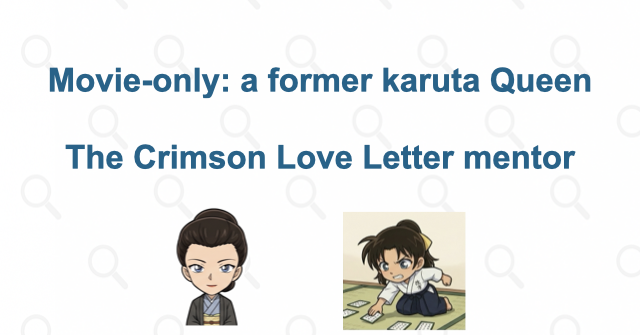
In the movie-only story The Crimson Love Letter, the twenty-first film, Shizuka is a former competitive karuta Queen. Heiji seeks her help when Kazuha prepares to face Momiji Ooka.
Momiji is a high-school champion described as a future Queen. That does not mean she already holds the Queen title. Nor does the film establish a match result between Shizuka and Momiji, so comparing their titles cannot supply a victory the story never shows.
Shizuka gives Kazuha intensive training in a short period. The setup reveals two kinds of trust: Heiji trusts his mother’s skill enough to place someone important to him in her care, and Kazuha accepts demanding instruction in order to take on the challenge herself.
Shizuka’s approach resembles the way she supports Heiji. She provides the technique and the necessary help, but Kazuha still has to do the work and face the competition. The movie-only mentor role complements her manga characterization without becoming evidence that every detail of the film has occurred in the manga.
It is not confirmed that she has formally chosen Kazuha as a future daughter-in-law. What is shown is warmer and more concrete: she gives her time and expertise to someone her son cares about.
How she supports Heizo, Heiji, and Kazuha
Shizuka understands Heizo’s ability to reason through a case. At the ski resort, she supplies observations from the scene, he considers them from elsewhere, and she brings useful advice back to Heiji. They do not have to stand side by side for their cooperation to work.
With Heiji, the same pattern combines attention and restraint. She attends his tournament, films his earlier ski trip, and helps when a case demands it, yet does not constantly interrupt his deductions. Her affection can be exuberant without denying his independence.
Her help for Kazuha in the movie-only karuta story shows a similar willingness to support another person’s effort. Calling that proof of an arranged future marriage would go beyond the scene. Seeing it as practical care for someone close to the family is enough to explain its warmth.
These roles do not require Shizuka to be quiet all the time or forceful all the time. She can step back while someone learns, then act decisively when help becomes necessary. That consistency connects the proud spectator, the secret videographer, and the woman who stops the sword.
Volume 106 reveals an older connection to the Toyamas
Volume 106 introduces Kazuha’s mother, Sakura Toyama, and establishes that Sakura and Shizuka were classmates. Sakura is also 42 and formerly served in an armed-response unit of the Osaka Prefectural Police.
Heizo and Ginshiro Toyama already have a long connection as childhood friends and police colleagues. The mothers’ school connection adds another link between the households. Heiji and Kazuha’s closeness may partly reflect that older family network, rather than a friendship formed entirely in isolation from their parents.
That remains an interpretation of the family background. How often Shizuka and Sakura meet now, and the details of their school relationship, are not established here. Being former classmates does not by itself reveal the intimacy or daily habits of a present-day friendship.
The Volume 106 story is also adapted in the three-part Japanese television case spanning Japanese episodes 1214-1216. The family connection expands the background of the Naniwa Harukas storyline; it does not reveal how close Shizuka and Sakura are in their everyday lives.
The new connection makes earlier scenes of Shizuka helping Kazuha feel richer: the children are surrounded by relationships with histories of their own. Yet Shizuka’s appeal still rests on what she actually does. She can be stern enough to command a dangerous room and tender enough to collect her son’s childhood videos. Her few appearances are memorable because those qualities belong to the same person.

Comments