Spoiler warning: Kazuha and Heiji’s manga relationship through File 1159, family revelations from Volume 106, and separate movie-only plots are discussed below.
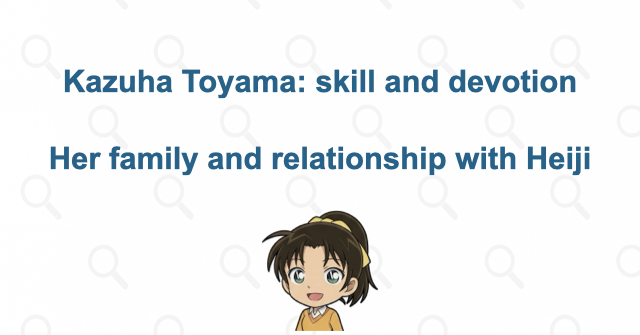
Kazuha Toyama is Heiji Hattori’s childhood friend and, after the confession in Volume 106, his girlfriend. She is a 17-year-old second-year student at Kaiho Academy, holds a second-dan rank in aikido, and is voiced in Japanese by Yuko Miyamura.
Her romance is important, but it is only one part of her character. Kazuha can be jealous and uncertain about Heiji, then act with remarkable courage when someone is in danger. Her friendship with Ran Mouri, her family background, and her willingness to fight give her a place in the story beyond waiting for a confession.
Kazuha’s personality, skills, and family
Warm and outspoken, but less confident in love
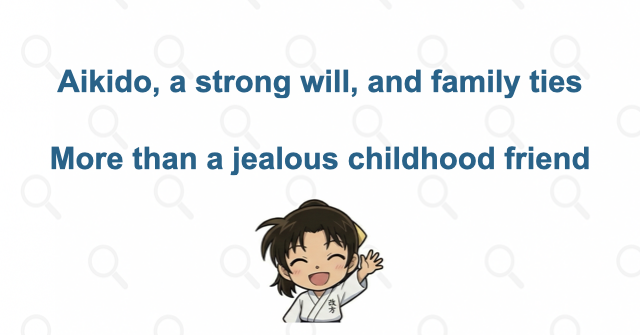
Kazuha attends the same school and year as Heiji. Her lively Kansai speech and concern for the people around her make her approachable, even if jealousy can take over when Heiji seems close to another girl.
That jealousy does not make her incapable of admitting a mistake. When an apparent rival turns out not to be one, she can change her attitude rather than cling to the grievance. Her first meeting with Ran becomes the clearest example.
The contrast is endearing: she can answer Heiji back without hesitation, yet a casual remark from him can shake her confidence about what she means to him. Being forceful in an argument is not the same as feeling secure enough to admit a romantic hope.
Second-dan aikido and the courage to act
Kazuha has a second-dan rank in aikido. When a case turns dangerous, she can throw or restrain an opponent herself. Like Ran with karate, she is not limited to being the person another character must rescue.
The important quality is not only athletic ability. Kazuha can make quick decisions and step forward to protect someone despite being afraid. Her willingness to help Ran and other people gives the strength a purpose.
She also has sharp hearing. Sounds other people may overlook can become useful information, and the separate film stories draw on that ability in karuta and other situations. She need not assemble deductions like Conan or Heiji to contribute something they need.
Ginshiro and Sakura Toyama
Kazuha’s father, Ginshiro Toyama, leads the criminal investigation division of the Osaka Prefectural Police. He has a long personal and professional relationship with Heiji’s father, Heizo Hattori.
Her mother is Sakura Toyama, whose resemblance to Kazuha is strong enough for Ran to mistake her for Kazuha when she is disguised. Volume 106 also establishes that Sakura and Shizuka Hattori were classmates.
The children’s near-family closeness may therefore reflect more than their own shared childhood. Their parents have connections on both sides. That is a meaningful background to Heiji and Kazuha’s familiarity, without making every detail of the parents’ past a known fact.
Are Kazuha and Heiji officially dating?
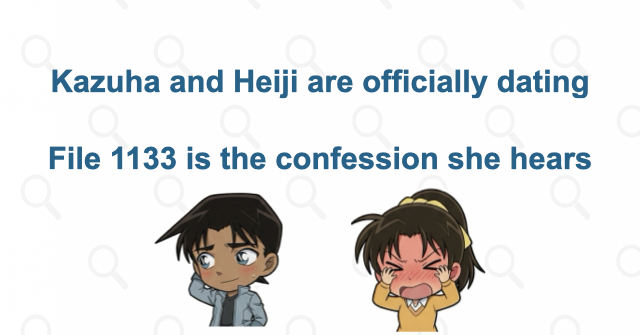
Yes. Their feelings reach each other in File 1133 of Volume 106, and File 1159 subsequently shows them telling other people that they are dating. Earlier protective outbursts and unsuccessful declarations are important steps toward that relationship, but they are not interchangeable with its confirmation.
Their long childhood friendship makes the change matter. They already know how to argue, travel together, and worry about each other; becoming a couple gives those familiar actions a new meaning. The romance does not require them to turn overnight into unusually polished or confident people.
The handcuff chain in the charm
As children, Heiji and Kazuha once became linked by handcuffs. Kazuha keeps part of the chain in a protective charm, preserving a physical reminder of that shared incident.
The object works beautifully because it carries a feeling she finds difficult to say aloud. What once literally connected them becomes a symbol of the bond she wants to protect. A childhood mishap is no longer just a funny memory when one of them has kept a piece of it so carefully.
Heiji, meanwhile, takes longer to put a romantic name to the importance Kazuha already has in his life. Their closeness may help explain that delay: a person who has always been there can be difficult to recognize as someone one is afraid to lose in a new way.
An outburst at Ebisubashi is not a formal confession
Episodes 816-817 (Japanese episodes 763-764), Conan and Heiji, Code of Love (Part 1) and Conan and Heiji, Code of Love (Part 2), give Heiji a particularly revealing slip. Believing unfamiliar men are taking Kazuha into danger, he refers to her possessively as he confronts them.
The point is that he has no time to choose a careful explanation. Concern exposes how special she is to him before embarrassment can cover it up. That makes the scene powerful evidence of affection.
It does not, by itself, establish that he has fully understood his feelings, and it is not a declaration received and accepted by Kazuha as the start of dating. The later confession gives the scene added weight without changing what happened in it.
Volume 106: the words arrive after the plan fails
Heiji plans to confess against the sunset at Naniwa Harukas, conscious of Shinichi Kudo’s confession to Ran in London. He wants a setting and a moment worthy of comparison. A case disrupts the schedule, and he concludes that he has missed his chance again.
Then he lets out the simplest thing he has been trying to say: he wants to tell Kazuha he loves her. Kazuha hears him. The carefully staged performance has failed, but the feeling underneath it finally reaches its intended listener.
File 1133, The Dark Red Closing Night, brings that long-running misunderstanding to its turning point. What makes it moving is that Heiji does not suddenly become smooth or eloquent. The words work because they are unguarded. After so many attempts to make the moment perfect, sincerity is enough.
Files 1157-1159: the surprise is on the couple
The planetarium storyline brings the pair to Tokyo after Naniwa Harukas. Their apparent distance can initially look like discomfort about how to behave now that they are together. File 1159 supplies the concrete explanation: they were deliberately keeping apart so they could surprise their friends with the news that they were dating.
Ran and the others already know. The plan therefore produces another mismatch between what the pair expects and what everyone else understands. This time, however, they are working together on the same secret. Their distance does not mean the confession was undone or that they have fallen out.
That is a satisfying continuation of the comedy. Before, they could not get the right words to each other. Now, the people they want to tell have got there before them. The familiar awkwardness survives, while the relationship itself has genuinely changed.
Kazuha’s first appearance and her friendship with Ran
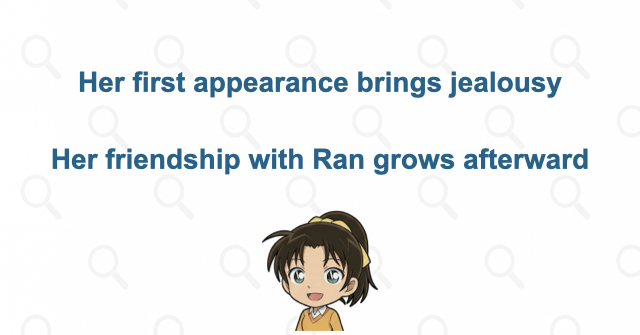
Kazuha debuts in Volume 19, adapted as Episodes 124-125 (Japanese episode 118), The Naniwa Serial Murder Case (1 Hour Special).
She has heard Heiji repeatedly mention Kudo and assumes this is a woman occupying his attention. When Ran comes to Osaka, Kazuha mistakes her for that supposed rival. Heiji’s enthusiasm about competing with Shinichi has inadvertently made his own romantic life more complicated.
Once the misunderstanding is cleared up, Kazuha and Ran become close friends. Ran’s feelings for Shinichi and Kazuha’s difficulty reaching Heiji give them something to understand in one another: both care about boys whose attention can vanish into a mystery.
Their friendship does not stop at romantic advice. They act to help each other in dangerous cases and trust one another when the situation changes. That gives them a relationship of their own, rather than making them merely the two detectives’ romantic counterparts.
There is warmth in the reversal from perceived rival to trusted friend. Kazuha’s initial insecurity remains part of her personality, but so does the honesty that lets her recognize she was wrong and form something better.
The mermaid case shows what Kazuha is willing to risk
In the Volume 28 mermaid case, Heiji and Kazuha are left hanging at a cliff. Heiji holds on to her, while she fears that continuing to save her will drag him down too. She tries to make him let go so that he can survive.
Heiji refuses to abandon her. They are not yet dating, but both place the other’s life ahead of their own. The scene replaces their usual verbal sparring with a terrible conflict between two attempts to protect the same bond.
The anime adaptation is Episodes 241-243 (Japanese episodes 222-224), from And Then There Were No Mermaids (The Case) to And Then There Were No Mermaids (The Resolution).
The emotional force comes from the contrast with their ordinary hesitation. They cannot readily say how much they care, yet danger makes that care impossible to miss. Kazuha’s courage here is not a romantic reward for Heiji; it is an action of her own, driven by her refusal to survive at his expense.
Momiji Ooka is a rival, not Heiji’s fiancee
Momiji Ooka confidently treats Heiji as her future husband and challenges Kazuha’s place beside him. But she is not his formally acknowledged fiancee.
The movie-only story The Crimson Love Letter explains the supposed childhood promise as Momiji’s misunderstanding of something Heiji said around a karuta encounter. A sincerely held belief on her side does not establish a marriage agreement between them.
That distinction need not make her feelings trivial. The interpretation of the promise was mistaken, but the attachment can still be real. Kazuha’s rival is more interesting when her disappointment is allowed to matter rather than treated as a technicality.
Dating changes the rivalry without settling Momiji’s future
Momiji’s interest does not simply disappear when Heiji and Kazuha’s feelings become mutual. Her butler, Muga Iori, supports her, but it would be wrong to attribute every failed confession to his interference. Cases, timing, and Heiji’s determination to create a spectacular occasion also repeatedly get in the way.
File 1159 gives Momiji a small but suggestive change: she thinks of Kazuha by her name rather than the belittling leaf-based nickname she used before. That may suggest a different recognition of Kazuha’s position. It does not establish that she has stopped loving Heiji or settled what she will do next.
Kazuha and Heiji’s relationship is confirmed; Momiji’s eventual response is a separate, unresolved matter. Keeping those two facts apart gives the triangle more emotional honesty.
Three films that bring out different sides of Kazuha
The following are movie-only stories. Their romantic moments should not be substituted for the manga’s confirmation of dating in Volume 106 and File 1159.
Crossroad in the Ancient Capital
The seventh film, Crossroad in the Ancient Capital, connects Heiji’s memory of a girl from his childhood with Kazuha, who has remained close to him all along. In this movie-only story, the person he imagines as a distant first love turns out to be the familiar girl beside him.
Kazuha is also caught in the danger of the Kyoto case, and Heiji’s effort to save her reveals how deeply he cares. The childhood revelation does not start their dating relationship. It instead makes the apparently ordinary closeness of their present feel more special.
The Crimson Love Letter
In the movie-only twenty-first film, The Crimson Love Letter, Kazuha faces Momiji in competitive karuta. Shizuka, a former Queen in that film, trains her for the challenge.
Rivalry over Heiji motivates the contest, but the training gives Kazuha effort and decisions of her own. Her hearing becomes useful in a setting where listening matters. The romance is expressed through work and competition, rather than only through jealousy or waiting for Heiji to choose her.
The Million-dollar Pentagram
In the movie-only twenty-seventh film, The Million-dollar Pentagram, Heiji pursues a confession in Hokkaido while Kazuha’s hearing also contributes to the case. She has a role beyond being the intended recipient of his declaration.
His words ultimately do not reach her, so the film does not establish that they have begun dating. That outcome should be kept separate from the manga’s later publication of the Volume 106 resolution; it is not a reason to ignore their confirmed manga relationship.
The anime adaptation and what to distinguish
The Volume 106 story is adapted across Japanese episodes 1214-1216. The three parts follow the theater murders and Heiji’s plan to confess at Naniwa Harukas, with the finale bringing the investigation and his confession together.
The later announcement to their friends in File 1159 is a separate manga development. It should not be folded into the Volume 106 anime case, or confused with the movie-only confession attempts.
Kazuha’s strongest scenes combine feelings she struggles to express with actions she takes without hesitation. The charm, her friendship with Ran, and the cliff rescue each show a different form of that care. Becoming Heiji’s girlfriend changes the relationship; it does not replace the brave, outspoken, sometimes insecure person who made the long journey worth following.

Comments