Major spoilers for Vermouth’s identity, the Black Organization and Akai family storylines, and Black Iron Submarine.
Vermouth is the woman behind both actress Sharon Vineyard and her supposed daughter, Chris Vineyard. The mother and daughter are two identities used by the same person. That revelation does not explain her birth name, exact age, apparently unchanged appearance, or precise relationship with the Organization’s boss.
Her conduct is equally complicated. She participates in the Black Organization’s crimes while protecting Conan and Ran, and knows Haibara’s identity without sharing the full secret. Each of those facts matters; none automatically makes her an ally.
Sharon and Chris Vineyard: one woman, two lives
Publicly, Sharon is a celebrated actress and Chris is her daughter. Chris continues her career after Sharon’s funeral. In reality, Vermouth uses disguise and vocal mimicry to maintain both identities, including Sharon’s older appearance.
The revelation comes together in the full-moon confrontation: evidence connected to Jodie Starling’s father, fingerprints, and Vermouth’s abilities link people who seemed separate. A family relationship has itself been used as a disguise. Once that is understood, earlier scenes involving Sharon and Chris acquire a very different meaning.
Does removing her mask reveal everything?
The familiar blonde face seen beneath her disguise is normally treated as Vermouth’s face. Removing a mask does not establish her entire personal history. Her original name and exact age remain unknown, and the story has not supplied a complete account of her appearance over time.
It is possible that Sharon was already an assumed identity, but that is not a confirmed earlier life. There is no need to invent a birth identity or a cosmetic procedure to explain a mystery the story still leaves open.
Her skills, teacher, and Japanese voice
Vermouth’s disguises reproduce both appearance and voice. She can imitate another person’s voice without a voice-changing device, making her especially dangerous in infiltration and impersonation. In Japanese, she is voiced by Mami Koyama.
As Sharon, she studied disguise with Yukiko Kudo under Toichi Kuroba, the original Kaito Kid. Their shared training explains a connection between the two women, but their uses of that skill diverge sharply. Vermouth can turn a familiar face into a way of manipulating or attacking someone who trusts it.
Her recurring remarks about women and secrets fit that method. Secrecy is part of how she controls an encounter: exposing one disguise still leaves an opponent unsure how much of her life has been revealed.
Why does Vermouth appear not to age?
Jodie remembers the woman involved in her father’s murder about 20 years earlier, yet the present Vermouth looks strikingly similar. The story explicitly draws attention to that discrepancy. It is a narrative mystery, not simply an inference from the art style.
Her apparently unchanged appearance is established; its cause is not. It does not prove immortality, an inability to die, or a specific episode of rejuvenation. An appearance that has not visibly aged and a body that has become younger are different claims.
Is APTX4869 responsible?
APTX4869, an earlier version of the Miyano research, or another experiment could be involved. Vermouth knows that Shinichi became Conan and Shiho became Haibara, and she has a strong hostility toward Sherry. These connections make the drug a plausible line of inquiry.
They do not show Vermouth taking APTX4869 herself. Nor does her hatred establish what happened to her or why she blames Sherry. The theory connects several clues, but the missing causal link is exactly what still needs explaining.
Giving Mary the drug does not prove she took it herself
Vermouth administers APTX4869 to Mary in London, passing it into her mouth through a kiss. Mary falls into the river and survives in a child’s body. This establishes Vermouth’s access to the drug and involvement in another shrinking incident.
It does not establish that Vermouth intended Mary to shrink, knew she had survived, or had personally undergone the same effect. The user of a drug and a recipient of it are separate roles. Mary’s experience expands the mystery into the Akai family without solving Vermouth’s own condition.
What is Vermouth’s relationship with the boss?
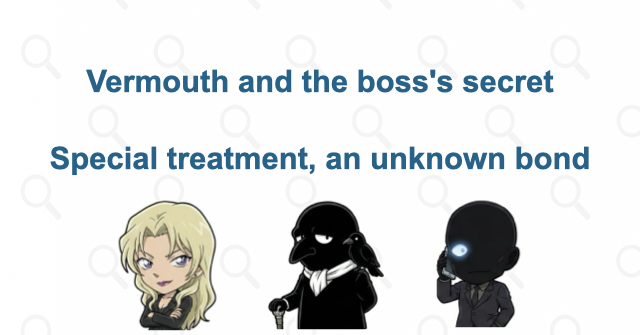
Vermouth receives special treatment from the Black Organization’s boss, Renya Karasuma. She has direct contact and unusual freedom, although that does not make her independent of the Organization’s demands. Her exact formal rank is not a reliable explanation for all of that privilege.
Bourbon knows a secret about her connection with the boss and uses it as pressure. His interrupted reference to that connection leaves the decisive relationship unstated. Daughter, wife, mother, lover, and blood relative remain theories, not interchangeable facts.
The secret could also connect to the Organization’s research or Vermouth’s physical condition. Until the missing part is revealed, special treatment alone cannot identify the relationship. That uncertainty gives the exchange its force: Bourbon knows enough to threaten her, while the reader does not.
What does Rum’s reference to a young woman establish?
In the account of Koji Haneda’s murder 17 years earlier, Rum refers to a young woman skilled in disguise and vocal mimicry. That combination strongly suggests Vermouth, but the wording should not be turned into an exact recruitment date.
Her involvement in Jodie’s family tragedy reaches back roughly 20 years. The reference to 17 years ago does not prove that she first joined the Organization then. Placing both events in order makes her long history more apparent while leaving the circumstances of her entry unresolved.
Gin: suggestive conversation, no confirmed romance
Vermouth and Gin work together and trade provocative remarks, including a reference to mixing a martini. The sexual implication helps explain romantic theories about them, but it does not confirm that they are lovers or have had a sexual relationship.
Gin recognizes her abilities while distrusting her secrecy and unilateral decisions. Vermouth, supported by her unusual standing with the boss, does not simply defer to him. Their conversations carry tension because familiarity has not become dependable trust.
Bourbon: cooperation under pressure
Bourbon, whose everyday identity is Tooru Amuro, cooperates with Vermouth in the pursuit of Sherry and later has her impersonate Yusaku Kudo. Their skills make them useful to one another, but his knowledge of her secret also makes him a threat.
There is no confirmed marriage, parent-child relationship, or other family tie between them. Nor should the moment when the reader learns Bourbon knows her secret be confused with the exact moment he discovered it. Their partnership works through competing interests as much as mutual confidence.
Why does she protect Conan and Ran?
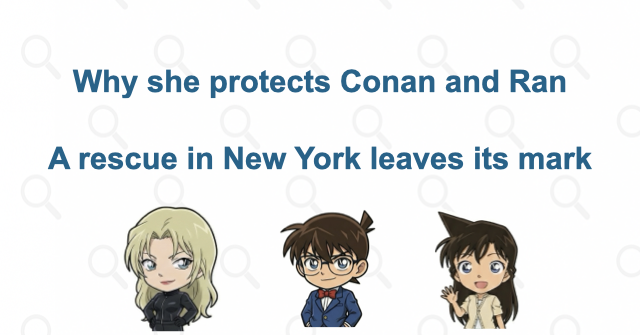
The crucial event is in New York. Disguised as a serial killer, Vermouth threatens Shinichi Kudo and Ran Mouri, then nearly falls from a building. Ran catches her, and Shinichi helps pull her to safety. They rescue someone who has endangered them without knowing who she really is.
Shinichi’s response distinguishes solving a murderer’s motive from needing a reason to save a life. That principle matters precisely because he usually approaches problems through deduction. Ran’s instinctive action puts the same idea into practice.
Vermouth subsequently calls Ran her angel and acts to protect her. Ran does not need to know Vermouth’s entire history for the rescue to have lasting consequences. The kindness returns in circumstances Ran could never have anticipated.
Conan as a silver bullet
Vermouth knows that Conan is Shinichi and sees the possibility that he could strike decisively at the Organization. Her silver-bullet imagery expresses more than gratitude for being saved: it suggests a hope attached to what he might accomplish.
Akai is also feared as a threat to the Organization, but Vermouth’s attitude toward Conan has a different emotional weight. Even so, her hopes for Conan do not fully explain what outcome she wants for the Organization or herself. Treating her as an openly committed destroyer of the Organization goes beyond what has been disclosed.
Why keep Haibara’s identity secret while trying to kill her?
Vermouth knows that Ai Haibara is Shiho Miyano, the former researcher Sherry. She targets her during the full-moon confrontation and cooperates in the Mystery Train pursuit. Yet she has not supplied the Organization with a complete report connecting Sherry to the child Haibara.
The staged death on the train therefore remains meaningful for members such as Gin. Vermouth’s knowledge is an exception to that shared assumption, not proof that everyone has seen through the plan.
Her promise to Conan, concern for Conan and Ran, hostility toward the Miyano research, and her own secrets may overlap. The full explanation for both her hatred and her silence remains unclear. That contradiction is more revealing than calling her either Haibara’s protector or an enemy who always follows orders.
Protection does not erase her crimes
Vermouth murdered Jodie’s father, attempted to kill Sherry, and continues to participate in the Organization’s operations. Her affection for two people does not turn those actions into a hidden campaign for justice.
Her personal exceptions make her difficult to predict. They may eventually affect the Organization’s fate, but a future choice to help Conan would still need to be understood through the motive and circumstances actually shown.
The episodes that connect her identities
Vermouth is introduced as Chris in Volume 24’s Reunion with the Black Organization, international Episodes 190-192 (Japanese episodes 176-178). At that point, the young actress’s relationship with Sharon has not yet been exposed as a deception.
Volumes 34-35’s New York case supplies the encounter with Shinichi and Ran. Volume 42 then brings the threads together in Head-to-Head Match with the Black Organization: A Dual Mystery on a Full Moon Night, international Episodes 371-375 (Japanese episode 345). The identity reveal and the reason she cannot treat the two teenagers as ordinary enemies reinforce each other.
Volume 78’s Mystery Train develops her conflict over Sherry and cooperation with Bourbon. Volumes 98-99 explore what happened to Mary. The Yusaku impersonation and the Organization’s operations around Volumes 99-100 show that her involvement continues well beyond the earlier identity reveal.
Volume 104 returns to the Haneda case and Rum’s reference to the disguise specialist. The relevant flashback is adapted in international Episodes 1222-1225 (Japanese episodes 1164-1167). These fragments expand her history without supplying the explanation for her appearance or the boss’s secret.
What Black Iron Submarine adds, and what it leaves open
In Black Iron Submarine, an age-spanning facial-recognition system creates a new threat to hidden identities. Vermouth acts against it, helping prevent Haibara’s secret from spreading through the Organization in that movie-only plot.
The system could also threaten Vermouth’s own aliases and the unexplained continuity of her appearance. That is a plausible personal stake, but fearing a technology is not proof of having taken a rejuvenation drug. The film’s Fusae-brand coda adds a personal dimension to her intervention without reducing all her motives to affection for Haibara.
The film does not settle the manga’s unanswered questions about Vermouth’s age, original identity, or relationship with Karasuma. Sharon and Chris are a solved deception; the life behind that deception remains the larger mystery.

Comments