Spoilers for the ranch case and the later revelation of Rumi Wakasa’s identity.
Rumi Wakasa knocks out Tooru Amuro to recover the shogi bishop he has picked up. The piece connects her to Koji Haneda and the case from seventeen years earlier. It is both a treasured possession and a clue she cannot casually leave in someone else’s hands.
She wins that encounter, but it takes place in darkness and gives Amuro little opportunity to respond. It does not settle who would win a fair fight. Nor does the scene establish that either character knows all of the other’s identities.
They properly meet in Volume 99 and in international Episodes 1110-1111 (Japanese episodes 1053-1054), “The Spark That Fell on the Ranch.” On the surface, it is an ordinary meeting between an assistant teacher at Teitan Elementary School and an employee of Café Poirot. Underneath that surface, however, Rumi is connected to the identity of Asaka, while Amuro is Rei Furuya and Bourbon. A shogi piece turns their apparently peaceful encounter into a tense collision with the Koji Haneda case.
What connects Wakasa and Amuro at the ranch?
The encounter brings two people with concealed lives into the same ordinary-looking outing. Wakasa is the assistant teacher at Teitan Elementary School; Amuro is the familiar face from Café Poirot. The audience knows Amuro is also Public Security officer Rei Furuya, working inside the Black Organization as Bourbon.
Wakasa’s connection emerges through a different investigation. The later account of the murders seventeen years earlier identifies her as Asaka, the bodyguard associated with Amanda Hughes and Koji Haneda. Her interest in the past is intensely personal.
At the ranch, those two histories overlap without becoming an open exchange of information. The lost bishop draws Amuro’s attention, while Wakasa has a pressing reason to take it back. That is the immediate cause of the conflict; a declared allegiance between them is not.
Keeping the order of revelation clear matters here. What readers eventually learn about Asaka explains Wakasa’s actions retrospectively. It does not mean Amuro has already reached that answer during the ranch case.
Why does the bishop make Amuro suspicious?
Amuro picks up the shogi piece and connects it with the Koji Haneda case. A seemingly small lost object becomes evidence that Wakasa may have a much older and more dangerous story behind her schoolteacher identity.
His interest continues after the immediate incident, including attention to her photograph. That supports a simple conclusion: Wakasa has become someone he wants to investigate. It is a much larger step to say that he has positively identified her as Asaka, and the ranch encounter does not establish that step.
A clue connecting Wakasa to the case is not proof that Amuro knows her identity. He can recognize the significance of the bishop while remaining uncertain about its owner and her role in the events seventeen years earlier.
Does Wakasa know that Amuro is Bourbon?
The reverse question is also unresolved. Wakasa may know things about the Organization that the reader has not yet been shown, and her experience gives her reason to notice someone whose movements do not fit his everyday occupation.
But noticing that Amuro is capable or suspicious is different from recognizing him as Bourbon. Recognizing Bourbon would, in turn, be different from knowing that he is an undercover Public Security officer.
Those distinctions leave room for several readings of her caution. She could see a skilled stranger holding an important possession, a possible Organization connection, or someone whose precise allegiance she cannot yet determine. Her attack alone cannot tell us which of these she believes.

Why Wakasa attacks him in the dark
The immediate objective is the bishop. In the dark basement, Wakasa strikes Amuro, leaves him unconscious, and retrieves it. The circumstances allow her to act without a straightforward face-to-face confrontation.
For Wakasa, losing the piece would mean more than misplacing a keepsake. It can draw attention to the Koji Haneda case and, through that case, to her own concealed past. Recovering it protects both something emotionally important and something potentially revealing.
The later explanation of her relationship with Koji gives the action a second meaning. Her determination is not simply professional secrecy. The bishop carries the memory of a person and a moment she has not left behind.
This combination makes the scene more revealing than an ordinary action sequence. She acts with extraordinary efficiency, yet the object she is defending exposes a vulnerable part of her life.
Does that make Wakasa stronger than Amuro?
It proves she can overpower him under those conditions. She has surprise, darkness, and a clear objective on her side. Amuro does not enter the exchange prepared for an evenly matched contest.
Wakasa’s background as Asaka makes her combat ability credible. Amuro has his own extensive training and demonstrated boxing skills. Comparing their backgrounds explains why the encounter is striking, but it does not remove its tactical imbalance.
A general ranking would require evidence the scene does not supply: both fighters aware of the threat, comparable conditions, and an exchange long enough to test their abilities. The more useful conclusion is that Amuro has met someone dangerous enough to take seriously, rather than that the story has settled a permanent power ranking.
How the Asaka revelation changes the encounter
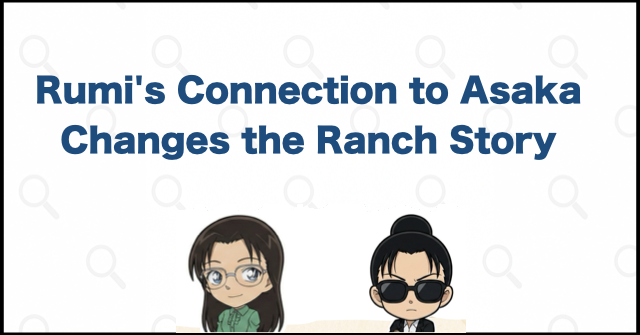
Knowing Wakasa is Asaka turns an initially puzzling reaction into a coherent one. The connection to Koji, her insistence on recovering the bishop, and her ability to disable Amuro all belong to the same concealed history.
It also clarifies why their future relationship cannot be reduced to allies or enemies on the basis of this one fight. Both are connected to the Organization story, but being opposed to the same organization does not guarantee that they recognize each other’s position or trust each other’s methods.
| What Wakasa might know | How it could affect her view of Amuro |
|---|---|
| Only his public identity | A capable stranger has taken possession of a clue she needs back. |
| His Bourbon identity | She could reasonably treat him as an Organization threat. |
| His Public Security role | Cooperation becomes possible, although trust would still need to be established. |
These are conditional possibilities, not three confirmed stages of their relationship. The story would need to show what she actually knows before one could explain every part of her conduct through it.
The same caution applies to Amuro. Investigating Wakasa could bring him closer to the truth about Asaka, but interest in her is not evidence that he has already solved it.
The ranch case leaves a productive tension between them: each has reasons to conceal information, and the bishop gives them a reason to pay attention to each other. For now, the clearest answer remains the immediate one—Wakasa takes back Koji’s piece, and Amuro discovers that the apparently unassuming teacher is far more formidable than she appears.
Further reading (contains spoilers): Wakasa and Wakita's seventeen-year feud.

Comments