Spoilers: This article reveals Curaçao’s role and ending in the film The Darkest Nightmare, and discusses her later mention in Black Iron Submarine. Her story is movie-only; a separate comparison considers Rum’s memory ability in the manga.
Curaçao is Rum’s right-hand operative in The Darkest Nightmare, and she dies saving the Detective Boys. Her change of allegiance is not simply the result of forgetting who she is: after her memories return, she still chooses to protect the children and conceal the secrets of people the Black Organization would kill.
That choice makes her more than a formidable guest villain. The film begins with someone capable of stealing the identities of undercover agents and ends with the same person using her abilities to save children. The past comes back, but it no longer gets to decide everything she does.
Who is Curaçao?
Curaçao is an original character created for The Darkest Nightmare, the twentieth Detective Conan film. In this movie-only story she works directly for Rum, the Black Organization’s number two, on infiltration and intelligence-gathering assignments.
Her real name, age, and nationality are not revealed in the story covered here. Her silver hair, mismatched eyes, and composed conduct suggest an experienced operative, but they do not establish an age such as thirty-something.
Her codename evokes the orange-peel liqueur curaçao and its range of colors. The association fits a film that repeatedly asks whether a person must remain the color chosen for them by someone else. That symbolic reading is more useful than treating the codename as a clue to her nationality.
Yūki Amami’s performance
Yūki Amami voices Curaçao in Japanese. The performance moves between the controlled hardness of an Organization operative, the gentleness of her time with the children, and the desperation of her final effort to save them.
Those shifts do not make her feel like three unrelated characters. They allow a different emotional range to emerge within the same person. The warmth of the aquarium scenes matters because the voice has already established what she sounds like when serving the Organization.
Rum saved her life, but did not give her freedom
In Curaçao’s movie-only backstory, she remembers information the Organization does not want her to retain. Vermouth restrains her, and she is in danger of being eliminated because she knows too much. Rum intervenes because he recognizes the value of her exceptional memory.
He spares her and demands the use of that ability, making her his close subordinate. It may look like rescue from one immediate threat, but survival is tied to serving him. His intervention does not amount to giving her control over her own life.
That dependency gives her eventual refusal a greater weight. Rum is both the person who kept her alive and the authority who determines how her gift will be used. Choosing something other than his orders means stepping beyond a life organized around that debt.
The NOC-list mission and the accident
The movie-only mission begins with Curaçao infiltrating Japan’s National Police Agency to steal information identifying undercover operatives inside the Black Organization. The NOC list includes Bourbon, Kir, Stout, Aquavit, and Riesling, exposing agents linked to the Public Security Bureau, the CIA, and other intelligence services.
This is not merely a useful collection of names. If the Organization confirms the identities, the agents may be executed. The opening places many lives inside a single person’s memory before the audience has had a chance to understand her.
Curaçao memorizes the information instead of simply carrying away a storage device. Her movie-only ability lets her leave with the data in her mind, making the assignment especially well suited to her.
Her escape brings her into conflict with Rei Furuya, Yuya Kazami, and Shuichi Akai. After a violent chase, she suffers an accident and loses her memories. The woman who could carry so many secrets can no longer recall her own identity.
The reversal is central to the film’s tension. She remains valuable and dangerous to everyone pursuing the information, while she temporarily lacks the personal knowledge that would explain why.
How her memory and physical abilities work
Five colors trigger recall
The film attributes Curaçao’s unusual memory to a rare condition involving damage to the fornix, a structure associated with memory. This is the movie’s fictional explanation of her power, not a demonstration that such damage normally produces extraordinary recall.
Orange, white, blue, green, and red provide the visual cues she associates with information. The arrangements and intensity of the colored film help her store and retrieve large quantities of names and affiliations.
In the movie-only sequence at the aquarium, five-colored lights on the Ferris wheel trigger the return of her memories, including the stolen NOC information and her service to Rum. The same visual mechanism that made her valuable to him brings back the knowledge she will have to choose what to do with.
Her left eye is blue, while the unusual appearance of her right iris makes it look pale or transparent against the white of the eye. A dark contact lens conceals that contrast. The striking appearance is memorable, but the film also connects her distinctive traits to the way the Organization exploits her.
The body remembers even when the mind does not
Curaçao holds her own against Furuya in the movie’s National Police Agency confrontation. The escape then shows her driving against traffic at high speed and evading pursuit until Akai’s shot interrupts it. She is not an intelligence specialist who becomes helpless once an assignment turns physical.
Her later movie-only rescue of Genta shows that those trained abilities survive her memory loss. She reacts when he falls from a height and saves him before she can recover the facts of her own life. At the aquarium’s darts game, she lands all three darts in the central double bull.
The continuity is important. Losing her identity does not mean losing every learned movement. More affecting still is the change in purpose: skills used to serve the Organization now protect and delight the children.
Is her ability the same as Rum’s left-eye memory?
A comparison with Rum’s manga ability is suggestive, but the two are not confirmed to work identically. Rum’s former left eye gave him extraordinary visual recall; he later lost that eye and uses an artificial one. Curaçao’s film ability instead involves her unusual neurological condition and five-color cues.
Rum may have recognized a talent resembling his own, or valued something that could compensate for an ability he had lost. Those are interpretations across manga and movie material. The film does not establish that Curaçao was a complete replacement for his eye or that their abilities had the same mechanism.
The resemblance can change the way the earlier movie is viewed without turning the comparison into a new fact about its story. It adds a possible reason for Rum’s interest, while his stated valuation of her memory remains sufficient to explain her usefulness.
Why the Detective Boys change her decision
A brief interval in which she is more than an operative
In the movie-only aquarium story, Ayumi Yoshida, Genta Kojima, and Mitsuhiko Tsuburaya find Curaçao sitting on a bench. Her broken phone and the colored film become clues as they try to help her recover her memory.
She cannot remember her name, yet she saves Genta, explores the aquarium with the children, and enjoys the darts game. The contrast is gentle rather than complicated: people who do not know her usefulness to Rum treat her as someone worth helping.
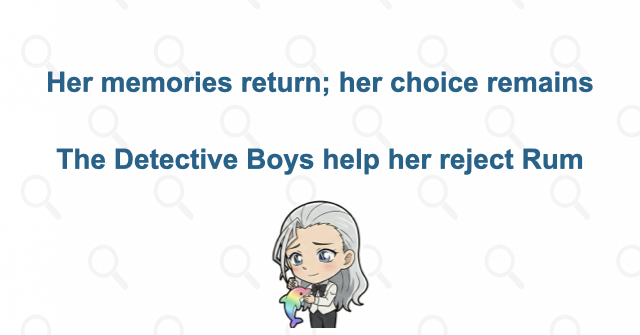
The white dolphin keychain she receives through their time together becomes a keepsake. Ai Haibara, however, senses the unsettling atmosphere of the Black Organization around her. The tenderness never entirely removes the danger; the film allows both to exist in the same afternoon.
Her memories return, but her choice remains
Curaçao’s movie-only change of allegiance survives the return of her memories. After the Ferris wheel lights restore her past, she remembers the children as well as the Organization. She does not automatically resume serving Rum.
When Haibara asks why she is helping them, Curaçao explains that she prefers the person she is now to the person she was before. Her association with different colors turns into a claim to choose for herself, rather than remain fixed in the Organization’s black.
That makes the decision more powerful than temporary kindness caused by amnesia. She knows what she is rejecting. The children have not erased her past; they have given her another experience against which to judge the life she had been leading.
Bourbon and Kir: endorsing Conan’s false message
While Curaçao is suffering from amnesia, Gin’s group detains Bourbon and Kir on suspicion that they are undercover agents. Conan impersonates Curaçao and sends a message denying that the two are NOCs.
In this movie-only operation, the recovered Curaçao accepts that message as her own. She protects the cover story instead of correcting it, helping prevent their executions. Her choice concerns information as well as physical rescue: the memory that could expose them becomes a means of concealing the truth.
Haibara: recognizing Sherry without handing her over
Curaçao’s warning to Haibara about Gin makes clear that, in the movie-only encounter, she recognizes her as Sherry. She does not seize Haibara or report her to the Organization. Instead, she warns her of the danger and helps her escape it.
A reference to Gin is enough to communicate the stakes between two people who know the Organization. There is no need for a long explanation of what he would do. Curaçao may also recognize something of another life constrained by the Organization in Haibara’s situation, but that motive remains an interpretation.
Together, these acts make her refusal concrete. She has the information needed to betray Bourbon, Kir, and Sherry, and chooses not to use it against them.
Does Curaçao die? The Ferris-wheel rescue
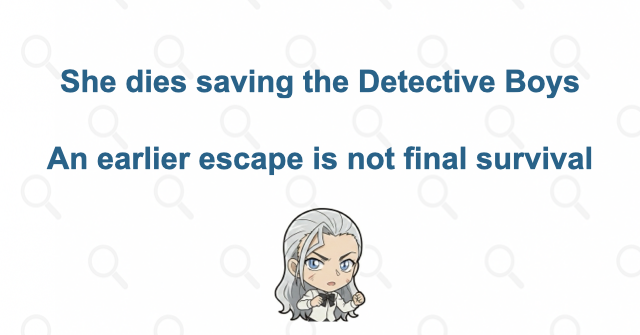
Curaçao dies in the movie-only climax of The Darkest Nightmare. Her earlier survival after an attack should not be confused with surviving the final rescue. The two events are separate.
She first falls into the sea after an attack from the Osprey carrying Gin’s group, but survives. The attack also destroys the Ferris wheel’s axle, sending the huge wheel rolling through the aquarium toward Ayumi, Genta, and Mitsuhiko.
Conan, Akai, and Furuya struggle to stop it. Curaçao realizes the children are in its path and gets into a mobile crane. She might otherwise have escaped, but instead drives toward the danger in an effort to halt the wheel.
The movie-only rescue succeeds: the children survive, while Curaçao is crushed with the crane and dies. The person who finally saves them is the former Organization operative, even with Conan, Akai, and Furuya all trying to help.
It is an action taken for the children, not an assignment from Rum. The same resolve that once made her a formidable operative now serves a choice she makes herself. That reversal is what gives the spectacle its emotional force.
Why the white dolphin matters
The dolphin keychain is a prize from the aquarium’s darts attraction, a keepsake connecting Curaçao with the children. Hers is a white prototype that has not yet been painted, and she treasures it even after remembering her past.
Its color invites an interpretation: white remains open to other colors, unlike the black imposed by her Organization identity. Read beside her explanation that she can choose who she becomes, the unpainted dolphin appears to stand for that possibility.
This symbolism does not reveal a secret survival. The object left behind recalls the brief, real bond she formed with the children. After the noise and scale of the action, the small white keepsake gives the ending a quiet focus. That contrast is why the loss lingers.
Does Black Iron Submarine bring her back?
In the later movie-only story of Black Iron Submarine, Curaçao is referred to as someone who has died. She does not return alive to take part in a new operation, and the mention supplies no resurrection or survival reveal.
Pinga is a new favorite of Rum’s after her death and works under his direction on the Pacific Buoy operation and its age-recognition system. However, Pinga is not explicitly established as Curaçao’s formal successor or as having the same memory ability.
The distinction preserves what is meaningful about the reference. Rum can favor another operative without the two being interchangeable. Curaçao’s place in the Organization’s history remains visible even after her own story has ended.
The later movie mention therefore extends her significance, not her lifespan. It is a reminder that a character whose main story occupies one film can still leave a trace in another.
Which work tells her story?
The Darkest Nightmare is the film to watch for Curaçao’s direct story: the National Police Agency mission, her amnesia, the Detective Boys, her rejection of Rum’s orders, and her death. Black Iron Submarine provides the later reference, not a new adventure with her alive.
These are movie-only events, distinct from Gosho Aoyama’s serialized manga and regular numbered television cases. A television broadcast of the film does not turn it into a normal TV episode. The works discussed here also do not establish a later return by her in the main series.
The film is available in anime-comic form, including collected editions that retell its story. Appearing in a comic adaptation of a film is different from becoming a participant in the original serialized manga.
A future flashback or mention is possible, but none should be predicted as certain. Her existing story already has a complete dramatic movement: from a person whose ability belongs to Rum to a person who decides what that ability will protect.
A final choice made with her memory intact
Curaçao begins as a movie-only Black Organization specialist who can carry the identities of endangered agents in her mind. By the end, she protects those secrets and gives her life for the children who helped her experience another way of being.
Her age and real name remain unknown, the comparison with Rum’s eye remains a theory, and Pinga is not proven to be an exact successor. Her death in the film, however, is the ending of her choice to save the Detective Boys. The white dolphin remains as a quiet image of the freedom she had only just begun to claim.
Further reading (contains spoilers): Black Organization codenames and allegiances and Rum's identity reveal.

Comments