Spoilers: Wataru Date’s death, Natalie, the notebook cases, the Police Academy Arc, and later flashbacks through Volume 107. This article also discusses fictional deaths by suicide.
Wataru Date is dead in the main story’s present. A driver who fell asleep at the wheel struck him after an all-night stakeout, when he went to retrieve his dropped police notebook. The story presents a traffic accident, not a Black Organization murder or a later survival reveal.
What can make his status confusing is how much more we learn about him afterward. These sides of Date—as squad leader, Takagi’s mentor, Natalie’s boyfriend, and Furuya’s friend—become clearer through memories and unfinished work. His past expands; his death is not reversed.
How Date died, and why it feels so unfair
The accident happened one year before the story’s present, after Date and Wataru Takagi finished a night of surveillance. Date dropped his notebook into the road and moved to retrieve it as the car approached.
Nothing in the events discussed here indicates that a criminal arranged the collision. His friendship with Rei Furuya, who operates as Tooru Amuro, does not turn it into an organization plot. Nor does Amuro’s later grave visit supply evidence of one.
Date was remembered as an exceptionally tough, dependable man. Yumi Miyamoto’s description makes him seem almost impossible to kill. That image gives an ordinary road accident its particular cruelty: the skills that made him formidable as a detective could not protect him from every danger outside a confrontation.
Where his death is explained
The accident and its aftermath belong to Files 804-808 in Volumes 76-77, adapted as Episodes 733-735 (Japanese episodes 681-683), The Life-Threatening Broadcast of Love.
The present-day emergency is Takagi’s imprisonment. Conan, Miwako Sato, and the police work to save him while the investigation uncovers the earlier loss of Date and Natalie. The structure places an urgent rescue beside a tragedy whose outcome can no longer be changed.
Amuro’s visit to Date’s grave then opens another connection, reaching beyond Takagi’s case toward the police-academy classmates. The episode does not need to undo Date’s death to show how many lives it touched.
What Date left inside the notebook

After the collision, Date entrusted the notebook to Takagi. His final request leaves it in his junior’s hands. At first, the engagement ring inside points toward a personal responsibility: getting something meant for Natalie to the person Date had hoped to marry.
Later, the notebook reveals another unfinished part of his life. It also contains a coded lead from an investigation he and Takagi had pursued.
It is unclear whether Date’s final request deliberately referred to both the ring and the case. What the story shows is that Takagi ultimately inherits both. The personal future and the professional work are physically held in the same object.
The ring and the future Date intended
The ring and the photograph of Date with Natalie make his intention to marry her clear. They do not establish that a formal proposal had already taken place. Natalie is most precisely described here as his girlfriend, for whom he had prepared an engagement ring.
The contrast is tender. The imposing mentor carried the possibility of a private future inside the notebook associated with his work. He never got to deliver the ring himself, and Takagi’s attempt to take on that responsibility could not repair what had already happened.
The unfinished Sunday appointment
In Files 1079-1081, spanning Volumes 101-102, numbers, symbols, and a note connecting Sunday with Takagi lead back to suspicious dealings. The clues point toward the window-side area of Café Poirot and a transaction on Sunday at noon.
Date had invited Takagi to accompany him and used wording about making a man of him. Amuro reads the intended meaning professionally: Date wanted his junior to earn a successful case result and grow into a capable detective.
Conan, the Detective Boys, Takagi, Sato, and Amuro follow the surviving clues. The anime adaptation is Takagi and Date and the Notebook Promise (Part 1) and Takagi and Date and the Notebook Promise (Part 2), Episodes 1167-1168 (Japanese episodes 1109-1110).
The payoff matters because Takagi is not merely preserving a relic. He is doing something with what his mentor left. An interrupted investigation finally moves forward through the people Date had taught or known.
Natalie and the misunderstanding behind Takagi’s case
Natalie Kuruma was an English-conversation instructor. Her relationship with Date went back to his police-academy years, and the academy story shows a quieter side of him in their phone conversation.
After Date’s death, Natalie also died by suicide. The characters suggest that she did not know about the accident and believed he had abandoned her when contact stopped. That explanation is an inference within the case, not direct access to all of Natalie’s thoughts.
Her parents then died in a traffic accident while going to collect her body. The loss of people who could have helped communicate what happened makes the story’s chain of misunderstanding still more painful.
Why the name Wataru becomes dangerous
A man who cared for Natalie came to blame a person named Wataru for her death. Date and Takagi share that given name, although it is written with different characters in Japanese. Takagi is mistaken for the man connected to Natalie, leading to his imprisonment.
The shared name had once been the basis for Date’s affectionate Wataru Brothers nickname. The case turns it into the source of a disastrous misidentification.
That shift is why the detail feels so well placed. What originally expresses closeness between mentor and junior becomes the reason the junior is endangered after the mentor’s death. Saving Takagi requires untangling the past rather than merely escaping the present trap.
It is painful to imagine what a timely message about Date’s accident might have changed. The story leaves that as a lost possibility, not something anyone can now guarantee or restore.
What Takagi and Furuya each carry forward
Takagi keeps using Date’s notebook. It accompanies his continued growth as a detective rather than replacing that growth with nostalgia. Date trained him hard, but also wanted him to achieve something he could call his own.
Furuya carries a different relationship: an academy classmate whose ability Date openly respected. When Takagi repeats the rumor that Date graduated at the top, Date rejects it:
“That is a false rumor. I was always second; I could never beat him in brains or strength” (unofficial translation).
The classmate he means is Furuya. The admission is not simply resentment at being second. Date also worries about the friend he can no longer reach, wondering whether he has taken one risk too many.
The later perspective makes that concern bitter. Furuya is alive, while Date dies before they can meet again. The man who worried that his friend might be gone becomes another friend the survivor has lost.
Amuro’s help and the toothpick
In the notebook case, Amuro understands the professional intention behind Date’s Sunday invitation. He provides guidance that lets Takagi move toward the answer rather than reducing the junior detective to a spectator.
His toothpick afterward evokes an object strongly associated with Date. It can be read as a small echo of his classmate, but Amuro does not explicitly describe the gesture as a memorial. The emotional reading is persuasive without requiring an invented explanation from him.
Takagi has the notebook in his daily work; Furuya has the memories and gestures of a shared past. The story gives them different ways of keeping the same absent person close.
The academy story asks what strength is for
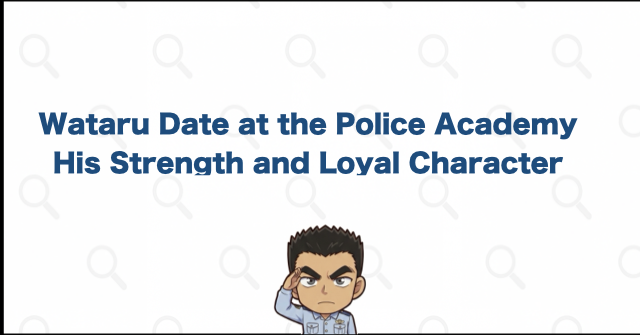
Date was squad leader among Rei Furuya, Jinpei Matsuda, Kenji Hagiwara, and Hiromitsu Morofushi in the Onizuka class. His leadership involved managing very different personalities, not merely being physically imposing. When Furuya and Matsuda clash, he helps turn their conflict into something the group can face together.
The same ability later appears in his work with Takagi. He can press a capable person to improve without treating that person as disposable. The academy story also shows that this understanding was something he had to learn.
His father’s apparent weakness
As a child, Date saw his policeman father comply with a convenience-store robber and judged him weak. He grew determined to become strong enough to impose justice, and criticized Furuya during training for declining to target his injured leg.
The later explanation changes the meaning of what he witnessed. His father had been protecting hostages. Accepting humiliation and choosing restraint were not failures to care about justice; they were decisions made to protect lives.
That is the important turn in Date’s development. Winning a fight and choosing the action that best protects people are not always the same thing. His renewed respect for his father gives a more generous meaning to strength than the one he had carried into training.
It may help explain the protective mentor he became, though the causal link is an interpretation rather than an explicit statement. The academy episode gives him room to be mistaken before he becomes the senior detective Takagi remembers.
His place among the classmates’ deaths
Date is the last of the four deceased classmates to die: Hagiwara died seven years before the present, Matsuda three years before it, Morofushi before Date, and Date one year before it. These relative points do not establish a more precise date for Morofushi here.
Furuya remains the survivor of the five. Date’s ordinary accident differs from the bomb incidents and undercover dangers surrounding the others, but its apparent randomness does not make the loss smaller.
Later appearances add to his past

For Date’s academy background, Police Academy Arc Wild Police Story CASE. Wataru Date is Episode 1095 (Japanese episode 1038), adapting material from the Wild Police Story manga. It explores his father, training, leadership, and relationship with Natalie.
Volume 107, chapters 1-3, adds a childhood encounter between Shinichi Kudo and Ran Mouri and the five academy classmates. It is a flashback to a time when they were alive, not a change to Date’s fate.
The Bride of Halloween is a separate film account
The Bride of Halloween adds movie events involving Date and his academy friends. Its past confrontation with Plamya belongs to the film’s story and should not be used as evidence that the main manga changed his cause of death.
The three-years-earlier incident must also be distinguished from the period when all five classmates were alive. Hagiwara had died seven years before the present, so he was already gone at that later point. Bringing the group’s memories together in one film does not place every friend alive in every flashback.
The warmth of their former companionship makes Furuya’s present isolation more tangible. It does not undo the accident, the undelivered ring, or the investigation Date left behind.
Date’s story is powerful because those unfinished things continue to matter. Takagi can solve the case his mentor could not finish, and Amuro can recognize what his friend meant. Neither can bring him back. What they can do is turn what he left into action in the present.

Comments