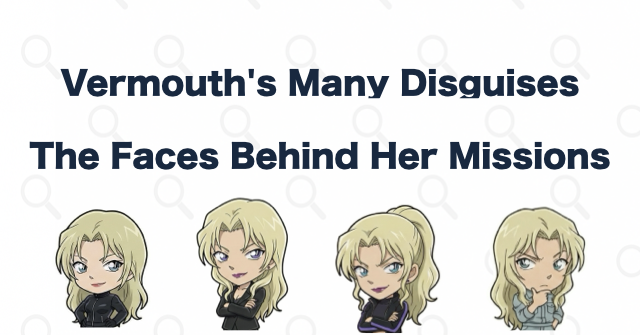
Who has Vermouth disguised herself as?
How were her most important disguises exposed?
Vermouth’s reputation as the woman with a thousand faces rests on more than convincing masks. She reproduces voices, mannerisms, professional behavior, and the relationships that make other people trust a familiar face.
Some disguises last only minutes. Others, particularly Tomoaki Araide and the Vineyard identities, require her to sustain another person’s life. Here is a guide to the identities she personally performs, the disguises she makes for allies, and the moments when those performances fail.
Spoiler warning: This article covers major manga and anime identity reveals, plus The Raven Chaser, Black Iron Submarine, and The Million-dollar Pentagram. Film evidence is identified separately.
Vermouth’s Disguises Across the Manga, Anime, and Films

Her personal disguises include Sharon Vineyard, a bartender, Tomoaki Araide, Inspector Radish Redwood, the silver-haired serial killer, Kiriko Busujima, scarred Shuichi Akai on the Mystery Train, Motoe Benzaki, Jodie Starling, Azusa Enomoto, Tsutomu Akai, and Yusaku Kudo.
Film examples include a female hostage in The Raven Chaser and a cleaner and elderly woman in Black Iron Submarine. Sharon is a long-term constructed identity rather than an ordinary one-case impersonation. The film’s manipulation of age-recognition results is another distinct category.
Wearing a Disguise Is Different from Making One for Someone Else
The same face can conceal different operatives. On the Mystery Train, scarred Akai is Vermouth. Earlier appearances of scarred Akai include Bourbon’s impersonation, using her disguise work.
Likewise, Vermouth plays Motoe Benzaki while Bourbon plays her husband, Tohei Benzaki. In The Raven Chaser, Irish—not Vermouth—plays Kiyonaga Matsumoto.
She is both a performer and a disguise specialist. Listing every mask she creates as an identity she personally assumes would merge those two roles and misidentify who carried out the operation.
What Counts as a Personal Disguise in This Guide?
The list covers identities Vermouth herself is shown performing. Unnamed film characters count when their role is identifiable, such as the hostage, cleaner, and elderly customer.
Sharon Vineyard is included because Vermouth sustained that public identity while also performing the supposed daughter, Chris Vineyard. The scale differs from a temporary mask, but the deliberate performance is central.
By contrast, the appearance of Shiho-like women in recognition results around the world is discussed as an information operation. The story does not establish that Vermouth personally played every woman at every location, so the operation is not reduced to one confirmed disguise as Sherry.
The People Vermouth Impersonates in the Manga and TV Anime
Her television and manga disguises range from quick information gathering to prolonged infiltration. As the story progresses, she increasingly exploits relationships: a doctor’s reassurance, an FBI colleague’s trust, or a wife’s hope that her husband has returned.
The threat lies as much in choosing the right person to imitate as in producing the right face.
Sharon Vineyard: Maintaining a Mother-and-Daughter Fiction
Vermouth performs both the internationally known actress Sharon Vineyard and Sharon’s supposed daughter, Chris. They are not two separate women.
After sustaining Sharon’s career, she stages that identity’s death and shifts into the daughter’s public role. This deception encompasses professional history and friendships, including Sharon’s relationship with Yukiko Kudo, rather than just an appearance during a crime.
Which appearance represents her original face, or whether an earlier identity precedes them, is not established here. Her ability to maintain the fiction also connects directly with the mystery of her apparent failure to age.
The Bartender and Tomoaki Araide: Short-Term Disguise and Long-Term Infiltration
Volume 29 shows both approaches in The Mysterious Passenger (Part 1) and The Mysterious Passenger (Part 2), international episodes 249–250 (Japanese episodes 230–231).
Vermouth approaches Organization colleagues as a bartender, but Gin recognizes her. Their reference to a martini plays on mixing gin and vermouth. It is suggestive banter, not sufficient evidence by itself to establish a romantic or sexual relationship.
Her impersonation of Dr. Tomoaki Araide is much more extensive. After researching him, she adopts his speech and behavior and blends into his work as Teitan High School’s doctor to approach Sherry. The real Araide and his family are protected by the FBI.
The reveal comes in Volume 42’s Head-to-Head Match with the Black Organization: A Dual Mystery on a Full Moon Night (2.5 Hour Special), international episodes 371–375 (Japanese episode 345).
The impersonation can be traced securely from Volume 29 onward. An earlier start in Volume 26 / Japanese episode 190 is not treated here as confirmed. During the bus hijacking, the disguised Vermouth tries to protect Conan despite pursuing Ai Haibara—a contradiction that makes her more than an identity puzzle.
Inspector Redwood and the Silver-Haired Killer: Two Faces in New York
Volumes 34–35 feature both Inspector Radish Redwood and a silver-haired Asian serial killer among Vermouth’s performances. Shinichi Kudo’s New York Case spans international episodes 308–310 (Japanese episodes 286–288), with the parts titled The Case, The Deduction, and The Resolution.
The killer’s appearance is part of her attempt to draw out FBI agent Shuichi Akai. During the operation she nearly falls, and Shinichi and Ran save her.
They act without knowing who she really is. For Vermouth, the experience becomes a personal debt that outlasts the disguise. A face used for an attack becomes the setting for the rescue that later shapes her treatment of Conan and Ran.
Kiriko Busujima: Supporting an Assassination in Black Impact
Vermouth impersonates Kiriko Busujima during Black Impact! The Moment the Black Organization Reaches Out (2.5 Hour Special), international episodes 459–463 (Japanese episode 425), from Volumes 48–49.
Busujima is a woman associated with an organized-crime group. Vermouth borrows her identity while supporting the assassination plan against Yasuteru Domon, helping create circumstances favorable to the snipers.
Unlike the Araide operation, this is not about taking over someone’s daily life. It is about using a particular identity’s credibility at the instant an operation needs it.
Scarred Shuichi Akai: Vermouth’s Role on the Mystery Train
In Volume 78’s Mystery Train case, Japanese episodes 701–704, Vermouth herself plays the scarred version of Akai. The concluding episode, The Jet-Black Mystery Train (Destination), maps to international episode 756.
She uses the appearance while assisting Bourbon’s pursuit of Sherry and unsettling people connected with Akai, notably Masumi Sera.
This does not mean every earlier scarred Akai was Vermouth. Bourbon used that likeness in earlier investigations into whether Akai had truly died. The wearer must be identified from the scene and operation, not the face alone.
Motoe Benzaki and Jodie: Exploiting FBI Trust
In Volumes 80–81, Vermouth and Bourbon approach the FBI as the Benzaki couple: Vermouth is Motoe, Bourbon is Tohei. The anime is Jodie’s Memories and the Cherry Blossom Viewing Trap (1 Hour Special), international episodes 786–787 (Japanese episode 734).
Their apparently ordinary married-couple interaction creates an opportunity to gather information about Akai. Later, during the Scarlet storyline in Volumes 84–85 / Japanese episodes 779–783, Vermouth impersonates Jodie herself and extracts information about Rikumichi Kusuda from Andre Camel.
The essential tool is trust. Camel responds to someone he believes is a colleague, not an unknown interrogator. Vermouth’s technical skill lets her exploit a relationship that already exists.
Azusa Enomoto: The Slip That Reveals Her Attachment to Ran
In Volume 90’s The Betrayal’s Stage (Part 1) and The Betrayal’s Stage (Part 2), international episodes 921–922 (Japanese episodes 866–867), Vermouth appears as Azusa Enomoto while working with Bourbon on information connected with ASACA and Koji Haneda.
The disguise initially fits the setting, but concern for Ran draws out Vermouth’s own distinctive form of address: “Angel.” That is not an ordinary part of Azusa’s speech.
Her face and voice can match the role, but her feelings override the performance. The memory of being rescued in New York is something she cannot simply replace with another woman’s personality.
Tsutomu Akai: Turning Mary’s Hope Against Her
The explanation for Mary’s shrinking appears in Volumes 98–99, adapted as Japanese episodes 1045–1046. The Birthday Party of Divine Punishment (Part 2) is international episode 1103.
Vermouth approaches Mary in the likeness of her long-missing husband, Tsutomu Akai. She exploits the possibility of his return to get close enough to force APTX 4869 on her and attempt to silence her.
Mary survives, but her body shrinks. This disguise links Vermouth directly to the Akai family’s central mystery and the drug’s effects. Its cruelty lies in using the face of someone Mary has waited for, turning a family hope into a weapon.
Yusaku Kudo: Pretending to Be Kid Pretending to Be Yusaku
In Volumes 99–100, Vermouth impersonates Yusaku while assessing him on Rum’s orders. The anime spans Japanese episodes 1071–1072; Yusaku Kudo’s Detective Show (Part 2) maps to international episode 1129.
The deception contains a second layer. She makes the performance suggest that Kaito Kid is the person under Yusaku’s face, encouraging Conan to reach a plausible but incorrect answer.
Recognizing an impostor is therefore not enough. Vermouth supplies a false explanation for the imposture itself. The Kudos are not completely unaware of suspicious activity around them, but the scene demonstrates how her acting can redirect even a correct initial suspicion.
Vermouth’s Personal Disguises in the Films

The films use her skills for infiltration and information manipulation within a compressed timeline. Their events are presented here as film examples rather than proof that an identical incident occurs in the manga.
The main personal appearances discussed are the hostage in The Raven Chaser and the cleaner and elderly woman in Black Iron Submarine.
The Female Hostage in The Raven Chaser
Vermouth uses an unnamed hostage’s appearance while investigating a memory card containing Organization information and monitoring the police inquiry. A victim’s apparent position makes her less immediately suspicious, although Conan notices inconsistencies in her behavior and involvement.
Meanwhile, Irish infiltrates the Tokyo Metropolitan Police Department as Kiyonaga Matsumoto using Vermouth’s disguise work. The two roles must remain separate: she plays the hostage; he plays the police manager.
The film shows that her abilities can support an operation larger than any one performance. She supplies another operative with a face that grants access to police information.
The Cleaner and Elderly Woman in Black Iron Submarine
As a cleaner, Vermouth enters Pacific Buoy with Bourbon and becomes involved in Naomi Argento’s abduction. An ordinary uniform helps her move through a sophisticated surveillance facility without appearing extraordinary.
The elderly woman in a kimono has a very different role. She is waiting for a limited Fusae-brand brooch when Haibara gives her a numbered ticket. The film later reveals that the woman was Vermouth.
The cleaner serves a cold Organization operation; the elderly customer receives Haibara’s kindness. Those two encounters help explain why the film’s Vermouth cannot be understood through a single, consistently hostile motive.
Manipulating Age Recognition Is Not One Simple Sherry Disguise
The recognition system identifies Haibara and Shiho as the same person. Vermouth undermines that conclusion by creating circumstances in which similar-looking women are recognized in different parts of the world.
The film establishes an intentional effort to make the result appear unreliable. It does not fully explain, within the chapters covered here, whether she personally performs every appearance or uses assistance and other methods.
The operation is therefore distinct from her confirmed personal disguises. Its objective is to deceive a system and the people interpreting its results, not merely convince one observer that she is Sherry.
Disguises Vermouth Creates for Other Operatives
Vermouth’s technical contribution does not always place her inside the finished costume. Bourbon and Irish use her work to enter situations under borrowed identities.
Separating the maker from the performer is especially important when the same likeness appears in multiple cases.
Bourbon as Scarred Akai and Tohei Benzaki
Bourbon uses scarred Akai’s appearance to test the reactions of people connected to Akai and investigate whether his death was genuine. Vermouth supplies the disguise.
During the cherry-blossom case, he instead plays Tohei Benzaki alongside her Motoe. Their coordinated behavior supports the illusion that they are an ordinary couple.
The Mystery Train changes the performer behind scarred Akai to Vermouth herself. Tracking that change is essential to understanding each operative’s role.
Irish as Kiyonaga Matsumoto
Irish performs Matsumoto’s role in The Raven Chaser, gaining access to police meetings and investigative information. Vermouth prepares the appearance used for that infiltration.
Irish’s build makes him a practical choice, but the story does not establish that Vermouth was physically incapable of taking the role herself. Assigning the impersonation to him may also reflect the operation’s division of work.
The confirmed point is the identity of the performer, not a universal rule about the limits of Vermouth’s body.
Do Not Confuse the Mask’s Maker with Its Wearer
There are two questions to ask: who prepared the disguise, and who carried out the performance? Their answers are sometimes different.
Scarred Akai is performed by both Bourbon and Vermouth in different circumstances; Tohei Benzaki is Bourbon; the film’s false Matsumoto is Irish. The timing, target, and purpose identify the operative more reliably than appearance alone.
What Makes Vermouth’s Disguise Skills So Effective?
Her skill combines appearance, voice, knowledge, and sustained acting. A convincing mask would fail quickly if the wearer could not behave like the person everyone expected.
That combination makes her useful for both fleeting encounters and prolonged intelligence gathering.
She Reproduces Voices Without a Voice-Changing Device
Vermouth imitates other people’s voices without Conan’s kind of voice-changing gadget. Her performances include adult men such as Araide, Tsutomu, and Yusaku as well as women.
Matching vocal tone, speech patterns, and word choice allows the deception to work even when the face is not clearly visible. The story does not explain every physiological detail or stage of her training, but it consistently depicts highly developed vocal acting.
She Can Sustain Another Person’s Routine
Araide is the clearest example of a disguise that must survive repeated everyday contact. A doctor and school physician has patients, colleagues, acquaintances, and established expectations.
Vermouth researches the target and reproduces enough of that routine to fit into it. Sustained impersonation depends on understanding how the person speaks and acts, not just how they look.
The unsettling aspect is therefore not simply that she steals a face. She occupies a place within other people’s ordinary lives.
Body Size and Information May Still Impose Practical Limits
Her impersonation of men shows that sex and moderate differences in build are not automatic obstacles. Very large differences in size may be practical constraints, but the story does not provide an absolute rule forbidding every larger or smaller target.
Preparation is another limitation. An accurate appearance cannot supply memories, habits, or private knowledge that the performer has never learned.
Those are useful considerations when analyzing a disguise, but they should remain reasoned limitations rather than invented technical rules.
Vermouth Learned Disguise from Toichi Kuroba

Toichi Kuroba, the original Kaito Kid, taught disguise techniques to both Sharon Vineyard and Yukiko Kudo. Their shared training connects the Organization’s master infiltrator with the Kudo family and the magician behind Kid’s legacy.
The Million-dollar Pentagram later adds a major film revelation about their teacher.
Yukiko and Sharon Studied Under the Same Teacher
The two actresses learned from Toichi for their work. His expertise therefore extends beyond his son Kaito to performers who later use the skills on opposing sides of the story.
That shared background helps explain why Yukiko can engage with Vermouth’s methods. It does not establish that every part of Vermouth’s vocal imitation or long-term infiltration technique was taught by Toichi.
The confirmed lineage concerns disguise training; the full development of her abilities remains less completely documented.
The Million-dollar Pentagram Reveals That Toichi Is Alive
Toichi had been believed dead after a stage incident eight years earlier. The film’s ending reveals his survival and his twin-brother relationship with Yusaku Kudo, connecting Kaito and Shinichi as cousins.
This changes the audience’s understanding of him from a figure confined to the past to someone still active. It does not disclose every reason for his apparent death, his present objectives, or whether he currently contacts Vermouth.
Those unanswered questions should not be filled in simply because his survival is revealed.
Teaching Vermouth Does Not Establish Membership in the Organization
Toichi’s role as her teacher is established. His membership in, cooperation with, or knowledge of the Black Organization is not established by that fact alone.
It is also not possible to reconstruct their entire later relationship from the training connection. Whether he knew her hidden activities or remains in contact with her is unresolved in the chapters covered here.
The teacher-student relationship is a link worth noting, but not proof of a second, organizational relationship.
How Are Vermouth’s Disguises Exposed?

Her masks and voices are difficult to challenge directly. The more revealing clues are often unexpected knowledge, an inconsistent purpose, or an emotion belonging to Vermouth rather than the person she is playing.
The cracks appear in behavior, even when the surface remains convincing.
Gin Recognizes the Bartender
Gin recognizes Vermouth despite the bartender disguise. Familiarity with her behavior or approach may help explain it, but the story does not explicitly identify every clue he uses.
The important confirmed observation is that the disguise fails to deceive him. Their brief exchange conveys a familiarity that a change of face cannot entirely conceal.
Conan Notices Mismatches Between Identity, Knowledge, and Purpose
Conan examines what a person knows and why they are involved, not merely the shape of the face. The hostage, Benzaki, and Azusa performances all invite scrutiny through behavior and context.
He is not infallible. With the false Yusaku, he initially selects Kid as the explanation rather than Vermouth.
She can therefore exploit deduction as well as evade it: detecting one deception may lead directly into another answer she has prepared.
Her Feelings for Ran Produce the “Angel” Slip
When Vermouth’s concern for Ran surfaces through Azusa’s appearance, it is not a failure of mask-making. It is a personal attachment interrupting the role.
Ran saved her in New York. Faced with danger to that same person, Vermouth prioritizes protection and lets her own form of address emerge.
The moment is memorable because the exposure also reveals something human. She can perform many lives, but cannot fully disguise the significance of the people who saved hers.
Conclusion
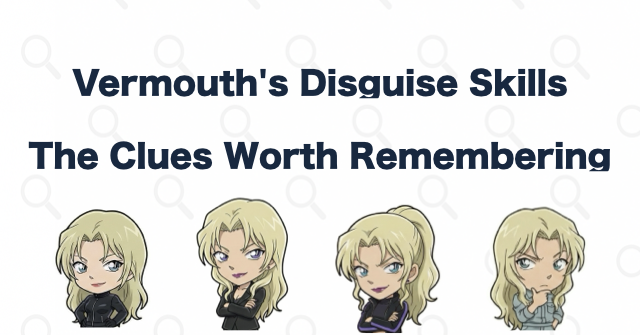
Vermouth’s disguises steal access, credibility, and trust as much as appearances. Araide gives her a place in ordinary life, Jodie gives her a colleague’s confidence, and Tsutomu gives her access to a family’s hope.
Her work for Bourbon and Irish expands that threat beyond the identities she personally performs. Yet the Azusa disguise shows the limit that matters most dramatically: her feelings for Ran can escape the role.
The combination of technical control and emotional vulnerability is why her disguises remain memorable long after the mask comes off.







Comments