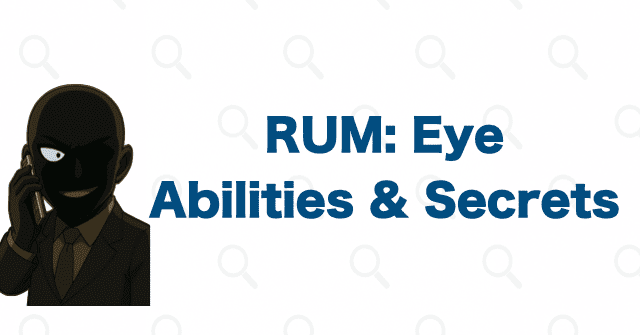
Spoiler warning: This article reveals Rum’s identity and discusses the seventeen-year-old case and File 1150.
Rum’s left eye is artificial. His everyday identity is Kanenori Wakita, the sushi chef whose eye patch conceals it. The unanswered question is how he lost that eye, rather than which eye is missing.
The flashback to Koji Haneda’s murder shows a younger Rum with both eyes and formidable powers of observation and recall. Photographic memory is a useful description of that threat; it should not turn every theory about his eyesight into an established supernatural ability.
The eye connects three strands of the story: the search for Rum, his actions seventeen years earlier, and the possibility that he wants a drug to restore something age or injury has taken away. Those strands have different degrees of certainty.
Why the artificial-eye clue leads to Wakita
Ai Haibara’s information about Rum contains incompatible descriptions of his appearance: a large, powerful man, a feminine-looking man, and an older man. The artificial eye is the common detail that survives those conflicting impressions.
That distinction changes how the suspect search works. A description of his build can send Conan in several directions, whereas an eye problem gives each candidate a concrete feature to investigate. Even that clue does not identify someone on its own.
The result is an effective diversion: Rumi Wakasa, Hyoue Kuroda, and Wakita all have eye-related details that can attract suspicion. Looking back, the clue was meaningful from the start, but its meaning was deliberately shared among several people.
The identity reveal gives the eye patch its meaning
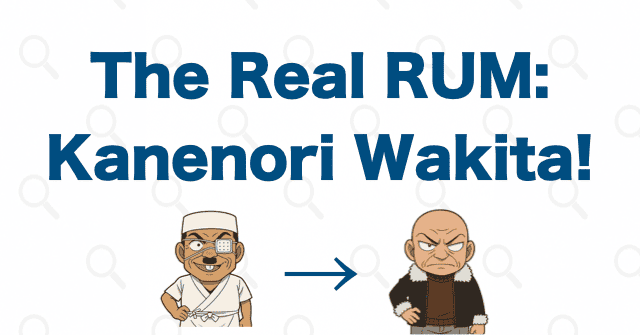
Wakasa’s apparent difficulty seeing, Kuroda’s injured right eye, and Wakita’s covered left eye belong to three different histories. Their resemblance as clues does not make the injuries interchangeable.
Kanenori Wakita is Rum. Once that identity is known, his left-eye patch joins up with the earlier information about an artificial eye. The apparently comic sushi chef carries the feature that mattered most.
What makes the reveal satisfying is the change in an ordinary detail. The eye patch remains the same object, but it now points directly to the Black Organization’s second-in-command. Wakasa and Kuroda’s eyes retain significance in their own stories.
What Rum’s memory shows in the seventeen-year-old case
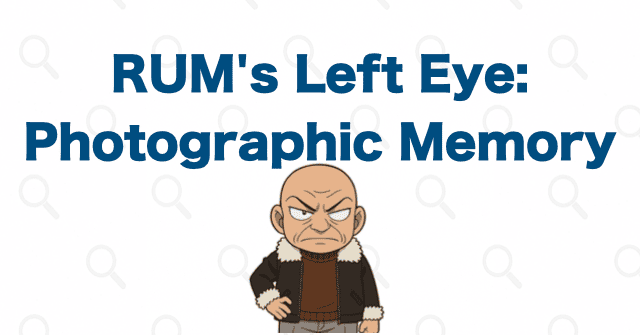
In the flashback to Koji Haneda’s murder, Rum still has both eyes. His observation and memory help him assess Amanda Hughes’s bodyguards and act against them. The danger lies in how efficiently he turns what he sees into useful information.
It is more revealing to follow that process than to call it a magic power: notice a face or position, retain the detail, and use it against the person involved. His strength is not simply physical force.
His attention to an irregularity in Haneda’s room gives the same ability a smaller, more unsettling scale. Information another person might overlook can become a lead for Rum. A minor visual discrepancy is enough to invite closer scrutiny.
That is why the lost left eye seems so consequential. It may represent a loss or weakening of an earlier advantage, but the flashback does not establish that all his memory is stored in an eye, or that replacing the eye alone would restore it.
Does File 1150 explain who injured Rum?
File 1150 strengthens the possible connection between Rum’s left eye and Tsutomu Akai; it does not conclusively show Tsutomu destroying that eye. The distinction matters when discussing the cause of the injury.
Rum sees Subaru Okiya and recalls Tsutomu, whom he believes to be dead. That association makes the Akai family difficult to leave out of the eye mystery. It also makes Okiya’s appearance more ominous without proving what Rum has deduced about Okiya’s identity.
The prospect of an old confrontation continuing through the Akai family is compelling. Yet an association in Rum’s memory is not a complete account of the injury. Asaka’s history and Kuroda’s injury should not be substituted for that missing account.
Could APTX4869 restore what Rum has lost?
The recovery theory starts with two observations: Rum once had both eyes and exceptional recall, while his present left eye is artificial. A desire to recover an old advantage would give his interest in bodily rejuvenation a disturbing personal dimension.
APTX4869 reduced Conan and Haibara to children’s bodies. From that unusual effect comes the possibility of turning an eye’s condition back to an earlier state. The drug’s effect on them does not demonstrate that it can regenerate Rum’s missing eye or restore his memory.
If Rum hopes to recover his former observational advantage, rejuvenation could seem attractive to him. That remains a theory about his motive and the drug’s possible use, rather than a demonstrated treatment.
What makes the possibility frightening is the practical consequence: an enemy who already notices too much might regain an advantage he once possessed. Whether Rum will take the drug, and what would happen if he did, remain unresolved.
Three eye clues, three different histories
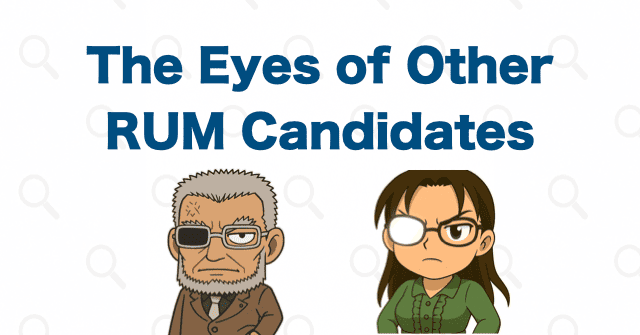
- Kanenori Wakita: Rum’s covered left eye is artificial. Tsutomu Akai may have been involved in the injury, but the cause has not been conclusively shown.
- Hyoue Kuroda: his right-eye injury belongs to the history surrounding the events seventeen years earlier and his police role. It is separate from Rum’s left-eye prosthesis.
- Rumi Wakasa: her difficulty seeing is tied to her own story as Asaka and the Haneda case. It should not be treated as Rum’s artificial eye.
Why this small clue carries so much of the Rum story
The firm starting point is simple: Wakita is Rum, and Rum’s left eye is artificial. The earlier rumors explain why several candidates looked plausible; the flashback explains why Rum’s observation and recall deserve attention beyond the identity puzzle.
File 1150 makes the possible Tsutomu connection more charged, while the APTX4869 theory raises a different question about recovery. Neither the exact injury nor a successful restoration should be presented as settled. The mystery becomes more interesting when those limits stay visible.
I find the progression especially effective: an external feature becomes a clue to identity, then to an old conflict, and finally to a possible vulnerability. The frightening part is the same throughout. What Rum sees can matter long after the moment has passed.
Further reading (contains spoilers): The 17-Year-Old Truth episode and manga guide.

Comments