Spoilers: Kaito Kid’s identity and family history in Magic Kaito, Detective Conan cases through Volume 105, and movie targets through The Million-dollar Pentagram. Movie evidence is discussed separately.
What has Kaito Kid actually stolen so far?
Has he targeted anything besides jewels?
Kaito Kid is usually pictured making a spectacular escape with a Big Jewel. That image is accurate, but it is not the whole list: across Magic Kaito, the main Detective Conan story, and the movies, he also becomes involved with crowns, paintings, a safe, historic objects, and even a Japanese sword.
For Kaito Kid, an object he steals, an object he targets, and an object he steals but later returns are not necessarily the same thing.
Keeping those categories separate reveals more than a list of trophies. A jewel can be the target of a notice, a temporary theft, or a clue in a larger search. His heists connect to the apparent death of his father, Toichi Kuroba, and to Kaito Kuroba’s search for Pandora.
How to Read Kaito Kid’s Targets
Kaito Kid’s targets are centered on Big Jewels, but that is not the whole story. His early adventures and movie appearances also involve objects that are not gems.
The key point is that Kid does not simply keep every object he takes: he often returns a jewel after determining that it is not Pandora.
At other times, his appearance helps move a case toward the truth rather than serving as a straightforward theft. The glamour of his performances sits beside grief over his father and anger toward a mysterious organization. That contrast is why a Kid case can feel playful in one moment and unexpectedly sad in the next.
Separate What He Stole, Targeted, and Returned
The clearest approach is to distinguish objects Kid stole, targeted, returned, or merely encountered during a case.
Even when he succeeds in taking a jewel, he may give it back after finding that it is not Pandora. Conversely, sending a notice and declaring a target does not prove that he ultimately stole it.
- Objects he actually stole
- Objects named in a notice or otherwise targeted
- Objects he stole and later returned
- Objects presented as targets but not actually stolen
- Objects connected to restitution or solving a case
The sections below group notable targets by series and explain special cases involving a safe, returned property, or a declared target. The reason Kid becomes involved can be more revealing than the object’s name.
He Steals Jewels to Search for Pandora
Kaito Kid’s central reason for targeting Big Jewels is to find and destroy Pandora.
Pandora is said to be a special jewel hidden within a Big Jewel, and the search for it forms a major continuing thread in Magic Kaito.
The current Kaito Kid is Kaito Kuroba. His father, Toichi Kuroba, was the original Kaito Kid. While pursuing the truth about Toichi’s apparent death, Kaito draws closer to Pandora and the mysterious organization associated with it.
That purpose becomes especially prominent from Blue Birthday onward. Kid’s act of holding a Big Jewel up to the moon is visually elegant, but the loss and desire for revenge behind it give the ritual a bitter edge.
Not every target is part of the Pandora search. As a movie-only example, The Million-dollar Pentagram shows Kid targeting a Japanese sword for reasons tied to his father rather than a gemstone.
Kaito Kid’s Targets in Magic Kaito
Magic Kaito shows the roots of Kid’s career. His early targets include more than jewels, and the story has not yet narrowed its focus to Pandora.
Blue Birthday changes the meaning of the heists by bringing Pandora to the foreground. Looking back, the shift in tone between the early thefts and later Big Jewel cases is striking.
Through the lens of Magic Kaito, the heists become a son’s pursuit of the truth about his father as well as flamboyant magic shows.
Many Early Targets Were Not Jewels
Early Magic Kaito stories involve several kinds of treasure. Before Pandora dominates the plot, Kaito’s search for traces of Toichi is the stronger emotional current.
- Moon’s Eye, a diamond
- Paris Is Full of Sunshine, a diamond
- Angel’s Crown
- Cleopatra’s vanity case
- Adam’s Smile, a painting
These adventures feel less like a systematic hunt for Big Jewels and more like a bereaved boy following his father’s shadow.
Adam’s Smile also brings Saguru Hakuba into the action, widening the circle of detectives around Kid. The episode matters not only for its target but also for the changing distance between the characters.
Big Jewels Targeted After Pandora Was Revealed
From Blue Birthday onward, Kid’s thefts lean much more heavily into the search for Pandora. The familiar pattern of taking a Big Jewel and examining it in moonlight becomes central.
- Blue Birthday, a sapphire
- Green Dream, an emerald
- Crystal Mother, a topaz
- Red Tear, a ruby
- Golden Eye, a cat’s-eye
- Dark Knight, a black opal
- Midnight Crow, a black diamond
- Sun Halo, a yellow diamond
Blue Birthday is the turning point that gives Kid’s jewel thefts a darker purpose. The showmanship remains, but danger, death, and revenge now sit behind the moonlit search for Pandora.
Green Dream and Red Tear also place strong human stories around the owners of the jewels. Kid’s intervention can become a catalyst for another person’s feelings rather than merely the removal of a gem.
Midnight Crow brings Kaitou Corbeau into the picture and deepens Toichi’s shadow over the story. The item belongs on the list, but the larger importance lies in how the mystery surrounding Kid’s father advances.
Targets That Need Careful Classification
Not every notable object in Magic Kaito should be placed in a simple list of successful thefts. Some are targets, plot symbols, or objects with a different role in the case.
The clock tower’s hour hand and diamonds are best treated as elements of the story leading into Black Star, not as ordinary Big Jewel entries.
Midnight Crow likewise carries more weight through Kaitou Corbeau and the presence of Toichi’s mystery than through the stolen object alone. The lasting question is what Kaito learns and what he begins to suspect.
Kaito Kid’s Targets in the Main Detective Conan Story
In the main Detective Conan story, many of Kid’s Big Jewel challenges are built around his rivalry with Jirokichi Suzuki. These appearances emphasize cases, deductions, and direct contests more strongly than Magic Kaito does.
A jewel theft may appear to be the whole event, yet Kid’s presence often redirects the atmosphere and the path to the truth. That interaction between theft and mystery gives these cases their distinctive energy.
Big Jewels Targeted in the Main Story
Many of Kid’s main-story targets come with an elaborate security challenge arranged by Jirokichi Suzuki. Kid attempts the theft, Jirokichi tries to stop him, and Conan works out the trick.
- Black Star, a black pearl
- Blue Wonder, an aquamarine
- Purple Nail, an amethyst
- Qilin’s Horn, an amber object
- Blush Mermaid, a red diamond
- Green Emperor, an alexandrite
- Luna Memoria, a moonstone
- Fairy Lip, a conch pearl
- Queen’s Bang, a garnet
- Siren Splash, a tourmaline
- The Azure Throne, a chair decorated with tanzanite
Black Star is the crucial target associated with Kaito Kid’s first appearance in the main Detective Conan story and the beginning of his rivalry with Conan.
From Blue Wonder onward, the challenges involving Jirokichi become more prominent. Fairy Lip, Queen’s Bang, and Siren Splash also weave character emotions and relationships into the spectacle surrounding the jewels.
Other Targets and Special Cases
Some main-story cases involve paintings, a safe, or returned property. Others involve a jewel presented as a target without a completed theft. These cases need more explanation than a gemstone name alone.
- Seiran, a painting — connected with a painting case
- Iron Tanuki, a large safe — a safe-opening challenge
- Objects associated with Ryoma Sakamoto — returned property
- Nio Stone, a diamond — presented as a target; treated separately from a completed theft
Seiran centers on a disturbing case involving a painting, while Iron Tanuki makes the safe itself the memorable challenge. The latter highlights Kid’s technique and boldness through the question of how he will open it.
In the story involving objects connected with Ryoma Sakamoto, Kid acts more as someone returning stolen property than taking it for himself. Nio Stone is more clearly classified as an object presented as a target than as a completed theft.
The Azure Throne: a Jewel Set in a Chair
The Azure Throne adds a jewel set in a chair to Kid’s targets. The case appears in Volume 105, Files 1119–1122, and international episodes 1252–1253 (Japanese episodes 1193–1194), Kid VS Hakuba: The Azure Throne (Part 1) and Kid VS Hakuba: The Azure Throne (Part 2).
The Azure Throne is a chair decorated with an exceptionally large tanzanite rather than a loose jewel. The confrontation among Kaito Kid, Saguru Hakuba, and Conan is a central attraction of the case.
A separate incident also occurs where Kid attempts the theft, creating the familiar Detective Conan shift from a dazzling notice to a much colder mystery. That contrast gives the case both spectacle and tension.
What Kaito Kid Stole or Targeted in the Movies
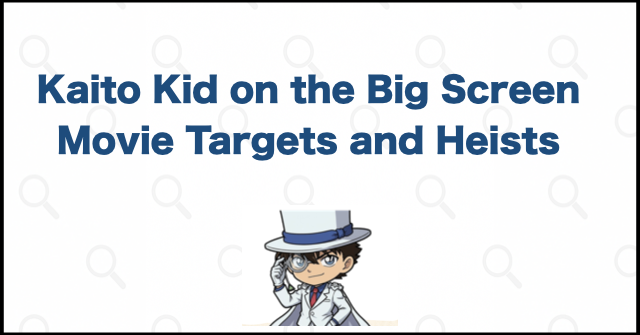
Kaito Kid’s role in the movies differs somewhat from his place in the manga and television continuity. Movie-only targets include not only jewels but also art and a Japanese sword.
In these stories, a declared theft may launch the case or give way to an effort to protect someone. The important question is often what Kid is hiding or trying to preserve, not simply whether he takes the target.
Jewels and Art Targeted in the Movies
The meaning of Kid’s target changes from one movie to another, and the list extends beyond gemstones.
- Imperial Easter Egg
- Jewel of Destiny
- Lady Sky
- Vincent van Gogh’s Sunflowers
- The Fist of Blue Sapphire
The Imperial Easter Egg in The Last Wizard of the Century is a defining movie target, combining a beautiful treasure with history and a family story.
The Jewel of Destiny in Magician of the Silver Sky foregrounds Kid’s theatrical glamour. Lady Sky in The Lost Ship in the Sky and the Fist of Blue Sapphire in The Fist of Blue Sapphire use the larger scale available to the movies.
Vincent van Gogh’s Sunflowers in Sunflowers of Inferno is the clearest art example and demonstrates the breadth of Kid’s movie targets. These are movie-only examples and should not be treated as manga evidence for his regular Pandora hunt.
He Targeted a Japanese Sword in The Million-dollar Pentagram
In The Million-dollar Pentagram, Kaito Kid targets a Japanese sword rather than a Big Jewel. This is an important exception in any list of his targets.
The sword is associated with Toshizo Hijikata. Because a sword is so unlike Kid’s usual Big Jewel targets, the question of why he wants it becomes part of the movie’s mystery.
The film also combines Heiji and Kazuha’s romantic storyline, a case set in Hakodate, and a secret connected with Kid. The non-jewel target leads the movie closer to Kid’s personal story than a routine jewel challenge would.
What the List Reveals About Kaito Kid’s Role
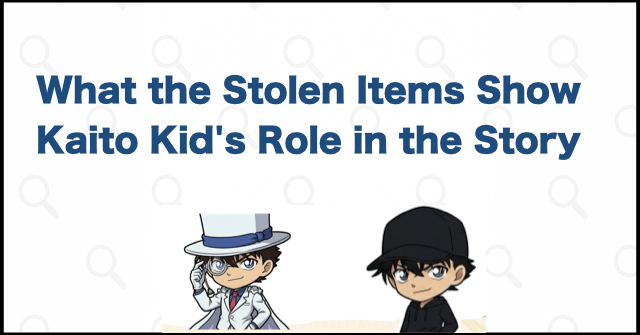
Taken together, these targets offer more than an inventory of treasure. They point toward the search for Pandora, Toichi Kuroba’s apparent death, help given to others, cases moved toward resolution, and Kid’s rivalries.
Read only as names, the targets form a jewel list; read with their context, they trace Kaito Kid’s story.
Thefts Connected to the Search for Pandora
Big Jewel heists connect directly to the continuing search for Pandora. Blue Birthday marks the clearest change in that direction.
After that point, Kid does not take jewels solely for possession; he examines them to determine whether one is Pandora. The beautiful image of a jewel held to moonlight gains a darker meaning through Toichi’s apparent death.
Crystal Mother, Red Tear, and Midnight Crow are therefore more than jewel stories. Through these treasures, Kaito Kuroba continues moving closer to the truth surrounding his father.
The heists remain bright and theatrical even though loss lies beneath them. That duality also shapes the impact Kid has whenever he enters the main Detective Conan story.
Thefts That Help People or Move the Truth Forward
Kaito Kid sometimes acts to help someone or push a hidden truth into view rather than merely to acquire treasure.
The objects associated with Ryoma Sakamoto provide the clearest example: Kid becomes involved in returning what was stolen. His role reverses the usual image of a thief by restoring objects to where they belong.
When a painting, Sunflowers, or a sword is involved, his function shifts again. He becomes the figure who disrupts the scene and changes the direction of the case.
Kid’s jokes and dazzling tricks can leave behind warmth or bitterness, because his appearances change the emotional temperature of the story as well as its plot.
Summary
Big Jewels make up the center of Kaito Kid’s targets. Across early Magic Kaito stories, the main Detective Conan narrative, and movie-only cases, however, he also encounters crowns, paintings, a safe, historic objects, and a Japanese sword.
He does not keep everything he takes. When a jewel proves not to be Pandora, he may return it, and in other cases his intervention helps someone or brings the truth closer.
The targets fall into several roles: the search for Pandora, the pursuit of Toichi Kuroba’s mystery, the disruption of a case, and movie-only exceptions. Together, those roles give Kaito Kid far more depth than a simple catalog of stolen treasure suggests.
His stories are exhilarating yet touched by sadness, and a theft can end on a surprisingly warm note. That unusual aftertaste is one of the enduring pleasures of a Kaito Kid appearance.
Further reading (contains spoilers): Kaito Kid and the Black Organization theory.


Comments