Spoilers include the Police Academy Arc, Mystery Train, and the later Café Poirot encounter; the Black Iron Submarine discussion concerns the movie separately.
How are Tooru Amuro and Elena Miyano connected?
Does knowing Elena mean Amuro knows who Haibara is?
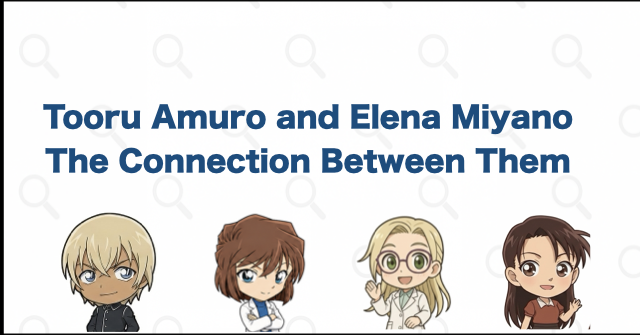
Elena Miyano treated Rei Furuya as a child, and she is strongly implied to be the first love he later wanted to find. Rei is the man now known as Tooru Amuro, an officer of the Public Security Bureau working undercover as Bourbon. Elena is Ai Haibara‘s mother.
Their connection began at the Miyano Clinic. Rei repeatedly went there with injuries, sometimes deliberately hurting himself so that he could see Elena. She treated him and challenged the prejudice directed at his appearance.
Elena connects Amuro to the Miyano family, but that connection does not establish that he knows Haibara is Shiho Miyano. His childhood memories, his knowledge as Bourbon, and Haibara’s hidden identity are three different parts of the story.
That separation is what makes the relationship so bitter. The doctor who welcomed an injured boy later became the Organization scientist known as Hell Angel. The boy eventually entered that same organization as an undercover officer. The warmth of the clinic survives in the story, even as their later roles change its meaning.
The scenes below explain the first-love reading, Elena’s disappearance, and Rei’s reason for entering police work, then trace his separate connections to Akemi Miyano and Shiho.
Elena Miyano and Tooru Amuro Were Doctor and Patient
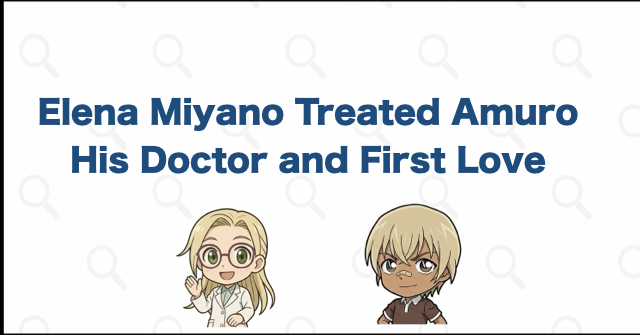
Elena was a doctor at the Miyano Clinic. Her young patient was Rei Furuya; he was not yet using the alias Tooru Amuro. She knew the boy behind the identities the adult would later adopt.
Rei often fought after other children mocked his appearance. The resulting injuries gave him reasons to visit the clinic, but treatment was not always the whole point. He sometimes created an injury because he wanted to see Elena again.
Her importance lies in how she responded to him. She discouraged the fighting without dismissing the hurt that caused it. In that sense, the clinic offered more than medical care: it gave him an adult who accepted him.
Young Rei Furuya Kept Visiting the Miyano Clinic
Elena worked at the clinic with her husband, Atsushi Miyano. Young Akemi also brought the injured Rei there. His childhood connection was with the Miyano household, not just with one doctor. That matters when Bourbon later speaks about knowing Sherry’s family.
Deliberately getting hurt is a dangerous way to seek someone’s attention. As characterization, though, it makes the young Rei unusually unguarded: he wants a reason to be treated by Elena and to talk with her.
The clinic may have been a place where a boy mocked for his looks could feel accepted as he was. Compare that with the adult who carefully manages several identities, and the memory acquires another warmth. Here, he is simply Rei.
Elena Miyano Was Rei Furuya’s First Love
Elena is best understood as Rei’s childhood first love. The main manga does not give him a direct declaration that Elena was his first love. The reading comes from the clinic memories and the older woman he describes in the Police Academy Arc, which strongly point to her.
His willingness to get hurt just to see her, and the vivid memory he carries as an adult, make the attachment clear. The scene presents a child’s crush and admiration for a kind doctor, with gratitude toward an adult who defended him. It does not depict a reciprocal adult romance.
That openness makes the later contrast more affecting. The boy who once made excuses to see Elena becomes a guarded undercover officer; the doctor he admired becomes an Organization scientist. The tenderness of the memory and the danger of the later setting now belong to the same history.
Elena Became an Ally Against Prejudice About His Appearance
Rei had been mocked for his hair and skin color. Elena objected to the prejudice as well as the fighting. She could tell him to stop getting into fights without treating his anger as meaningless.
“Black people, white people, and Asian people all have the same red blood flowing through them. Tell them that.” — Elena Miyano (unofficial translation)
“But if it is an honorable wound from making up with the person you fought, I can at least put a bandage on it.” — Elena Miyano (unofficial translation)
Her answer gives him something more useful than a reprimand: words with which to challenge the prejudice, and a way to make peace with the other child. The distinction matters. She is correcting his response while refusing the idea that his appearance makes him lesser.
For a reader who knows Rei’s later aliases, her insistence that people share the same human core has an added resonance. The names and roles will change; the person beneath them remains. That is an interpretation of the contrast between the childhood and adult scenes, rather than a stated explanation for his undercover identities.
Manga and Anime Stories That Reveal Elena and Amuro’s Connection
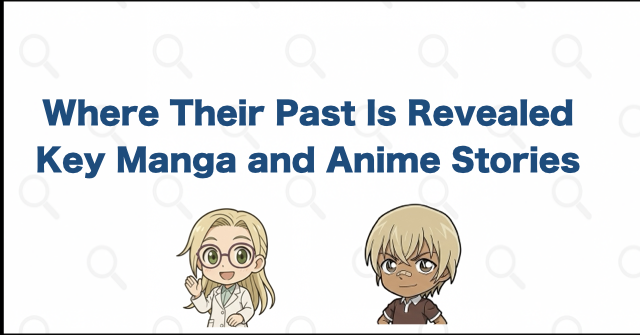
The connection is revealed in stages. Volume 84 first gives us an unnamed woman in a white coat calling Amuro “Rei.” Volume 95 identifies her as Elena and fills in the Miyano Clinic memories. The Police Academy Arc then connects the missing woman to his wish to become an officer.
- Volume 84, File 889, “Zero”; Episode 824 (Japanese episode 771), “The Tense Tea Party (Part 2)”
- Volume 95, Files 1010-1011; Episodes 1010-1011 (Japanese episodes 953-954), “The Unsolved Cocktail Case (Part Two)” and “The Unsolved Cocktail Case (Part Three)”
- Police Academy Arc, CASE: Rei Furuya
Each later disclosure changes how the earlier scene reads. A clue to a real name becomes a memory of affection and separation, then part of the histories of the Miyano family and the Karasuma Group.
Volume 84, File 889 and Episode 824 Reveal the Name “Rei”
The first hint is in Volume 84, File 889, “Zero,” adapted as international Episode 824, Japanese episode 771, “The Tense Tea Party (Part 2).” During the Haido Central Hospital case, Amuro remembers treatment from a woman in a white coat. At this point, her identity is still withheld.
She calls him Rei and says she is going far away. Her goodbye appears below in unofficial translation.
“I told you not to fight again. Even if you come back hurt, I will not be able to treat you, because I am going far away.” — Elena Miyano (unofficial translation)
“I guess this is goodbye, Rei.” — Elena Miyano (unofficial translation)
Initially, the exchange helps uncover Amuro’s name. After Volume 95, its gentle goodbye becomes harder to hear: Elena is preparing to move, while Rei is losing someone important without knowing where she will go. The words have not changed, but what the reader knows about them has.
Volume 95, Files 1010-1011 and Episodes 1010-1011 Connect the Past
Volume 95, Files 1010–1011, identifies the doctor as Elena. The anime adaptation is international Episodes 1010–1011, Japanese episodes 953–954, “The Unsolved Cocktail Case (Part Two)” and “The Unsolved Cocktail Case (Part Three).” The later flashback supplies the family behind the earlier memory.
A reference to an injury prompts Amuro’s recollection. We learn that he sometimes hurt himself to see Elena. She is pregnant with Shiho, and she and Atsushi discuss moving to a research facility. The conversation is ordinary family planning until the sponsor’s name, the Karasuma Group, changes what it means to readers.
This is why the revelation does more than identify a face. Elena is Haibara’s mother, Rei’s childhood attachment, and a future Organization scientist. Several apparently separate histories meet in one quiet clinic. The brief flashback can linger after the immediate case because it rearranges so much of the larger story.
CASE: Rei Furuya Explains One Reason He Wanted to Be a Police Officer
In CASE: Rei Furuya, Rei tells Jinpei Matsuda about a woman he is looking for who suddenly disappeared. The clinic scenes make Elena the strongly implied woman, although he does not name her in that conversation.
His wish to find her links a personal childhood loss to a profession concerned with finding the truth. That gives the career choice emotional weight without turning every later assignment into an extension of the same crush.
The distinction is important: seeking Elena helps explain an origin of his police career. It does not establish why he was assigned to Public Security or sent into the Black Organization. The friendships, experiences, and losses that followed also belong to the adult Rei’s history.
Why Did Elena Miyano Disappear from Amuro’s Life?
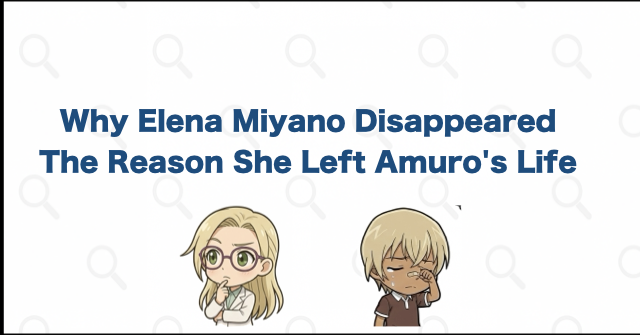
Elena left Rei’s life when the Miyanos decided to leave the clinic for a research facility. The Karasuma Group was backing that research. What looked like support for Atsushi’s work would lead the family toward the Black Organization.
The offer and its eventual consequences should be kept separate. Atsushi was being offered a place to continue work others had not accepted; the scene does not establish that the couple already understood the sponsor’s full criminal nature.
Atsushi Miyano Accepted Support from the Karasuma Group
Atsushi’s research had received little understanding, so an offer of funding and a suitable facility mattered. Elena was pregnant with their second child, and they were weighing a change to both work and family life. The disturbing part is how quietly the turning point enters an ordinary conversation.
For readers who know Renya Karasuma’s connection to the Organization, the sponsor’s name casts a shadow over that hopeful possibility. The couple can discuss their future calmly while the reader sees where the move will lead. That difference in perspective gives the scene its unease.
We do not know how much Elena and Atsushi understood about the group when they accepted. Calling the move a knowing choice to conduct criminal research would erase that uncertainty. The scene establishes the invitation and the decision, not their knowledge of every consequence.
Elena Cannot Be Treated as the Sole Reason for Rei’s Undercover Career
Elena is one starting point for Rei’s police career; she does not explain its whole course. A wish to locate a missing woman and a national undercover assignment are connected parts of his life, but they are not interchangeable motives.
At the academy, he trained alongside Jinpei Matsuda, Kenji Hagiwara, Wataru Date, and his childhood friend Hiromitsu Morofushi. Their friendships and rivalry, followed by later experiences and losses, helped shape the convictions he shows as an adult.
The story contains no statement that he infiltrated the Organization specifically to reach Elena. Leaving room for his later commitments gives Rei more depth: a deeply personal beginning can grow into a responsibility larger than the person he first wanted to find.
How Much Does Amuro Know About Elena Miyano?
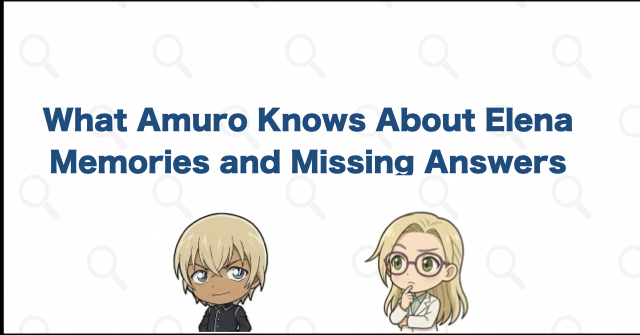
Amuro knows Elena was called Hell Angel and that she was Sherry’s mother. His knowledge of APTX 4869, its effect on age, and the details of the laboratory fire is less clear.
The boy’s memory of a gentle doctor and Bourbon’s information about an Organization scientist concern the same woman. The gap between those two views is compelling, but it should not be filled with information the story has never shown him receiving.
He Knows the Nickname “Hell Angel”
On Mystery Train, Bourbon calls the apparent Shiho Hell Angel’s daughter. His wording establishes knowledge of Elena’s Organization epithet and her relationship to Sherry.
It also connects the doctor he knew with the scientist he now names. What remains missing is the route between those discoveries: the story does not show when he learned it or which assignment brought him the information.
Perhaps he found traces of the woman he had searched for inside the Organization he infiltrated. That is a possibility, not a confirmed sequence. If that reading is right, reaching her history would carry a bitter reward: the affectionate childhood memory would lead to the name Hell Angel. Even without confirming the route, the contrast gives the alias weight.
His Knowledge of APTX 4869 and Elena’s Death Is Unclear
An alias is not evidence of complete knowledge of the research. Elena worked on the Organization’s research and called APTX 4869 the Silver Bullet. None of the scenes discussed here shows Amuro explaining the drug’s workings or its effect on age.
His undercover status alone cannot fill that gap. It is reasonable to consider that research staff and field operatives may receive different information, but the article cannot turn that possibility into a confirmed account of what Bourbon was told.
Likewise, when he learned of Elena and Atsushi’s deaths in a laboratory fire, and how much he knows about the circumstances, remain unclear. The gap between his memories and his later information leaves room for their histories to connect again; it does not tell us what a future revelation will be.
Amuro’s Connections to Akemi Miyano and Shiho Miyano
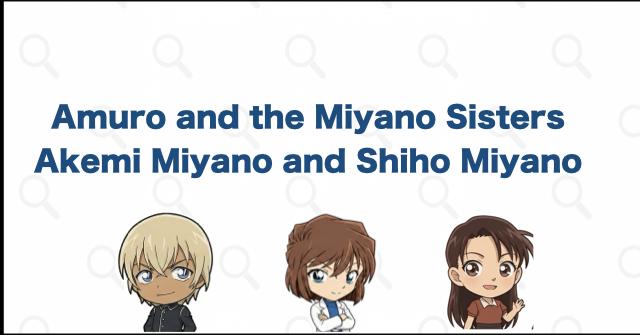
Rei knew Akemi in childhood; his supposed meeting with Shiho on Mystery Train was actually with Kaitou Kid in disguise. These are separate encounters with very different implications.
Knowing the Miyano family does not automatically mean knowing Haibara’s identity. The scenes discussed below establish the state of the question through July 20, 2026; later material is outside this article’s scope.
He Knew Akemi Miyano in Childhood
Young Akemi brought the injured Rei to the clinic for Elena to treat him. That small act gives him a direct childhood connection to Haibara’s older sister. He was part of the family’s everyday surroundings before their departure.
Her care for an injured child also echoes the kindness later associated with her efforts to protect Shiho. There is no established adult reunion with Rei in the material discussed here, however. The childhood connection is real; what became of it afterward is a gap in the story, which gives the memory a quieter sadness.
The “Shiho” on the Mystery Train Was Kaitou Kid in Disguise
Bourbon believed the woman before him was Shiho, but the listener was Kaitou Kid. The Organization was pursuing Sherry on the Bell Tree Express, and Conan’s side used Kid’s disguise to protect the real Haibara.
“As expected of Hell Angel’s daughter. You look very much like her. It is a pleasure to meet you. Bourbon—that is my codename.” — Bourbon (unofficial translation)
His introduction indicates that he had not met Shiho before. He had known Elena, Atsushi, and Akemi, but the family had left his life before Shiho grew up. The distinction comes from what he says, rather than from an assumed friendship with every member of the family.
The disguise makes the scene a striking near-connection. Bourbon reveals his knowledge of Shiho’s family, yet Shiho herself is not there to hear him. It looks like the past is being shared across the gap between them; the person receiving it is someone else. The scene therefore cannot establish an exchange of secrets between Amuro and Haibara.
Confirmed Childhood Acquaintances Are Elena, Atsushi, and Akemi
Bourbon also explicitly says he has met Shiho’s parents and sister. The confirmed acquaintances are Elena, Atsushi, and Akemi.
“I have met your parents and your sister.” — Bourbon (unofficial translation)
Read alongside his introduction, the statement draws a clear line between those three and Shiho. Amuro had not known the entire Miyano family all along. That limitation is essential when discussing his later proximity to Haibara.
It also makes his role in the confrontation more uncomfortable. As Bourbon, he tries to return the daughter of the family who once cared for him to the Organization. The warm memory is being invoked during a threatening mission. His complete private intent at that moment is not established here, so that tension should remain unresolved rather than be explained away.
There Is No Confirmation That Amuro Knows Haibara Is Shiho
The material covered here does not confirm that Amuro knows Ai Haibara is Shiho Miyano. On Mystery Train, Bourbon is made to believe Sherry died in the explosion. The scenes discussed here do not show him learning that the real Haibara survived.
In Volumes 101–102, “Takagi and Date and the Notebook Promise,” Amuro and Haibara are together at Café Poirot. The adaptation is international Episodes 1167–1168, Japanese episodes 1109–1110, “Takagi and Date and the Notebook Promise (Part 1)” and “Takagi and Date and the Notebook Promise (Part 2).” The encounter gives readers a later moment in which to examine his attention to her.
His look can invite suspicion, but it does not identify what he has noticed. A resemblance to Elena is one possible reading; attention for another reason is another. He does not state that Haibara is Shiho. The scene is suggestive precisely because it leaves that distinction open.
Black Iron Submarine separately raises the Organization’s suspicion that Haibara and Shiho are the same person. The movie evidence discussed here does not give Amuro a clear recognition scene, either. Movie-specific suspicion cannot resolve his knowledge in the manga.
Nor do these scenes establish that he protects Haibara because of Elena. His Public Security duties, Bourbon role, and dealings with Conan all complicate his actions. What is moving is the proximity: the man who wanted to find Elena and the daughter who lost her can be near each other without a confirmed shared understanding of that history. A future conversation could join those threads, but the story covered here has not done so.
Conclusion
The clinic memory is an origin for Rei, and an unfinished connection to Haibara. The main distinctions are:
- Elena treated Rei and defended him against prejudice; his childhood attachment is strongly implied to be a first love.
- The family left for a Karasuma Group-backed research facility; their knowledge of its hidden nature is unclear.
- Searching for Elena helps explain his police career’s beginning, without establishing the motive for every later assignment.
- He knew Elena, Atsushi, and Akemi. His supposed meeting with Shiho was with Kid in disguise.
- He knows Elena’s alias and family connection, but the covered material does not confirm that he knows Haibara is Shiho.
What stays with me is the way a gentle childhood memory becomes part of an Organization story without losing its warmth. The injured boy and the doctor who accepts him remain visible beneath Bourbon and Hell Angel. The later danger changes how the past feels; it does not replace it.
The name “Rei” first opens a question about Amuro’s identity. Later, the same short memory carries a first love, a goodbye, the Miyano family, and the Karasuma Group. That gradual change in meaning is the strongest part of the construction.
Elena matters both as someone Rei once wanted to find and as the mother of a girl now living nearby under another name. Their connection has almost reached across the years, but there is still an unspoken part between Amuro and Haibara. That open space gives the relationship its continuing force.
Further reading (contains spoilers): Haibara and Akai's family connection.

Comments