Spoilers for Vermouth’s identities through manga Volume 100 and the corresponding anime, plus The Raven Chaser, Black Iron Submarine, and The Million-dollar Pentagram.
Vermouth personally impersonates Dr. Tomoaki Araide, Tsutomu Akai, Yusaku Kudo, Jodie Starling, Azusa Enomoto, and several other people. She also creates disguises for Bourbon and Irish. Distinguishing the person wearing a face from the person who made it is essential, especially with scarred Akai.
Her most dangerous skill is choosing whose trust an identity will unlock. Araide gives her access to ordinary school life, Jodie lets her question an FBI colleague, and Tsutomu lets her exploit Mary’s hope for her husband’s return. The appearances, purposes, and failures below show how much more is involved than a convincing mask.
Which disguises does Vermouth wear herself?

Her manga and television identities include Sharon Vineyard, a bartender, Tomoaki Araide, Inspector Radish Redwood, the silver-haired serial killer, Kiriko Busujima, scarred Shuichi Akai on the Mystery Train, Motoe Benzaki, Jodie Starling, Azusa Enomoto, Tsutomu Akai, and Yusaku Kudo. The films add the unnamed female hostage in The Raven Chaser and the cleaner and elderly woman in Black Iron Submarine.
Two distinctions prevent common mix-ups. First, the scarred Akai on the Mystery Train is Vermouth, while earlier appearances include Bourbon’s impersonation. Second, Vermouth performs Motoe Benzaki; Bourbon plays her husband Tohei. The false Kiyonaga Matsumoto in The Raven Chaser is Irish.
Sharon belongs in the guide as a sustained public identity rather than a temporary borrowed face. By contrast, the manipulation of age-recognition results in Black Iron Submarine is a separate operation: it does not establish that Vermouth personally played every Shiho-like woman seen around the world. It should not be counted as one straightforward, confirmed impersonation of Sherry.
The manga and anime disguises, with their purposes
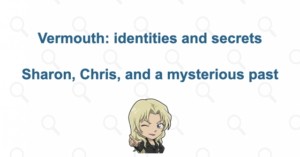
Sharon and Chris Vineyard: constructing two public lives
Vermouth performs both the internationally known actress Sharon Vineyard and her supposed daughter Chris. After maintaining Sharon’s career, she stages Sharon’s death and moves into the daughter’s public role. The deception includes professional history and personal relationships, notably Sharon’s friendship with Yukiko Kudo.
This is a much larger undertaking than passing as someone else for a few minutes. Vermouth sustains the fiction of a mother and daughter across years, giving two apparent lives to one person. It connects directly to her apparent failure to age.
Which appearance is her original face, or whether an earlier identity lies behind both, remains unconfirmed. The disguise explains how she presents herself to the world, not the origin of the person beneath it.
The bartender and Dr. Araide: two uses of the same skill
Volume 29’s The Mysterious Passenger, international episodes 249–250 (Japanese episodes 230–231), places a brief disguise alongside a prolonged infiltration. Vermouth approaches her Organization colleagues as a bartender, but Gin recognizes her. Their martini banter plays on the cocktail made with gin and vermouth. It suggests familiarity; it does not establish a romantic or sexual relationship.
Araide is the more consequential role. Vermouth researches the real doctor, adopts his speech and professional behavior, and fits into his position as Teitan High School’s physician. Her target is Sherry, now living as Ai Haibara after shrinking. The real Araide and his family are kept out of danger under FBI protection.
The reveal comes in Volume 42 and Head-to-Head Match with the Black Organization: A Dual Mystery on a Full Moon Night (2.5 Hour Special), international episodes 371–375 (Japanese episode 345). Her impersonation can be securely followed from Volume 29 / Japanese episode 230 onward. An earlier starting point in Volume 26 / Japanese episode 190 remains unconfirmed here.
During the bus hijacking, the disguised Vermouth tries to protect Conan. That action complicates the operation: she is using the doctor’s reassuring presence to reach Haibara, yet intervenes for Conan’s sake. Discovering the impostor does not resolve the contradiction in her intentions.
Inspector Redwood and the silver-haired killer in New York
In Volumes 34–35, Vermouth uses both the identity of Inspector Radish Redwood of the New York police and the appearance of a silver-haired Asian serial killer. Shinichi Kudo’s New York Case spans international episodes 308–310 (Japanese episodes 286–288), with the parts titled The Case, The Deduction, and The Resolution.
The killer’s appearance serves her attempt to draw out FBI agent Shuichi Akai. During the operation, she nearly falls from a height, and Shinichi Kudo and Ran Mouri save her. They do not know the person behind the disguise; they reach for someone they believe to be a dangerous stranger.
For Vermouth, that rescue outlasts the operation. It helps explain the special regard she later gives Conan and Ran. A face intended for an attack becomes the setting of a debt she carries into later cases. The disguise ends, but the relationship it creates does not.
Kiriko Busujima in Black Impact
Vermouth impersonates Kiriko Busujima, a woman associated with an organized-crime group, in Volumes 48–49. The adaptation is Black Impact! The Moment the Black Organization Reaches Out (2.5 Hour Special), international episodes 459–463 (Japanese episode 425).
She uses the identity during the planned assassination of Yasuteru Domon, helping stop his vehicle and create an opening for the Organization’s snipers. Unlike the Araide infiltration, this role does not require taking over months of daily life. It needs a particular person’s credibility at one critical point in an operation. A borrowed identity becomes a way to arrange the target’s movements.
Scarred Akai on the Mystery Train
In Volume 78’s Mystery Train case, scarred Akai is Vermouth herself. The anime runs through Japanese episodes 701–704; its conclusion, The Jet-Black Mystery Train (Destination), is international episode 756.
She uses that appearance while assisting Bourbon’s pursuit of Sherry and unsettling people connected with Akai, particularly Masumi Sera. The likeness carries the emotional force of a man believed dead, making the reactions to it useful to the operation.
Earlier appearances during the bank robbery and department-store bombing cases include Bourbon wearing the same face to investigate whether Akai really died. They should not be reassigned to Vermouth because she wears it on the train. The case, target, and objective identify the operative more reliably than the scarred face alone.
Motoe Benzaki and Jodie: approaching the FBI from inside its trust
In Volumes 80–81, Vermouth plays Motoe Benzaki alongside Bourbon as Tohei Benzaki. The anime is Jodie’s Memories and the Cherry Blossom Viewing Trap (1 Hour Special), international episodes 786–787 (Japanese episode 734). Their coordinated behavior as an ordinary married couple lets them approach Jodie and gather information connected with Akai.
During the Scarlet storyline in Volumes 84–85 / Japanese episodes 779–783, Vermouth instead becomes Jodie Starling herself. She draws information about Rikumichi Kusuda from Andre Camel by appearing to be his colleague.
The change of identity changes the source of credibility. As Motoe, she seems like an unremarkable outsider. As Jodie, she occupies an existing relationship in which answering a question feels natural. The mask does not merely conceal Vermouth; it gives her another person’s right to be trusted.
Azusa Enomoto: the Angel slip
Vermouth appears as Azusa Enomoto in Volume 90’s The Betrayal’s Stage, international episodes 921–922 (Japanese episodes 866–867). Working with Bourbon, she investigates information connected with ASACA and the Koji Haneda case.
Her appearance and voice fit Azusa, but concern for Ran interrupts the performance. When Ran approaches danger, Vermouth tries to stop her and lets slip her own name for Ran: Angel. It is a form of address belonging to Vermouth’s relationship with the person who saved her, not to Azusa’s ordinary speech.
The revealing flaw is emotional rather than cosmetic. At that moment, protecting Ran matters more than maintaining the role. Her memories of New York emerge through a face designed to hide them, making the exposure a glimpse of her attachment as well as a clue to her identity.
Tsutomu Akai: exploiting Mary’s hope
Volumes 98–99 reveal how Mary came to have a child’s body. The corresponding anime is Japanese episodes 1045–1046; The Birthday Party of Divine Punishment (Part 2) is international episode 1103.
The man appearing as Mary’s long-missing husband, Tsutomu Akai, is Vermouth. She uses the possibility of his return to draw Mary close, then forces APTX 4869 on her in an attempt to silence her. Mary survives, but her body shrinks.
This impersonation connects Vermouth directly to the Akai family and the drug’s effects. Its particular cruelty comes from the identity she selects. Araide lets her enter an everyday routine; Tsutomu lets her approach through the hope that a missing family member has finally returned. The stronger the relationship being imitated, the more the disguise can take from its target.
Yusaku Kudo: a false answer beneath the false face
In Volumes 99–100, Vermouth impersonates Yusaku on Rum’s orders to assess the threat he poses to the Organization. The anime is Japanese episodes 1071–1072; Yusaku Kudo’s Detective Show (Part 2) is international episode 1129.
She layers the performance so that it looks as though Kaitou Kid is the person disguised as Yusaku. Conan initially reaches that explanation. His suspicion that the man is an impostor is useful, but his identification of the impostor is wrong.
That extra layer makes the scheme especially effective. Vermouth can allow a disguise to look suspicious and still direct the deduction toward a false answer. The Kudo couple are alert to surveillance and unusual activity around them, so they are not simply defenseless targets. Even so, the scene shows how an accurate first observation can lead into an explanation she has prepared.
Vermouth’s own disguises in the films

The following are film examples. They show how she uses the same skills in those stories without establishing that identical incidents occurred in the manga.
The female hostage in The Raven Chaser
Vermouth takes the appearance of an unnamed woman held hostage while seeking a memory card containing Organization information and monitoring the police investigation. A victim seems an unlikely person to question first, although Conan notices problems in her behavior and involvement.
Meanwhile, Irish enters the Tokyo Metropolitan Police Department as Kiyonaga Matsumoto, using a disguise prepared by Vermouth. These are two separate performances: Vermouth is the woman; Irish is the police manager. Her skills support access both from the apparent victim’s side of the investigation and from inside the police hierarchy.
The cleaner and the elderly customer in Black Iron Submarine
Disguised as a cleaner, Vermouth enters Pacific Buoy with Bourbon and takes part in Naomi Argento’s abduction. The ordinary uniform provides an inconspicuous route into a facility built around sophisticated surveillance. The disguise works by making her presence look routine.
Her other personal disguise is an elderly woman in a kimono waiting for a limited Fusae-brand brooch. Haibara gives the woman her numbered ticket, and the film later reveals that the recipient was Vermouth.
The two roles place her on different sides of the film’s encounters. As the cleaner, she acts for the Organization; as the customer, she receives kindness from the person it is hunting. Vermouth ultimately acts in a way that helps Haibara. The contrast gives those disguises a purpose beyond showing off how many faces she can wear.
The age-recognition deception is a separate operation
The system identifies Haibara and Shiho Miyano as the same person. Vermouth undermines confidence in that result by creating circumstances in which similar-looking women are recognized in different parts of the world. The aim is to make the correct match look like a faulty identification.
The film does not fully explain whether Vermouth personally performed every appearance, used collaborators, or employed other means. The confirmed operation should therefore be distinguished from a confirmed personal disguise as one specific person called Sherry.
Here the target is the interpretation of evidence. Instead of persuading one observer to trust a face, she makes the observers distrust the system that matches faces. It extends the use of disguise into manipulating what an apparent identification means.
The disguises she makes for Bourbon and Irish
Bourbon’s scarred Akai disguise helps him test reactions and investigate Akai’s supposed death. Vermouth prepares the appearance; Bourbon carries out those performances. On the Mystery Train, she becomes the wearer herself. Tracking that change explains why the same likeness does not imply the same operative or objective each time.
The Benzaki couple offers a simpler division: Bourbon is Tohei, and Vermouth is Motoe. Their conversation and behavior must work together for the married-couple cover to feel ordinary. Her craft supplies the faces, while both contribute to the performance.
In The Raven Chaser, Irish wears Matsumoto’s face to attend police meetings and obtain investigative information. His build makes him a practical choice for the role. It does not establish that Vermouth was physically incapable of impersonating Matsumoto herself. The assignment may also reflect how the operation divides its work.
For each scene, ask who made the disguise, who wore it, and what that person was trying to learn or accomplish. These questions resolve the apparent contradictions more reliably than adding every face she creates to a list of her own performances.
Why her disguises survive close contact
Voice and performance matter as much as appearance
Vermouth reproduces other people’s voices without a voice-changing device. Her roles include adult men such as Araide, Tsutomu, and Yusaku, as well as women. Tone, speech patterns, and word choice let her sustain an identity when a clear view of the face is unavailable.
The story does not explain every physical detail or stage of training behind this skill. What the performances demonstrate is that she can coordinate appearance with vocal acting. A mask alone would be much less useful if the first sentence gave its wearer away.
Araide’s routine requires preparation
A school physician encounters patients, staff, acquaintances, and people who already know how he behaves. Vermouth’s Araide performance has to survive repeated contact with those expectations. She researches him and reproduces enough of his manner and everyday conduct to belong in the role.
That sustained work is what makes the infiltration unsettling. She takes over a position in other people’s lives, including the professional reassurance a doctor offers. Her success depends on learning how the person would act, then continuing to act that way after the first convincing encounter.
Practical limits are not absolute rules
Her male disguises show that gender and moderate differences in build are not automatic barriers. Extreme differences in size, including a very large adult or a child, may be practical obstacles. The story does not establish a universal physical cutoff from the choice to have Irish play Matsumoto.
Information creates another limit. A perfect appearance cannot supply private knowledge or habits that she has not learned. The length of the performance and the people she must face therefore matter alongside body size and voice. These are reasonable constraints to consider, not a fully disclosed technical rulebook.
Her teacher: Toichi Kuroba

Toichi Kuroba, the original Kaito Kid, taught disguise techniques to Sharon Vineyard and Yukiko Kudo when they were learning for their acting work. Their shared teacher connects Vermouth’s methods with the Kudo family and the skills associated with Toichi’s son, Kaito Kuroba.
That background helps explain Yukiko’s ability to recognize and respond to Vermouth’s methods. It does not establish that Toichi taught every aspect of Vermouth’s vocal imitation or long-term undercover performance. The training in disguise is established; the full development of her other abilities is less clear.
The Million-dollar Pentagram’s revelation
Toichi had been believed dead after a stage incident eight years earlier. The ending of the film The Million-dollar Pentagram reveals that he is alive and that he and Yusaku Kudo are twin brothers. Within that revelation, Kaito and Shinichi are cousins.
This makes the teacher a figure still active in the film’s present, rather than someone confined to his students’ memories. The circumstances of his apparent death, his current aims, and any continuing contact with Vermouth remain unresolved here. His survival does not settle those questions.
Teaching Vermouth does not establish an Organization connection
Toichi’s teacher-student relationship with Vermouth is established. It does not prove that he belonged to the Black Organization, worked for it, or knew the nature of her hidden activities. The teaching relationship alone cannot establish the opposite claim of complete noninvolvement either.
Whether he knew her position or remains in contact with her is unconfirmed. We know that his techniques became useful to her work; we do not have a complete account of what he understood about that work. The gap is a reason to keep the question open, not to invent an allegiance for him.
How can a convincing disguise be exposed?
Gin recognizes the bartender, but the exact clue is unclear
Gin sees through Vermouth’s bartender appearance. Familiarity with her approach, habits, or behavior may account for it, but the scene does not fully explain which observation is decisive. His recognition is established; the method should not be treated as a demonstrated ability to defeat every disguise.
The exchange matters because an altered face cannot entirely erase familiarity. It also makes their martini banter suggestive without turning that suggestion into a confirmed intimate relationship.
Conan follows knowledge, purpose, and inconsistencies
Conan looks at why someone is present and what their conduct reveals. The hostage, Motoe Benzaki, and Azusa roles invite scrutiny through their involvement, reactions, or knowledge. A person may fail to know something the real individual would know, or react to information an innocent observer should not possess.
Conan does not always arrive at Vermouth as the answer. The false Yusaku leads him first toward Kid. Her acting can therefore exploit his search for an explanation: detecting the mask becomes the first step toward a second mistaken identity.
Ran brings Vermouth’s own voice back into the role
The Azusa disguise fails at the point where concern for Ran becomes stronger than the performance. Calling her Angel exposes a relationship that the borrowed identity cannot explain.
Vermouth can sustain another person’s manners and history, yet the memory of being saved in New York still affects her choices. The moment reveals something human in the same action that exposes the infiltrator. It is especially affecting because the feeling that breaks the disguise is gratitude toward someone she once encountered while disguised for an attack.
The borrowed faces reveal a consistent pattern
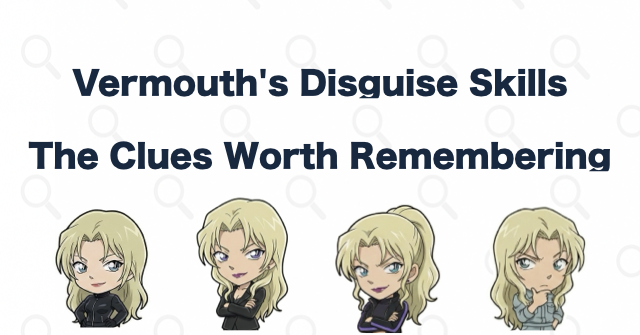
Araide gives Vermouth a trusted place in daily life; Jodie gives her a colleague’s confidence; Tsutomu gives her a family’s hope. Her work for Bourbon and Irish extends those tactics beyond the identities she personally performs.
Yet Azusa’s face cannot entirely contain her concern for Ran. The disguises are memorable because they combine calculated use of other people’s attachments with an attachment Vermouth cannot suppress in herself. The skill lets her borrow many lives, while the memory of who saved her own keeps showing through.
Further reading (contains spoilers): Vermouth and Yukiko's friendship and rivalry.

Comments