Spoiler warning: Major spoilers for character identities and events in the manga through File 1166, plus the films discussed below.
Why does Amuro hate Akai?
Did Akai really kill Scotch?
Akai did not kill Scotch. Amuro’s anger grows out of losing his childhood friend Hiromitsu Morofushi and arriving at a rooftop where Akai was holding the gun beside him. Readers later see that Akai tried to save Hiromitsu; Amuro’s full knowledge of that attempted rescue remains unconfirmed in the manga covered here, through File 1166.
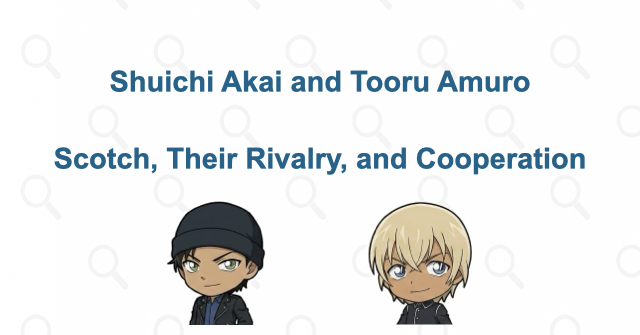
Shuichi Akai and Tooru Amuro also serve different agencies. Akai is an FBI agent who infiltrated the Black Organization as Rye. Amuro is the cover identity of Rei Furuya, a Japanese public-security officer still working inside it as Bourbon. Their common enemy does not erase either that professional tension or the loss of Scotch.
Their relationship is most interesting where resentment and trust overlap. Amuro can oppose Akai personally and still rely on his shooting when a crisis demands it. Akai can respect Amuro’s responsibilities without receiving forgiveness. Cooperation is possible before their personal history has been settled.
The Darkest Nightmare and Black Iron Submarine are discussed separately as film evidence, so their shared operations are not treated as an unseen manga reconciliation.
Understanding Akai and Amuro's Relationship
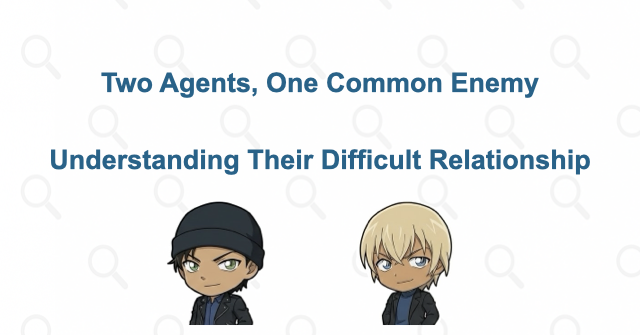
Akai and Amuro are neither straightforward enemies nor uncomplicated allies. Both want to bring down the Black Organization, but their institutional responsibilities and personal histories prevent an easy partnership.
A crisis can force each man to rely on precisely the skill he recognizes in the other. That makes their conflict more compelling than a simple contest: disliking Akai does not make Amuro misjudge his ability, and respecting Amuro does not let Akai erase what happened to Scotch.
Akai Is an FBI Agent; Amuro Works in Japanese Public Security
Shuichi Akai is a 32-year-old FBI agent and an exceptional sniper. He previously infiltrated the Black Organization as Rye. After faking his death, he disguises himself as Subaru Okiya and lives at the Kudo Residence.
Tooru Amuro is the everyday identity used by Rei Furuya, a 29-year-old public-security officer. He continues to operate inside the Organization as Bourbon while working at Café Poirot and maintaining his connection to Kogoro Mouri.
The two men are highly capable investigators, but their duties are not identical. Akai pursues the Organization as part of the American FBI, while Amuro's obligations are tied to Japan's security and the National Police Agency.
Amuro consequently does not regard FBI activity in Japan as something he must automatically welcome. The jurisdictional friction exists alongside his anger over Scotch; it should not be reduced to a purely personal feud.
The hostility is also uneven. Akai is not shown holding a private grudge of equal intensity against Amuro. He recognizes Amuro's ability and responsibilities even when faced with open antagonism.
They Infiltrated the Organization as Rye and Bourbon
Akai and Amuro operated inside the Organization at the same time as Scotch, another Japanese undercover officer. From the Organization's perspective, all three appeared to be its own members.
The Unfriendly Girls Band, in Volumes 88-89, includes Masumi Sera's memory of seeing the three at a station. The cases they carry appear to conceal weapons, suggesting that they may be heading to an assignment. The mission itself is not revealed.
The apparent Organization trio is actually one FBI agent and two Japanese undercover officers. There is an almost absurd irony in that lineup, but also danger: being on the same side in principle does not mean they can safely reveal it to one another.
Amuro and Scotch knew each other, but that does not mean Akai's FBI affiliation was openly known to them at the time. The uncertainty surrounding identities is part of the danger of their situation.
The station memory does not establish a long-standing hatred between Akai and Amuro. Scotch's later death gives their conflict its deepest personal wound.
Amuro Refused to Believe Akai Could Be Killed So Easily
Akai's apparent death at Raiha Pass does not satisfy Amuro. He continues to investigate the possibility that the fatal shooting by Kir was staged.
Gin comments on Bourbon's refusal to accept the death and his insistence that he was the one capable of taking Akai down. The statement conveys how personally Amuro sees the rivalry.
His refusal to believe the death carries a grudging compliment. The man he wants to defeat is also the man he considers too capable to have died so easily. That tension gives the investigation its particular force: resentment keeps him looking, while respect makes the official story feel inadequate.
Akai does not mirror the obsession in the same terms. He can regard Amuro as a fellow investigator pursuing the Organization and pass information to him when that serves their broader purpose.
Their hostility is uneven, while their assessment of each other’s ability is much closer. That difference prevents the rivalry from becoming a symmetrical grudge match. Akai can respond to Amuro as a fellow investigator even when Amuro still approaches him as a personal adversary.
They Can Cooperate Without Having Fully Reconciled
Through File 1166, the manga does not show Amuro forgiving Akai over Scotch. It also does not announce a formal alliance between the FBI and Japanese public security. Those are separate unresolved matters: a personal settlement would not automatically establish an interagency agreement.
Their relationship is nevertheless capable of more than immediate confrontation. After the tea meeting at the Kudo home, Akai remains there as Okiya rather than being handed over to Japanese public security.
In the film Black Iron Submarine, Amuro also relies on Akai's marksmanship as part of the response to a shared danger. That is movie evidence of practical trust, not confirmation of a manga reconciliation.
A temporary truce or limited cooperation describes their behavior reasonably well. It should not be mistaken for the actual terms of a disclosed agreement. What we can see is that a shared objective can restrain the hostility; what they have privately promised each other is still unknown.
Why Do They Clash? The Death of Scotch
Hiromitsu Morofushi's death is the central personal issue between them. To Amuro, he was not merely a colleague lost during an assignment: he was a childhood friend and a police-academy classmate.
When Amuro reached the rooftop, he found his friend already dead and Akai nearby holding the gun. The difference between what had actually happened and what Amuro could see created an enduring source of anger.
Scotch Was Amuro's Childhood Friend, Hiromitsu Morofushi
Scotch's real name was Hiromitsu Morofushi. Rei Furuya called him Hiro, and their friendship long predated their work as undercover officers.
They also trained at the police academy together. Hiromitsu later infiltrated the Organization under the codename Scotch, placing both friends in dangerous roles within the same criminal network.
Hiromitsu's older brother is Takaaki Morofushi of the Nagano Prefectural Police. After their parents were killed when they were young, Hiromitsu grew up in Tokyo apart from his brother.
For Rei, Hiromitsu connects childhood, police training, and adult duty. That history explains why the loss is more than another dangerous assignment ending badly. Akai’s presence at the scene becomes associated with someone whose place in Rei’s life cannot be measured only in professional terms.
Akai's presence at the scene became inseparable from that loss. The intensity of Amuro's response makes more sense when viewed as grief over a lifelong friend rather than as abstract rivalry between agencies.
Amuro Arrived to Find Akai with a Gun Beside Scotch
By the time Amuro reached the rooftop, Hiromitsu had already died. Akai was holding the gun and spoke in a way that suggested an Organization member enforcing punishment against a traitor.
The gun, the body, and Akai’s reference to punishing betrayal create the appearance of an Organization execution. Amuro reaches the scene after the decisive events, so the visible aftermath offers a very different story from the one readers eventually learn.
Those words are not proof that Akai shot Scotch. The fuller account later reveals that he had been trying to prevent the death.
Akai is still operating as Rye, so his harsh words can be read as an effort to protect his cover. His full intentions in that exchange remain unspoken.
The bitterness comes from that reversal: a man who tried to save Hiromitsu appears to be the one who killed him. Concealing an undercover identity may help explain Akai’s performance, but it also leaves Amuro with an account that hides the attempted rescue.
Akai Expresses Regret During the Scarlet Arc
During the Scarlet arc in Volumes 84-85, Akai identifies Amuro over the phone as Rei Furuya, a Japanese public-security officer. He also expresses regret concerning a man understood in this context to be Scotch.
The apology is not a confession to having killed Hiromitsu. Akai actually tried to help him escape, and the later rooftop flashback makes that distinction essential.
His regret can be read as the weight of a rescue he could not complete and the consequences that still divide them. That remains an interpretation of what the apology carries, rather than a full account of his private thoughts. For a man who rarely explains his feelings, even this brief acknowledgment is affecting.
It shows that he does not treat the death lightly. It does not show Amuro accepting the apology or learning every detail of what happened before he arrived.
The apology matters without being enough. Regret has been spoken, but Amuro is not shown accepting it, and the conversation does not supply a complete shared understanding of the rooftop. That unfinished quality gives the exchange its sting.
The Truth About Scotch's Death: Akai Did Not Kill Him
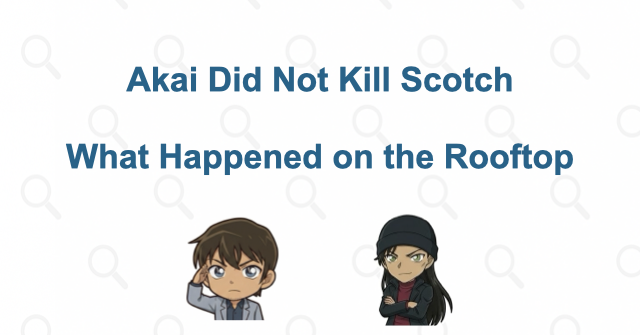
Akai did not kill Scotch. After Hiromitsu's undercover identity was exposed, he attempted to take his own life to prevent sensitive information from falling into the Organization's hands.
Akai intervened, disclosed his own FBI affiliation, and tried to arrange an escape. The situation ended tragically when approaching footsteps were mistaken for pursuers.
The person approaching was Amuro, who was trying to help his friend. The resulting misunderstanding is central to the scene; it is not evidence that either rescuer intended harm.
Akai Revealed His FBI Identity and Tried to Save Him
On the rooftop, Hiromitsu takes Akai’s gun and attempts to shoot himself. Akai restrains the gun to stop him, then reveals that he is an FBI agent operating undercover as Rye. He is trying to change Hiromitsu’s understanding of who stands beside him.
That disclosure opens a possible way out: the apparent Organization member is also working against it and is offering help. Akai risks revealing his own identity in order to make that option credible. The scene establishes an attempted rescue, not an execution.
Hiromitsu was under extreme pressure. His cover had been exposed, and his phone contained information that could endanger others if obtained by the Organization.
That context explains the urgency without presenting his death as inevitable or the only possible answer. Akai was actively trying to create another option, but there was little time for trust to take hold.
The scene hurts because survival seems possible for a moment. Help is standing beside Hiromitsu, and more help is approaching. The reader can see both facts, while the pressure of the situation prevents them from becoming a successful rescue.
He Mistook Amuro's Footsteps for Pursuers
While Akai was trying to persuade him, footsteps approached the rooftop. Hiromitsu believed that Organization pursuers were closing in, though the person coming was actually Amuro.
When Akai is briefly distracted by the sound, Hiromitsu uses the gun to shoot himself in the chest. The bullet also destroys the phone he is carrying there. The physical connection between the shot and the phone explains his attempt to prevent its information from endangering others.
Akai had been attempting to stop him, and Amuro was hurrying to reach him. Neither man's intention matched the disastrous result.
The cruelest detail is the sound itself. Amuro is hurrying to save his friend, but Hiromitsu hears the arrival of danger. A rescue attempt becomes part of the fatal misunderstanding without either approaching investigator intending harm.
That is why the rooftop should not be reduced to a verdict assigning malice to either man. Akai is trying to stop the death, and Amuro is trying to reach Hiromitsu. Their intentions and the outcome pull in opposite directions, leaving an unusually bitter tragedy beneath the later rivalry.
Readers Know the Full Scene, but Amuro's Knowledge Is Not Fully Shown
Volume 90's The Betrayal's Stage reveals the rooftop sequence to readers. That does not automatically mean Amuro has been told the same details within the story.
He was not present when Akai disclosed his FBI identity or tried to help Hiromitsu escape. Nor is there a shown conversation informing him that his own approaching footsteps were mistaken for pursuers.
His exact present understanding should therefore not be simplified into either extreme. We cannot assume that he knows every detail, but we should also not confidently insist that he still believes Akai personally fired the fatal shot.
He may understand some elements and not others. The unresolved question is the extent of what he knows, rather than a license to supply unspoken beliefs for him. His continuing anger could involve the failure to save Hiromitsu as well as a missing account of what happened; the manga does not settle every part of that distinction here.
Readers can place the attempted rescue beside the aftermath Amuro found. The characters have not been shown laying out that same full sequence together. That information gap gives the feud its painful asymmetry: the audience can understand both men while they still cannot easily reach one another.
How Much Do They Know About Each Other's Identities?
Akai knows that Tooru Amuro is Rei Furuya, a public-security officer. Amuro learns that Akai is alive, while The Betrayal's Stage renews his suspicion that Subaru Okiya is Akai.
Knowing an identity is different from knowing every detail of a disguise or every arrangement behind it. Those distinctions matter when following the sequence of revelations.
Neither man has simply handed the other's undercover identity to the Black Organization. Their antagonism operates within limits shaped by their common enemy and professional responsibilities.
Akai Identifies Amuro as Rei Furuya of Public Security
During the Scarlet arc, Akai addresses Amuro by his real name and identifies his role in Japanese public security. Clues associated with the name Zero and Amuro's behavior help him reach that conclusion.
Hearing his own name over the phone makes Amuro aware that Akai has seen through the identity he is using. The exchange places them on a different footing from apparent Organization rivals.
Akai also passes information related to the source of Rikumichi Kusuda's gun for the Japanese authorities to handle. He treats Amuro as an investigator with a legitimate responsibility, not merely as an enemy to remove.
That behavior reinforces the asymmetry in their hostility. Akai knows a secret that could endanger Amuro, yet does not expose him to the Organization.
Akai protects the distinction between Bourbon’s apparent allegiance and Furuya’s actual duty. That is a concrete basis for professional trust even when friendship is absent. A man who can expose the other investigator instead treats his role as something worth preserving.
Amuro Learns Akai Is Alive and Again Suspects Okiya
Amuro doubts the reported death at Raiha Pass and reconstructs the possibility of a staged killing involving Kusuda's body and gun. His investigation leads him toward Subaru Okiya at the Kudo home.
In the Scarlet arc, however, the Okiya he confronts is Yusaku Kudo in a disguise prepared by Yukiko. The real Akai is elsewhere and speaks to Amuro by phone, temporarily dispelling the suspicion that the person before him is Akai.
In The Betrayal's Stage, Okiya's behavior and left-handedness lead Amuro to suspect again that he is Akai. The scene renews a question that the Scarlet arc's misdirection had temporarily put to rest.
At the end of The Unsolved Cocktail Case, Amuro enters the Kudo home and confronts Akai directly. His knowledge of Akai's survival is no longer merely an abstract theory by that meeting.
Confirming Akai's survival is different from establishing how much Amuro knows about the Okiya disguise or the Kudos' arrangements. The story does not disclose him receiving every operational detail. Keeping those questions separate also lets his persistence stand out: the Scarlet misdirection does not end his investigation.
Hostility Does Not Stop Them Recognizing Each Other's Ability
Amuro's refusal to accept an easy death for Akai reflects respect for his opponent's skill. In Black Iron Submarine, that respect becomes a practical decision to rely on Akai's long-range shooting.
Akai similarly recognizes Amuro's intelligence, undercover ability, and position within Japanese public security. He does not treat him as a disposable Organization operative once he understands who he is.
Amuro’s judgment of a skill does not require affection for its owner. When a situation calls for Akai’s shooting, the resentment can remain and the choice can still be clear. That is the most persuasive form of trust the films give them: the task is too important to assign on the basis of who he likes.
Akai can similarly respect Amuro’s ability and Japanese responsibilities without claiming that their agencies have become allies. Their professional confidence is narrower than friendship, but it is still valuable. It makes a shared operation possible while leaving the personal wound intact.
Did the Tea Meeting at the Kudo Home Resolve Their Conflict?
The tea meeting does not establish a complete reconciliation. What is shown is a confrontation with guns giving way to a discussion involving Yusaku and Yukiko Kudo.
Yusaku made a proposal to both Akai and Amuro and is waiting for their response. Neither the proposal's contents nor their answer has been revealed.
A discussion about limiting conflict in order to confront the Organization is a plausible interpretation. It is still an interpretation, not the revealed text of their agreement.
An Armed Confrontation Becomes a Conversation Over Tea
At the end of Volume 95's The Unsolved Cocktail Case, Amuro enters the Kudo home while investigating Shinichi Kudo under Rum's orders. There he encounters Akai, who is supposed to be dead.
They point their guns at one another, bringing their long-standing hostility into the quiet setting of the house. The tension is immediate, but it does not end in a shootout.
Yusaku and Yukiko intervene, and Yusaku invites Amuro to talk over tea. Men who were pointing guns at each other are suddenly seated before teacups. The abrupt change is almost comic, but the calm surface leaves an unsettling question: what could bring them to the table, and what could keep them there?
How much the Kudos anticipated and prepared for the intrusion is not fully disclosed. What is clear is that they bring the men into a conversation instead of resolving the intrusion by force.
Agreeing to sit down is a meaningful change in the immediate situation. It is not, by itself, a statement that every personal or institutional dispute has vanished.
A Truce or Limited Cooperation Fits Better Than Complete Reconciliation
The covered manga does not show Amuro forgiving Akai over Scotch, nor does it announce a formal joint investigation between the FBI and Japanese public security.
At the same time, Amuro does not turn Akai over, and Akai continues living at the Kudo home as Okiya. Their actions leave room for an understanding that restrains immediate conflict.
A limited truce directed toward their common enemy is therefore a reasonable way to interpret the situation. Its precise conditions, however, remain unknown.
That uncertainty is more convincing than an instant reconciliation. They can see the practical need for restraint while still carrying grief, resentment, and different institutional obligations. The absence of an emotional settlement is part of what makes any limited cooperation feel hard-won.
The scene’s promise is that they can talk without first becoming friends. It leaves open whether a proposal can turn that temporary calm into coordinated action. Treating the tea as forgiveness would remove the very tension the withheld conversation preserves.
Yusaku's Proposal and the Response Remain Unrevealed Through File 1166
The full conversation is not shown. The later Inauspicious Matchmaking story, including Volume 100’s File 1067, A Secret Visit to the Shrine, returns to the question of a response to Yusaku’s proposal. That follow-up confirms that the meeting has consequences beyond an uneasy cup of tea.
Yusaku is the one waiting for an answer. His proposal was addressed to both Akai and Amuro, rather than being a joint offer from Yusaku and Akai to Amuro alone.
Possible subjects include information sharing, how to handle Rum's inquiry about Shinichi, or a limited arrangement between the investigators. These are theories about the missing conversation, not confirmed terms.
It is also unknown whether they discussed Scotch's death, the full details of Akai's staged death, or what Amuro should tell Rum. None of those topics can safely be inserted into the unseen meeting as fact.
The proposal and response remain unresolved within the manga covered here, through File 1166. Revealing them could connect several threads at once: the two investigators, the Kudos’ position, and Rum’s inquiry about Shinichi. That is a possible consequence of the missing answer, not a prediction of its contents.
Their Rivalry and Cooperation in the Movies
The Darkest Nightmare and Black Iron Submarine are especially useful films for comparing their direct hostility with their ability to trust one another's expertise.
The former puts them in a physical fight, while the latter lets them coordinate without meeting face to face. These movie-only depictions do not establish an unshown manga reconciliation.
The Darkest Nightmare: Fighting on the Ferris Wheel
In the 2016 movie The Darkest Nightmare, Akai and Amuro fight on top of a Ferris wheel during the crisis involving Curaçao. The urgency of the wider situation does not initially prevent Amuro’s anger from taking over.
Amuro uses boxing, while Akai fights with Jeet Kune Do. Their confrontation turns professional rivalry and unresolved personal resentment into a highly physical exchange.
The emotional imbalance is as important as the punches. Amuro’s anger is plainly driving him, while Akai is not shown returning an equivalent hatred. The fight gives visible form to a conflict in which the two men do not want the same thing from one another.
The fight is interrupted before a definitive winner is established. Its role is to reveal the intensity of the conflict, not to provide a final ranking of their combat abilities.
It is exhilarating action with a bitter history underneath. Knowing about Scotch makes the exchange harder to watch as a simple display of strength: the man Amuro attacks had tried to save the friend whose loss helps fuel his anger.
The Darkest Nightmare: Setting the Fight Aside During a Shared Emergency
The film also shows that they can stop fighting when lives are at immediate risk. As the Ferris wheel crisis escalates, both contribute to the response alongside Conan.
Their coordination does not require Amuro to forgive Akai first. It requires them to recognize what must be done and prioritize the people in danger.
Akai uses his specialized skills as part of the attempt to avert disaster, while Amuro acts from his own position. Their roles fit into a response to the same threat.
There is something satisfying about the same Ferris wheel becoming the object of cooperation immediately after serving as their battlefield. They can turn from fighting each other to protecting other people. That reversal shows what their duty can demand of them without claiming that the grudge has disappeared.
Black Iron Submarine: Rye and Bourbon Trust Each Other's Skills
In the 2023 film Black Iron Submarine, Amuro relies on Akai's shooting ability in the operation against the Organization's submarine. Their coordination occurs through Conan rather than a direct meeting.
Amuro addresses Akai as Rye and acknowledges the exceptional sniper he knows him to be. Akai, in turn, responds to Bourbon's request and acts on the shared objective.
Rye and Bourbon once named apparent allies inside the Organization. Here, those same names pass between men coordinating against it. The reversal is rewarding because it uses their shared undercover history without needing an affectionate reunion to make the cooperation work.
The contrast with The Darkest Nightmare is specific. There, hostility drives a face-to-face clash. Here, Amuro can entrust an essential shot to Akai without even meeting him. Confidence in a specialist’s ability has become enough to support action, although personal forgiveness is still not stated.
It is not a confession of forgiveness or a formal interagency agreement. It is strong film evidence that resentment does not prevent operational trust when the stakes demand it.
The 2026 Film Does Not Supply a Reconciliation
Fallen Angel of the Highway focuses on Chihaya Hagiwara, Jugo Yokomizo, Kenji Hagiwara, and Jinpei Matsuda rather than directly resolving Akai and Amuro's personal history.
The film does not directly answer the remaining questions about Scotch or Yusaku's tea-meeting proposal. It should not be cited as a story in which the two men finally reconcile.
For the relationship discussed here, The Darkest Nightmare and Black Iron Submarine remain the principal movie examples. Their contrast illustrates hostility and practical cooperation without supplying the missing emotional resolution.
Which Is Stronger, Akai or Amuro?
The story has not settled an overall winner across all their abilities. Akai has the clear specialist advantage in long-range sniping, but their hand-to-hand confrontation has no definitive conclusion.
Deduction, strategy, infiltration, driving, and the use of institutional resources are different kinds of skill. A single overall ranking would obscure the situations in which each man is most effective.
Long-Range Sniping Is Akai's Specialty
Akai is an exceptional FBI sniper whose ability is taken seriously by the Black Organization. His precision and capacity to judge difficult shooting conditions repeatedly make him a decisive factor.
Amuro's decision to rely on him in Black Iron Submarine reinforces that assessment within the film. The task is entrusted to the man whose specialty best fits the situation.
Amuro is highly capable with a handgun, but that does not make his skill set identical to Akai's long-range expertise. Treating all firearms ability as one interchangeable category would miss the distinction.
The assessment is especially persuasive because Amuro has so little reason to flatter Akai. He can resent the man and still choose his marksmanship for a task that demands it. The judgment is about the skill the operation needs, rather than a declaration that one investigator wins every comparison.
Their Hand-to-Hand Fight Has No Definitive Winner
The Ferris wheel fight in The Darkest Nightmare is interrupted. It does not establish either a decisive Akai victory or proof that Amuro is categorically superior.
Their fighting styles differ: Akai's Jeet Kune Do contrasts with Amuro's boxing. The film allows both to show speed, power, and adaptability without completing the contest.
Terrain, objectives, and the circumstances of a confrontation would also matter. A brief exchange in one dangerous location is not a comprehensive test under every possible condition.
The unfinished fight also captures something larger about their relationship. Before they can resolve their private contest, other lives are at risk. Their ability to stop and respond is more revealing here than a final score between boxing and Jeet Kune Do would have been.
There Is No Established Overall Ranking in Deduction, Infiltration, or Driving
Akai excels at shooting, observation, strategy, and coordinating complex operations. His staged death and extended life as Okiya also demonstrate considerable skill at maintaining a concealed identity.
Amuro combines investigative ability, information gathering, performance, driving, and close combat. He balances the roles of a café employee, Kogoro's apprentice, Bourbon, and Rei Furuya.
Their institutional positions create different strengths as well. An operation using Japanese contacts and public-security authority is not the same problem as a task requiring an FBI sniper's specialized reach.
The story provides no definitive overall ranking. Akai and Amuro have overlapping talents and different specialties, so each situation brings a different strength to the fore.
Their different strengths help explain why a shared operation can be so exciting. Each can answer a need the other does not meet in quite the same way. The pleasure is in seeing that fit work despite their strained relationship, rather than pretending that collaboration has made the tension vanish.
Key Manga Cases and Anime Episodes
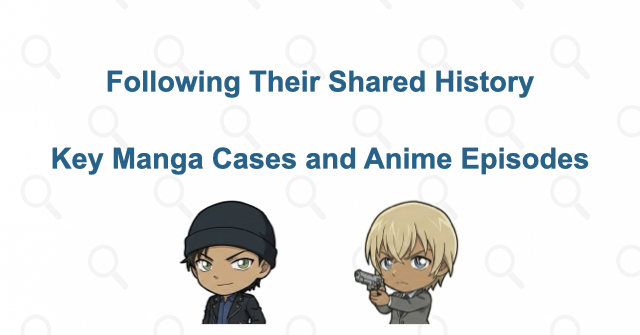
Their relationship develops across several stories. The Scarlet arc brings their concealed identities into conflict, the station flashback establishes their shared undercover past, and The Betrayal's Stage reveals the rooftop tragedy.
The Unsolved Cocktail Case and The Inauspicious Matchmaking then move the focus to the Kudo home and the unanswered proposal. The films provide separate illustrations of rivalry and cooperation.
Volumes 84-85: The Scarlet Arc
The arc runs from Volume 84, chapter 9, through Volume 85, chapter 5, and international Episodes 832-836 (Japanese Episodes 779-783), from The Scarlet Prologue to The Scarlet Truth.
Amuro reconstructs Akai's apparent death and investigates Okiya. The Kudo family's substitution temporarily dispels his suspicion in that confrontation rather than giving him a complete identification there.
Akai, meanwhile, identifies Amuro as Rei Furuya of Japanese public security and expresses regret concerning Scotch. Several layers of identity and knowledge intersect in the same sequence.
The arc is essential for following what each man knows, but it must be read alongside the later scenes that revive Amuro’s suspicion about Okiya rather than treating every answer as having been obtained at once.
Volumes 88-89: The Unfriendly Girls Band
The Unfriendly Girls Band spans Volume 88, chapter 10, through Volume 89, chapter 1. Its anime adaptation is international Episodes 891-892 (Japanese Episodes 836-837), Parts 1 and 2.
Masumi's memory shows Rye, Bourbon, and Scotch together on a station platform. The three appear to be Organization members, while readers can recognize the undercover affiliations behind those appearances.
The precise assignment is not disclosed. The scene's importance lies in establishing that shared past and placing Scotch within the history of the two men who later clash so bitterly.
After the rooftop revelation, this brief station memory becomes painfully ordinary: the three men can still stand together, and the loss that will divide them has not yet occurred. Nothing new has to happen in the flashback for its emotional meaning to change.
Volume 90: The Betrayal's Stage
The Betrayal's Stage appears in Volume 90, chapters 6-9, and international Episodes 921-922 (Japanese Episodes 866-867), Parts 1 and 2.
It reveals that Akai tried to save Scotch and disclosed his FBI identity. Hiromitsu mistook the approaching Amuro for pursuers, and the attempted rescue ended in his death.
Okiya's left-handedness also renews Amuro's suspicion that he is Akai, after the Scarlet arc had temporarily diverted it.
For understanding the personal feud, the rooftop account is indispensable. It separates the reality available to readers from the incomplete encounter that initially shaped Amuro's anger.
Volume 95: The Unsolved Cocktail Case
The Unsolved Cocktail Case covers Volume 95, chapters 6-9, and international Episodes 1009-1011 (Japanese Episodes 952-954), from Part One through Part Three.
Acting on Rum's interest in Shinichi Kudo, Amuro enters the Kudo home and confronts Akai. Their armed standoff then gives way to a discussion with Yusaku and Yukiko.
The scene does not erase the feud. It establishes that they can be brought to the table and leaves the substance of that discussion as an ongoing mystery.
Treating the tea meeting as a negotiation rather than an automatic reconciliation preserves both its promise and its unresolved tension.
Volume 100: The Inauspicious Matchmaking
The relevant Volume 100 story includes File 1067 and is adapted as international Episodes 1143-1144 (Japanese Episodes 1085-1086), The Inauspicious Matchmaking (Parts 1 and 2).
The later reference to a reply shows that Yusaku's proposal still matters. He is waiting for a response to the suggestion he made to both men.
The scene reveals neither the proposal's terms nor a complete reconciliation. The answer remains an open question through File 1166.
Movies: The Darkest Nightmare and Black Iron Submarine
The Darkest Nightmare, released in 2016, is the main movie reference for their direct physical confrontation. The fight on the Ferris wheel gives way to action against a common danger.
Black Iron Submarine, released in 2023, emphasizes trust in specialized ability. Amuro relies on Akai for a difficult shooting task, and Akai accepts the role.
Together, the films show that unresolved hostility can coexist with effective coordination. They do not provide a missing manga conversation or establish that every issue involving Scotch has been settled.
Conclusion
Akai and Amuro share an enemy, but they approach that enemy from different institutions and carry a painful personal history. Akai is a 32-year-old FBI agent living as Okiya; Amuro is the 29-year-old Rei Furuya, continuing his undercover work as Bourbon.
The clearest distinction is between forgiveness and practical trust. The manga covered here leaves the personal resolution open; the films show how cooperation can work before that resolution arrives. Keeping those two forms of evidence separate preserves what makes their relationship so compelling.
The Misunderstanding Left by Scotch's Death
Hiromitsu Morofushi was Amuro's childhood friend and a fellow undercover officer. Akai did not kill him: he disclosed his FBI identity and attempted to help him escape.
Hiromitsu mistook the sound of Amuro approaching to help for the arrival of pursuers. Readers are shown that tragic sequence, but Amuro's full knowledge of every detail remains unconfirmed.
The resulting gap between a failed rescue and the scene Amuro encountered is central to the feud. It should not be collapsed into the inaccurate claim that Akai executed Scotch.
Identity Revelations and Limited Cooperation
Akai identifies Amuro as Rei during the Scarlet arc. Amuro's suspicion about Okiya is temporarily dispelled there and revived in The Betrayal's Stage. His later encounter with Akai at the Kudo home establishes a direct meeting, without revealing every detail he knows about the disguise.
The Kudo tea meeting turns an armed confrontation into a discussion, but its full contents remain unknown. Yusaku made a proposal to both men and is waiting for a response; the scene is not proof of a formal FBI-public-security alliance.
Their film appearances likewise show cooperation without confirmed forgiveness. Akai has the specialist edge in sniping, while their close-combat contest and overall ranking remain unsettled.
Professional Trust Survives the Personal Conflict
Both men tried to help Hiromitsu. Akai’s failed rescue made him look responsible, while Amuro’s arrival was mistaken for a threat. No malicious intention is needed for the misunderstanding to leave a lasting wound.
Yet Amuro can still recognize the value of Akai’s shooting, and Akai can respect Furuya’s duty. Their anger and competence do not cancel each other out. That makes the moments when they act toward the same goal feel earned rather than emotionally tidy.
The strongest part of this relationship is that unresolved mix of grief, resentment, and reliance. They understand what the other can do even when they cannot settle what the other means to them. When the same danger threatens the people they protect, that knowledge can be enough to bring them onto the same side again.
Further reading (contains spoilers): Akai and Amuro's manga, anime, and movie appearances.

Comments