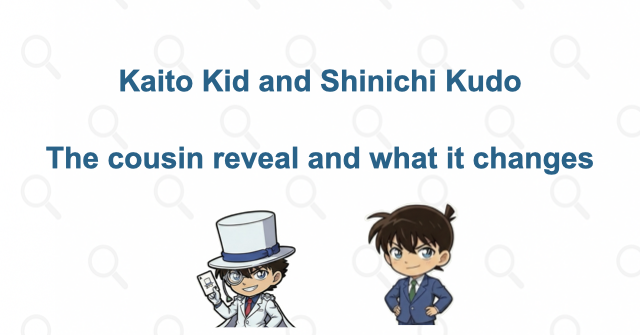
Major spoilers for the ending of The Million-dollar Pentagram, Kaito Kid’s identity, and manga material through Volume 108.
The Million-dollar Pentagram reveals that Kaito Kuroba and Shinichi Kudo are cousins: their fathers, Toichi Kuroba and Yusaku Kudo, are twin brothers. Kaito and Shinichi themselves are neither twins nor the same person.
That is the film’s answer to their striking resemblance. It should be distinguished from a second question: have the two teenagers learned the family secret themselves? The material considered through Volume 108 does not show them confirming it to one another.
The family relationship revealed in the film
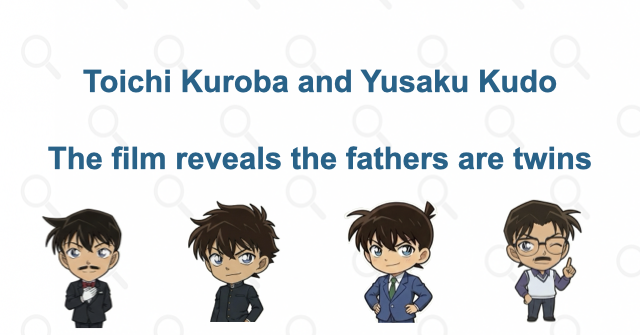
Kaito Kuroba is the present Kaito Kid. His father, Toichi Kuroba, was the original Kid. Shinichi Kudo is the son of mystery novelist Yusaku Kudo and lives in his shrunken body under the identity Conan Edogawa.
In the film’s post-credits revelation, Toichi is the older twin and Yusaku the younger. Their sons are therefore first cousins. The twin relationship belongs to the fathers’ generation, which is the key to avoiding the common claim that Kaito and Shinichi are brothers.
The result gives the detective-and-thief contrast another layer. The younger pair are related while pursuing opposing roles, and the older pair had already engaged in their own contests of riddles and deduction.
Why are their family names different?
The film explains that the twins’ parents separated while the boys were very young. Toichi grew up with their father and Yusaku with their mother, leaving them with the Kuroba and Kudo surnames.
Their family connection is not widely shared. Yukiko’s response indicates that even she had not been told about Yusaku’s twin. Different names and separate households help explain why the sons’ resemblance had not simply produced an openly acknowledged family relationship.
The resemblance is visible; the family history needed to interpret it is not. That gap allows the reveal to change the meaning of earlier scenes without requiring the characters to have known the answer all along.
What else does the ending reveal about Toichi?
The ending also shows Toichi alive and indicates continuing contact with Yusaku. That film revelation does not establish that Kaito has learned his father survived. The audience’s access to the ending and the son’s access to information are separate.
Toichi’s apparent death is central to why Kaito took up the Kid identity and began looking into what happened to him. Learning more as a viewer does not erase that motivation or retroactively make Kaito’s earlier uncertainty a performance.
Why Kid and Shinichi look and sound alike
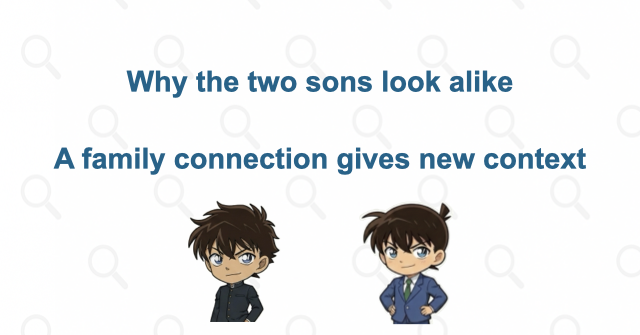
There are three related but distinct elements: the family explanation revealed by the film, the actors used by the Japanese anime, and Kid’s ability to impersonate someone within the story.
Similar faces, separate lives
Kaito and Shinichi have closely similar faces, though their usual hairstyles differ. Their fathers also resemble each other. The twin-father reveal makes the resemblance part of the story’s family structure.
It is a fictional explanation for these characters, not a claim that real cousins must look identical. Nor does looking alike make the two interchangeable. Kaito has his own family, school, and childhood friend, while Shinichi has a different everyday life and relationships.
Kaito became the second Kid after discovering his father’s hidden identity and seeking the truth about his apparent death. Shinichi solves crimes and was transformed by the Black Organization’s drug. Their different circumstances drive the choices they make when they meet.
Both are voiced by Kappei Yamaguchi in Japanese
Kappei Yamaguchi voices both Shinichi and Kaito/Kaito Kid. This makes Kid’s appearances as Shinichi sound natural to viewers of the Japanese anime.
A shared voice actor is production information, not independent proof of a family relationship. The in-story evidence is the fathers’ relationship revealed in the film. Kid’s vocal mimicry supplies a separate explanation for how he can reproduce other people’s voices without a voice-changing device.
Those elements work together on screen, but they should not be collapsed into one argument. Casting can reinforce a resemblance without being the fact that establishes it.
How Kid impersonates Shinichi
Because his face already looks so similar, Kid does not need an elaborate facial mask to pass as Shinichi. Styling, clothing, manner, and voice do much of the work. His disguise skill makes the physical resemblance more useful.
The Volume 105 case Kid VS Hakuba: The Azure Throne brings that resemblance into the foreground, alongside the impersonation and cooperation between the rivals. Its anime adaptation is international Episodes 1252-1253 (Japanese episodes 1193-1194).
Knowing the film’s reveal changes how those scenes read: what looked like an unusually convenient resemblance now has a family explanation. It does not mean that every successful disguise proves Kid knows that explanation himself.
Do Kaito and Shinichi know they are cousins?
No scene considered here establishes that they have learned or confirmed the relationship. The family secret is revealed to the audience in the film’s ending, away from the two teenagers.
That is more precise than asserting that neither could possibly suspect a connection. A character may notice a resemblance, make a joke, or have an unspoken suspicion without possessing the family history required to confirm it.
Conan recognizes the resemblance, not necessarily Kid’s everyday identity
In Volume 105, Conan gets a close look at Kid’s face and recognizes its similarity to his own original appearance as Shinichi. That is different from learning the name Kaito Kuroba, his family circumstances, or that he attends Ekoda High School.
Seeing a face is not the same as identifying the whole person behind it. Conan’s recognition should not be used to claim that he has solved every aspect of Kid’s identity or deduced the twins’ childhood separation.
Does the joke about ancestry prove prior knowledge?
Volume 105 includes light conversation about the resemblance that invites thoughts of bloodlines and ancestry. After the film, the joke acquires an additional meaning for the reader.
It could function as foreshadowing, but it does not prove that Kaito already knows the cousin relationship. A joke about two similar faces can be made without access to their fathers’ hidden history. Authorial hints and a character’s confirmed knowledge are different layers of the scene.
That difference is part of the pleasure of returning to it: the audience can now hear something beneath a line that the characters may still be treating as banter.
Their rivalry still has its own logic
Conan tries to interpret Kid’s advance notices, uncover his tricks, and stop the thefts. Kid uses illusion, disguise, and timing to pursue his targets and evade capture. Their skills overlap in ingenuity, but each solves a different kind of problem.
The contest is not one-sided. Kid can escape or misdirect Conan, while Conan can prevent him from achieving his purpose. Their relationship works because each understands how capable the other is, not because the film’s family reveal secretly explains every act of cooperation.
Why do they sometimes work together?
Kid is a thief, but murder is not his objective. When a killing or shared danger interrupts a theft, his interests can align with Conan’s. Conan in turn can use Kid’s disguise skills and mobility when ordinary investigation is not enough.
Volume 105 gives a clear example of cooperation under conditions while each retains a separate purpose. They can trust a particular ability without becoming permanent teammates or abandoning the detective-and-thief conflict.
The cousin reveal adds resonance to that compatibility. It does not replace the practical reasons the story gives for a temporary alliance.
The fathers’ contest and the origin of the name Kid
Yusaku investigated the original Kid, while Toichi challenged him through codes and misdirection. Yusaku’s reading of the international criminal designation 1412 as KID helped create the thief’s familiar name.
In light of the film, the younger twin has effectively helped name the older twin’s masked identity. The next generation then repeats the contrast: Yusaku’s detective son pursues Toichi’s thief son.
Earlier exchanges between the fathers can consequently feel like a private contest between brothers as well as a confrontation between investigator and thief. That is an interpretation encouraged by the reveal; it does not tell us the precise motive behind every earlier message.
The key stories to revisit
The clearest sequence is Volume 55 for the fathers’ connection, Volume 105 for the sons’ resemblance, and the film for the family reveal. These are a useful reading order, not a claim that the separate movie event occupies an established point in the manga’s chronology.
Volume 55: Shinichi Kudo’s Childhood Adventure
International Episodes 512-513 (Japanese episodes 472-473) adapt the case in which young Shinichi and Ran encounter a mysterious man and a set of clues at school. The man is Toichi in disguise, and Yusaku is the deeper intended recipient of the challenge.
The case explores their exchange through puzzles and the origin of the Kid name. After the film, the elaborate conversation gains a familial dimension. What once seemed only like a contest between two talented rivals can also be read as the brothers communicating in a way suited to them.
Volume 105: Kid VS Hakuba: The Azure Throne
Volume 105, chapters 6-9, brings Saguru Hakuba into the conflict and makes Conan and Kid cooperate while protecting their respective interests. The anime versions are international Episodes 1252-1253 (Japanese episodes 1193-1194).
Conan sees Kid’s resemblance to Shinichi directly, and Kid uses that resemblance in his disguise. The light discussion of ancestry makes the later family answer satisfying, while still stopping short of confirming that either teenager knows it.
The Million-dollar Pentagram: the audience receives the answer
The 27th film provides the post-credits reveal about Toichi and Yusaku, their separated upbringing, and Toichi’s survival. The cousin relationship follows from that explanation.
The relationship is revealed in the film; the sons’ recognition of it remains a separate, unanswered development. Their faces, skills, and rivalry can now be viewed with additional context, while the story still has room to explore their response if they later learn or confirm the connection.

Comments