Spoiler warning: This article reveals Rum’s identity and discusses how the name clue develops beyond the original audience reveal.
Rum’s unusual alias is Kanenori Wakita. In Japanese name order, WAKITA KANENORI can be rearranged into TOKIWA KANENARI, meaning that time is money.
The clue links a seemingly ordinary sushi chef’s name to Rum’s impatient messages to Bourbon. It becomes more useful when combined with the information about Rum’s disguise and artificial eye.
Vodka describes the alias with a phrase rendered here as silly name (unofficial translation). The joke lies in an identity clue hidden inside a plausible civilian name, rather than in the name sounding inherently ridiculous.
The audience’s knowledge and Conan’s investigation also need to stay separate. Seeing the identity revealed does not mean Conan learns it in the same scene.
Why the alias points to Kanenori Wakita
Kanenori Wakita is Rum, the Black Organization’s second-in-command. His public role as a sushi chef puts him near Kogoro Mouri and the ordinary life surrounding Conan.
The everyday presentation is part of the tension. A light conversation at a sushi counter can involve the same person who applies pressure from inside the organization.
The spelling used for the puzzle is WAKITA KANENORI, with the family name first. Reading it in the English display order, Kanenori Wakita, can obscure why the Japanese wordplay works.
Rearranging those letters produces TOKIWA KANENARI. It points to the Japanese proverb expressed in English as Time is Money, the same expression associated with Rum’s messages to Bourbon.
The payoff is satisfying because it makes a familiar-looking name retrospectively unsettling. The alias can pass in everyday life while giving the reader a route back to the hidden identity.
What Camel hears from Vodka
During the Black Organization’s Scheme story, Andre Camel hears information that Rum has changed his face and is using an unusual alias. He obtains it while being pursued, rather than through a calm interview about Rum.
Neither fragment supplies Wakita’s identity by itself. A changed face allows for a disguise, and an unusual name suggests that the alias deserves closer scrutiny.
The clue becomes more informative when set beside the name puzzle and the eye patch. Separate pieces begin to converge on the same person.
That is why Camel’s contribution matters beyond his escape. Information gathered under immediate threat becomes something Conan can use in the longer identity investigation.
The audience reveal and Conan’s deduction occur at different stages
The identity reveal for readers appears in Volume 100, File 1066, the volume’s eighth chapter, titled RUM in the English chapter list. That chapter title is an established secondary title, not a claim of an official English edition title.
For anime viewers, the corresponding reveal is The Black Organization’s Scheme (Identity), Episode 1137 (Japanese episode 1079). The episode name is used as a display title here.
The audience learning that Wakita is Rum does not mean Conan has learned everything at that same point. Conan has to work with Camel’s information and the clues he encounters himself.
That gap changes Wakita’s ordinary scenes. The audience can recognize the danger behind the comic manner while watching Conan continue an investigation with less complete information.
How the name puzzle works
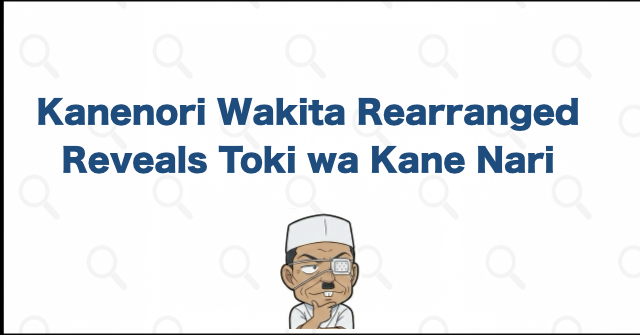
An anagram uses the same letters in a different order. Wakita’s alias is especially suggestive because the result is not an unrelated phrase but an expression tied to Rum’s behavior.
The name, the message to Bourbon, and the pressure to act quickly reinforce one another. The puzzle connects a civilian presentation to a recognizable organizational voice.
A word game alone would leave room for coincidence. The surrounding clues make it meaningful in the identity investigation.
WAKITA KANENORI to TOKIWA KANENARI
Start with WAKITA KANENORI. Ignore the space, then rearrange the letters to form TOKIWA KANENARI. No additional letters are needed for that comparison.
The Japanese phrase is toki wa kane nari, meaning that time is money. The written wa represents the spoken particle in the proverb.
Rum’s use of Time is Money in messages to Bourbon gives the rearranged phrase a recognizable destination. The alias and the message can now be read together.
The unsettling feature is the concealment in plain sight. Wakita can introduce himself normally, while the same name contains a clue to the person giving Bourbon orders.
The expression fits Rum’s impatience
Rum’s messages put pressure on Bourbon to move quickly. The proverb functions as an impatient demand in that relationship, rather than merely as a general observation about work.
Read alongside the anagram, it becomes an identity clue as well as a character detail. The same idea appears in the hidden name and the way Rum gives instructions.
That correspondence should not be expanded into a claim that every use of the proverb identifies Rum. Its significance comes from this combination of name, behavior, and other evidence.
Wakita’s public manner creates the contrast. A chatty sushi chef can seem far removed from an impatient organization superior, even though the alias links the two.
I like how the small verbal clue gains weight over time. A phrase that first sounds incidental becomes disturbing once its place in the name is visible.
The earlier Kid alias suggests the method
Katsuki Doito is an earlier example of a disguise name concealing a clue to Kaito Kid, also written Kaitou Kid. The familiar presentation Doi To Katsuki makes the parts of the Japanese name puzzle easier to notice.
The comparison provides a method rather than an identity. If one alias can hide its wearer through rearrangement, an unusual alias may deserve the same treatment.
It does not mean that Katsuki Doito is Rum or that Kid devised Wakita’s name. The connection is a recurring form of wordplay in the stories.
That return of an old device is part of the appeal. A playful Kid disguise offers a way to think about a much darker mystery involving the organization’s second-in-command.
Wakita’s ordinary role makes the answer more threatening
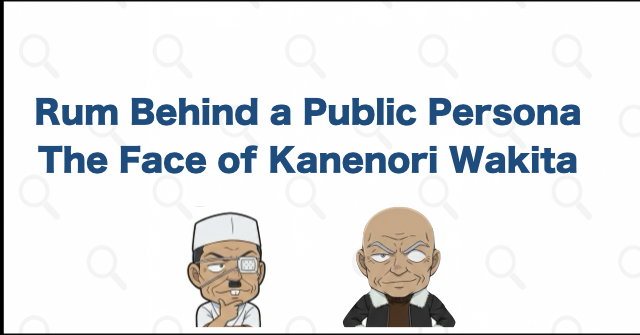
Wakita works at Iroha Sushi and presents himself as someone interested in Kogoro Mouri. His approach brings Rum into a familiar neighborhood rather than keeping him at a distant command center.
The everyday role and the coded alias work together. One makes him approachable; the other contains a route to the identity hidden beneath that approachability.
It is tempting to reinterpret every joke as a deliberate interrogation after the reveal. The identity makes those scenes more ominous, but it does not prove a specific purpose behind each remark.
The sustained effect is stronger than any single line. An established figure in Conan’s surroundings turns out to carry a central threat from the wider story.
Iroha Sushi brings Rum near the Mouri Detective Agency
Iroha Sushi is close to the Mouri Detective Agency. Wakita’s work therefore places him within Kogoro and Conan’s ordinary sphere of activity.
His interest in Kogoro, including the posture of a would-be pupil, gives him a way to take part in conversations and cases around that sphere.
That proximity is what I find frightening. The organization is not only something Conan encounters in isolated confrontations; one of its most important people can be present during an apparently routine outing.
The alias helps hold the two faces together. The shop offers a plausible public life, while the name contains an expression already connected to Rum.
The changed-face and artificial-eye clues
Wakita covers his left eye, and Rum has an artificial eye. The appearance clue belongs beside the name clue, rather than replacing it.
Camel’s information about a changed face also makes an apparently ordinary presentation less reassuring. A cover identity is designed to be seen without being understood.
The artificial eye is an important clue, but its cause is a separate mystery. Identifying Wakita as Rum does not automatically explain how he lost it.
Tsutomu Akai and Rumi Wakasa have histories relevant to the older events. Their possible connection to Rum’s injury should not be made certain simply because the identity puzzle has an answer.
Name, appearance, and behavior support a converging investigation. They answer who Wakita is without settling every question about his past.
How the clue continues beyond the audience reveal
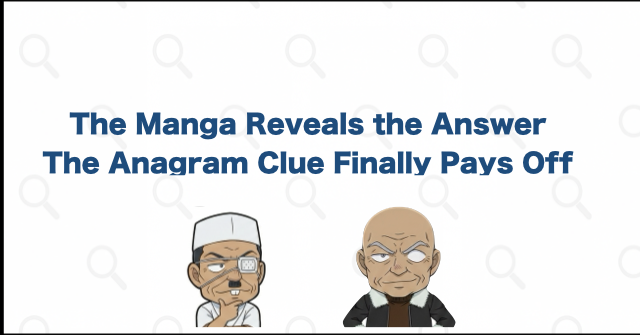
The later manga material discussed here brings the alias together with the artificial eye, Wakita’s speech, and Haibara’s reaction to the organization’s presence. Conan’s progress depends on their convergence.
Conan’s identification of Rum is a different milestone from the earlier reveal to readers. The distinction prevents two stages of the story from collapsing into one.
The name clue’s return gives Camel’s overheard information a continuing role. It was not a disposable remark once readers saw Rum’s face.
The sequence matters: the audience sees the answer first, and Conan reaches it through the information available to him. The alias clue belongs to that continuing process rather than ending with the initial reveal.
Several clues make the anagram more than a coincidence
The rearranged name gains force from the message to Bourbon and the information Camel brings back. The eye patch and other behavior then place those verbal clues beside a specific person.
That does not mean Conan learns Rum’s entire history. A conclusion about Wakita’s identity leaves questions about the injury, older events, and organizational plans unresolved.
The distinction makes the payoff more satisfying. A long-running identity puzzle can be solved without pretending that every larger mystery has ended with it.
I find the strongest moment in the accumulation: a name once treated as ordinary becomes harder to dismiss when several independent-looking details point toward it.
Camel’s information makes the reasoning possible
Camel’s task is survival during the organization’s pursuit of the FBI. Yet he also listens closely enough to bring back information about Rum’s cover.
The information is incomplete, which is precisely why its use matters. Conan must transform a description of a changed face and an unusual name into a line of inquiry.
Camel contributes evidence rather than the finished answer. His role should not disappear merely because the final insight concerns an anagram.
That combination gives the story two scales of tension: immediate danger to an agent, and a small piece of knowledge that changes the longer conflict.
A clue to the larger story
The Black Organization’s Scheme contains problems resolved within the operation, including the pursuit and the concealment of Camel’s survival. Rum’s alias belongs to the continuing identity mystery.
It can remain useful after the immediate danger has passed because the clue has not yet finished its work for Conan.
The earlier Kid example contributes in the same way. A device introduced in one case can return later as a way to approach a different problem.
This does not make the two cases one operation or their disguised characters one person. It shows how Conan can reuse a lesson about reading names.
That is the source of the pleasure in revisiting the scenes: the small detail retains a purpose that extends beyond the case in which it first stood out.
What the alias establishes, and what it leaves open
WAKITA KANENORI rearranges into TOKIWA KANENARI. Its meaning connects the alias to Time is Money and Rum’s impatient instructions to Bourbon.
Kanenori Wakita is Rum. The changed-face information, artificial eye, and name puzzle make the everyday sushi-chef identity more disturbing once viewed together.
The audience reveal in Volume 100 and Episode 1137 (Japanese episode 1079) comes before Conan’s own identification process. One stage should not be used as the date of the other.
The cause of the eye injury and the full scope of Rum’s plans remain separate questions. An identity answer should not silently become an answer to them as well.
For me, the name’s effect comes from how little it advertises its danger. A plausible introduction at a sushi shop can conceal the same impatient voice that commands Bourbon from inside the organization.
Further reading (contains spoilers): Rum's left eye and photographic memory and Wakasa and Wakita's seventeen-year feud.

Comments