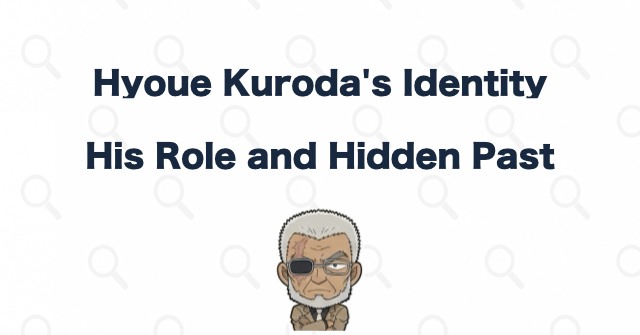
Spoilers through manga Volume 104, including Rum’s identity and the events seventeen years ago; the discussion of Zero the Enforcer is identified separately.
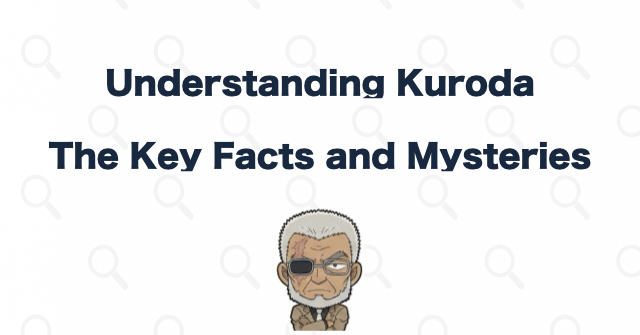
Hyoue Kuroda is Rei Furuya’s public security superior, and he is not Rum. His exact current position within public security remains undisclosed. The evidence establishes his authority over Furuya without establishing that he commands the entire division or holds the highest office in Zero.
His white hair, prosthetic eye, and knowledge of Bourbon once made him look like an enemy. The Koji Haneda case gives those same details a different meaning: they belong to an officer caught in the Organization’s violence. His connections to Furuya, Muga Iori, and Rumi Wakasa reveal that history, while leaving important limits on what we know.
Kuroda’s identity: what his police career establishes
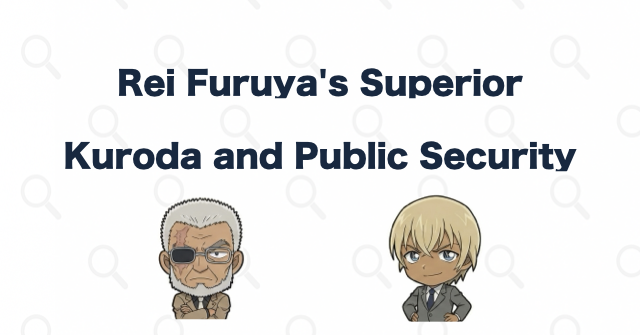
Kuroda is 50, holds the rank of superintendent, and manages criminal investigations in the First Investigation Division of the Tokyo Metropolitan Police Department. His Japanese voice actor is Yukimasa Kishino. Those details describe his public position; his involvement in undercover operations extends beyond what that job title alone explains.
His first substantial appearance is in manga Volumes 86–87, in the case adapted as The Darkness of the Prefectural Police, international episodes 865–867 (Japanese episodes 810–812). At that point he heads Nagano’s First Investigation Division. Previously employed by the National Police Agency, he later succeeds Kiyonaga Matsumoto in the Tokyo post.
The intimidating appearance arrives with an equally unsettling history: a damaged right eye, facial scars, roughly ten years unconscious, and hair that turned from black to white. Initially, those facts invite us to suspect a hidden identity. Later, the story makes the history behind them more revealing than the disguise theories they encouraged.
His past in the Security Planning Division
Seventeen years earlier, at 33, Kuroda belonged to the National Police Agency’s Security Planning Division, the public security division associated with Zero and Furuya’s work. His superior assigned him to contact Amanda Hughes at a hotel hosting a chess tournament.
That posting connects details that otherwise seem unrelated. His approach to Amanda, his knowledge of Bourbon, and his familiarity with a former undercover officer all fit a career involving sensitive police operations. He was part of the central mystery long before he entered Conan’s present-day investigations.
Is he the concealed supervisor from Zero the Enforcer?
Zero the Enforcer introduces the idea of a supervisor managing undercover officers outside the visible chain of command. Kuroda’s access to Furuya and knowledge of Iori’s past make a comparable role plausible.
The film does not settle Kuroda’s exact current official title. Whether he heads the whole Security Planning Division, supervises Furuya in a narrower capacity, or still formally belongs to that division remains unconfirmed. Calling him Furuya’s superior is justified; extending that into chief of the entire Public Security Bureau goes further than the evidence.
He recognizes Conan’s ability from their first meeting
Kuroda already knows that Conan Edogawa contributes to the cases associated with Kogoro Mouri. He explains where that reputation circulated:
Kuroda: “The brains behind Sleeping Kogoro, finding clues through unexpected observations and supporting his deductions… That was the rumor at the National Police Agency, Conan Edogawa.” (unofficial translation)
The important point is the reputation itself. Kuroda sees Conan as a source of deductions, not merely a child accompanying a detective. Furuya may have supplied reports, but information shared more broadly among police officers is another possible explanation. The person who informed Kuroda has not been identified.
Nor does the remark establish that he knows Conan is Shinichi Kudo. It explains why he listens to Conan; it does not explain whether he knows about the shrinking. His later willingness to discuss the seventeen-year-old case develops this trust in a concrete way.
Why Kuroda looked like Rum
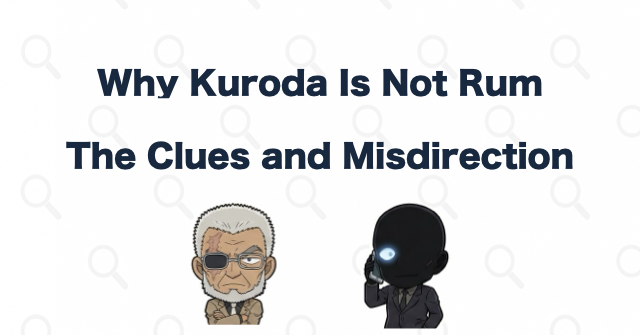
The Black Organization’s second-in-command is Kanenori Wakita, the man working at Iroha Sushi. Kuroda’s earlier presentation as a suspect still matters because the clues were real observations with misleading implications.
Appearance was a match, not an identification
The conflicting descriptions of Rum included a powerfully built man, an effeminate man, and an elderly man. The shared detail was an artificial eye. Kuroda’s size, white hair, and prosthetic right eye matched several pieces at once, while his severe manner made the possibility feel convincing.
Volume 104 gives those features a different context. His injuries and changed appearance connect to the crash and long coma after his attempt to rescue Asaka. The detail that seemed to mark an enemy instead records the cost of trying to protect someone. That reversal gives the misdirection an emotional consequence as well as a solution.
His memories put him at the scene, but on which side?
Kuroda reacts strongly to Wakasa’s photograph and recalls Haneda’s body. With Rum already connected to the old murders, those moments could look like a culprit remembering his crime. Watching Wakasa could likewise resemble a search for the surviving bodyguard.
The flashback changes the meaning without changing the memory. Kuroda really was at the hotel, and he really did see the bodies of Amanda and Haneda. He reached them during a public security assignment and after an attack by Organization members. A memory of the victim is evidence of presence; it never established participation in the killing.
The Bourbon clue had two possible explanations
In the film Zero the Enforcer, Kuroda gives Amuro instructions by phone, and his lip movement suggests the undercover codename Bourbon:
Kuroda: “Don’t slip up… Bourbon.” (unofficial translation; the final name is suggested through lip movement in the film)
An Organization superior such as Rum could know that name. So could the public security officer responsible for Furuya’s infiltration. The scene leaves both readings available when first encountered; his established public security role makes the second reading coherent. The film’s suggestive lip movement should still be distinguished from an explicitly spoken manga disclosure.
Kuroda, Wakita, and Wakasa are connected to the same tragedy from different positions: Wakita is Rum; Kuroda was the public security officer; Wakasa is Rachel Asaka, Amanda’s former bodyguard. Their shared history explains why they circle the same mystery without making them allies.
Furuya, Iori, and the call to Takaaki Morofushi
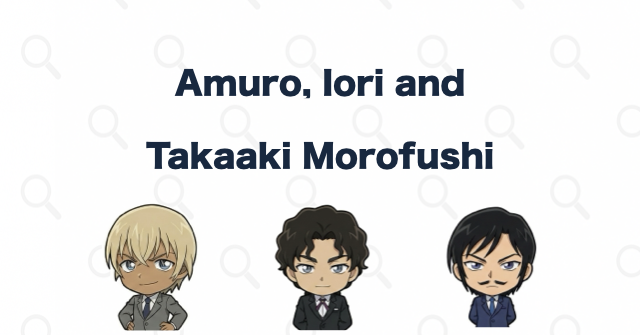
Kuroda’s authority is most visible in the information he holds and the instructions he gives. The three relationships below reveal different things, and they do not all establish the same formal chain of command.
Furuya is his subordinate; the full scope of his command is unknown
Rei Furuya is the public security officer’s real name. Tooru Amuro is his identity as a private detective and Café Poirot employee. Bourbon is his codename inside the Black Organization. Kuroda knows that undercover identity and gives him mission-related instructions.
Their calls place the usually self-contained Amuro within a reporting relationship. This is an officer carrying out an assignment, with someone above him who knows what the other identities conceal. What remains undisclosed is how far Kuroda’s authority extends beyond Furuya.
Iori’s old alias establishes a past connection
Iori now works as Momiji Ooka’s butler, but he previously served in public security. When he checks his surroundings after leaving a car, Kuroda recognizes the habit and uses an old name:
Kuroda: “That habit of checking… You still haven’t shaken it, Sakakibara?” Iori: “I’m sorry, but please stop calling me Sakakibara. Being addressed by the alias I used on an old undercover assignment brings back those days and gets me down.” (unofficial translation)
Sakakibara was Iori’s undercover alias. Knowing both that name and the associated habits establishes that Kuroda knew him during his public security work. It does not confirm that Kuroda was Iori’s direct superior. His access makes a senior role involving Iori’s operations plausible, but the precise reporting relationship remains unconfirmed.
The parallel with Bourbon is revealing. Both names belong to undercover assignments rather than the men’s visible present-day lives. By using them, Kuroda reveals how much of that concealed history he knows.
Takaaki’s changed behavior suggests protection of Amuro’s cover
In Volume 97’s The 36-Cell Perfect Game, Takaaki Morofushi sees Amuro and remembers Rei Furuya, the friend of his younger brother Hiromitsu Morofushi. Kuroda phones him; afterward, Takaaki acts as if he and Amuro have never met. The anime adaptation is international episodes 1060–1062 (Japanese episodes 1003–1005).
Wakita is there too. Once we know he is Rum, the danger of mentioning Furuya’s connection to Hiromitsu becomes clear. The timing strongly suggests that Kuroda’s call concerns protecting Amuro’s cover.
The actual conversation is not shown. We cannot turn the sequence into a confirmed quotation or a specific order to pretend they are strangers. What the scene does show is a change in Takaaki’s behavior around Kuroda’s intervention, a small action with potentially large consequences for an undercover officer.
What happened to Kuroda seventeen years ago?
Volume 104 brings the scars, coma, and uneasy recognition of Wakasa into one account. Kuroda was trying to contact Amanda; he became a target of the Organization and attempted to rescue Asaka. His connection to the victims comes from that experience.
The assignment and its unanswered purpose
Amanda was an influential American with ties to the FBI and CIA. Kuroda’s superior sent him to approach her discreetly at the chess tournament hotel, but what he was meant to learn has not been fully disclosed.
Sensitive intelligence may explain the assignment, but its precise purpose remains unconfirmed. Haneda, Amanda’s bodyguard Rachel Asaka, and Rum were at the same hotel. The quiet setting of a chess tournament conceals the collision between a police mission and an assassination operation.
A rescuer mistaken for an attacker
Kuroda fights off Organization members in the hotel and discovers Amanda’s body. In Haneda’s room, he finds another victim and the surviving Asaka. She mistakes him for someone on the attackers’ side and attacks him.
He subdues her and carries her unconscious to his car, trying to remove her from pursuit. Seen only from her alarmed perspective, he is a frightening stranger appearing amid the deaths. Following his actions shows a man trying to save someone who has just attacked him. That gap between appearance and intention is central to their relationship.
The crash and the years he lost
During the escape with Asaka, Kuroda is pursued and suffers a traffic accident. His right-eye injury and facial scars are connected to it. He remains unconscious for approximately ten years; when he wakes, his hair is white and his appearance has changed dramatically.
The transformation once made replacement or disguise theories tempting. The flashback supplies a sequence connecting the officer, the rescue, and the crash instead. The altered face carries the consequences of injury and lost years. It has more weight once we understand what he was doing when he was hurt.
What Wakasa remembers remains unresolved
Rumi Wakasa is Rachel Asaka. She and Kuroda passed each other at the hotel before their confrontation in Haneda’s room. In the present, she recognizes his face, and he suspects her connection to Asaka.
How much she remembers of the rescue is unclear. We do not yet know whether she still sees him as an enemy, understands his attempt to protect her, or holds a more complicated view. Her recognition should not be treated as proof of either continuing hatred or complete reconciliation. One person tried to save the other, and the other may still misunderstand why.
Why the Tsutomu Akai theory no longer fits the account
Kuroda and Tsutomu Akai, Shuichi Akai’s father, occupy separate roles in the history of the case. The old identity theory drew on two genuine mysteries: both men were connected to Haneda, and Kuroda returned from a long absence looking very different.
The chronology distinguishes them. Kuroda was at the hotel on the day of the killings, assigned to approach Amanda and later trying to protect Asaka. Tsutomu became involved afterward when the Haneda family asked him to investigate. One experienced the events; the other investigated their aftermath.
A later substitution remains unconfirmed and is difficult to support from the account available here. Kuroda’s memories connect his present self with the officer in the flashback, and no replacement is demonstrated. His injuries, coma, and changed hair now have an explanation without requiring another man beneath the face. The public security and Akai family stories converge on one case through separate people.
Does he know Conan is Shinichi?
Kuroda’s respect for Conan’s reasoning is established; knowledge of Conan’s true identity remains unconfirmed. He listens to Conan at crime scenes and shares memories of an incident involving covert work and the Black Organization. That suggests considerable trust in the boy’s judgment and discretion.
He has also reacted to news about Shinichi and can access police information. Those points make it possible that he is approaching the truth. They do not establish that he has connected Conan with Shinichi or learned about the physical shrinking.
The simpler alternative remains available: he may value Conan as the extraordinary boy described in the National Police Agency’s reports. We also do not know precisely when that trust developed or whether Furuya’s reports helped build it. Ability, information, and identity are related questions, but answering one does not answer all three.
The Haneda case changes how Kuroda’s connections look
Viewed through the old case, Kuroda and Asaka belong among the people harmed by Rum’s operation. His memory of Haneda, interest in Wakasa, and public security connections cease to be isolated signs of menace. They become different consequences of the same encounter with the Organization.
That is why revealing his allegiance does not empty the character of mystery. The broad sides are clearer, while the purpose of his assignment, Wakasa’s understanding, and the extent of his present knowledge remain open.
What is settled, and what Kuroda still keeps hidden
Kuroda is Furuya’s public security superior, not Rum or Tsutomu Akai. His attempt to escape with Asaka explains the injuries and lost years that once encouraged suspicion. The apparent signs of an enemy turn out to be part of a rescuer’s history.
His exact current authority, his direct reporting relationship with Iori, the contents of his call to Takaaki, and his knowledge of Conan’s identity remain less certain. Keeping those limits intact makes his role more interesting: we can recognize an ally without assuming we know everything he knows. His guarded manner retains its force even after the evidence changes what it means.
Further reading (contains spoilers): The 17-Year-Old Truth episode and manga guide and why the Kuroda-is-Tsutomu theory fails.

Comments