Spoilers: This article discusses Vodka’s activities through manga Volume 108, including Rum’s identity, and separately covers four Black Organization films through Black Iron Submarine.
Vodka is Gin’s longstanding operational partner in the Black Organization, and he is alive and active in Volume 108. He handles illicit deals, infiltration, driving, communications, and abductions. He can be careless in a battle of wits without being useless in the field. Saburo Uotsuka is a name associated with him in a festival register, but the story does not formally establish it as his legal name.
The comedy around Vodka can obscure how dangerous he is. One moment he is nervously asking Gin for an explanation; another, he is helping carry out a kidnapping. Understanding him means keeping both sides in view.
Who is Vodka, beyond Gin’s familiar companion?
Vodka has appeared since the first chapter and first anime episode. His alcohol-based codename follows the Black Organization’s naming pattern. In the events covered here, he has not been revealed as an infiltrating agent like Bourbon or Kir.
His role is practical. Rather than designing every operation himself, he turns instructions into movement: taking a meeting, collecting software, driving a car, passing on information, or securing a target. Calling him only Gin‘s driver misses much of what he actually does.
Is Saburo Uotsuka his real name?
In Volume 28’s mermaid-island case, a register of past Dugong Festival participants on Bikuni Island includes Shiho Miyano’s name. Nearby is Saburo Uotsuka, the name associated with Vodka’s entry.
The register connects that name with Vodka; it does not prove that it is his legal identity. He is not introduced using it, and the story does not authenticate it through an official personal record. It may be his real name, but a name used on a list and a confirmed legal name are different things.
The small detail is unsettling in its own right. A case that seems separate from the Organization contains traces of people connected to it, quietly changing the significance of the page when it is revisited.
Age, nationality, rank, and voice
Vodka’s age and nationality are not established in the material discussed here. His large build, black hat, sunglasses, and long association with Gin suggest experience, but they do not establish that he is in his thirties. A Japanese-sounding name on a register does not determine citizenship either.
His Japanese voice actor is Fumihiko Tachiki. The low, forceful delivery gives him menace, while his anxious exchanges with Gin let a much more ordinary, flustered personality through.
His precise organizational rank is also unclear. Having a codename and longstanding field experience does not establish a formal title, an executive position, or equality with every other codenamed member.
Is he competent or incompetent? Compare what the scenes show
The job he keeps being trusted to do
At Tropical Land, Vodka conducts the illicit transaction that Shinichi Kudo witnesses. Later assignments include receiving software developed by Suguru Itakura, infiltrating a costume party, pursuing FBI agents, and relaying information among Organization members. He also drives Gin’s Porsche, supporting both movement and escape.
Gin often makes the judgment while Vodka handles the practical next step. Their repeated deployment together suggests that this division of labor is useful to the Organization. It does not prove that Gin trusts him above everyone else, but it makes a blanket verdict of incompetence hard to sustain.
Vodka can also coordinate with difficult colleagues. He passes on developments to Chianti and Korn, shares information with Vermouth, and sometimes tries to calm an agitated Chianti. That work is less spectacular than Gin’s deductions, yet it helps a field operation function.
He remembers Shinichi, but that is not Conan’s identity
In Volume 42, Heiji Hattori appears disguised as Shinichi during the costume-party operation. Vodka recognizes the face as Shinichi’s. Unlike Gin’s dismissive treatment of people he has attacked, Vodka has retained a useful memory of the teenager from the first case.
Remembering Shinichi’s face does not mean Vodka knows that Conan Edogawa is Shinichi. Through Volume 108, the events discussed here do not show him establishing that identification or demonstrating an understanding of the shrinking effect of APTX 4869.
His familiarity with Organization affairs has limits too. He notices tension between Bourbon and Gin and asks Gin about Rum, but that does not make him the keeper of every secret. He occupies a position where information passes through him without necessarily reaching him in full.
The contrast is appealing: the man who needs things explained can still remember a detail that others dismiss. That memory may become dangerous, but its future significance remains a possibility.
The Itakura exchange exposes his weakness
Itakura, who has been commissioned to develop software for the Organization, dies in another case before the planned handover. Conan impersonates him over the phone and changes the arrangements, drawing Vodka toward a coin locker containing the software.
Conan’s trap aims to collect identifying evidence. Handling the package could leave fingerprints, and the chewing-gum device creates the possibility of obtaining saliva. Vodka is so focused on retrieving the software that he nearly proceeds without recognizing the danger.
Gin detects that something is wrong and intervenes, even pointing a gun at Vodka. The scene exposes a serious weakness: Vodka accepts the apparent transaction instructions too readily instead of questioning why the exchange has changed.
Without Gin’s intervention, Conan might have obtained evidence leading closer to the Organization. That is a meaningful failure, not merely a comic misunderstanding. It does not erase Vodka’s other abilities; it shows that countering deception is a different skill from executing an assignment.
Why he feels like a middle manager
Vodka receives orders from more powerful figures while coordinating with other operatives. That can give him the air of a middle manager, caught between a demanding superior and temperamental colleagues.
The comparison is an interpretation of his behavior, not a confirmed job title. Nor do his forms of address prove a precise hierarchy. Calling Bourbon by name does not establish disrespect, and sharing codenames does not demonstrate equal authority.
There is something recognizably human in his predicament. The discomfort becomes darker when we remember that the work he is helping organize includes illicit deals and kidnapping.
Is Vodka dead? What Volume 108 establishes
Vodka is alive in Volume 108 and continues to act for the Black Organization. Absence from a run of cases is not evidence of his death. His appearances in Volumes 100 and 108 provide positive evidence of continued activity within the scope covered here.
The FBI pursuit in Volume 100
During the campaign against FBI agents, Conan spots Vodka on a rooftop and realizes that the Organization is conducting another major operation. Vodka then works with Gin’s team in the pursuit of Andre Camel.
The sequence also shows Vodka asking about Rum. His questions suggest that he has not personally met the Organization’s number two by this point. Gin knows that Rum has changed his appearance and is using an absurd name; Vodka does not display the same knowledge of his actual appearance.
The distinction matters. Receiving information or orders through a command structure is not the same as meeting the person behind them.
Rum’s operation against Camel in Volume 108
In Volume 108, Camel again comes close to Kanenori Wakita, whose identity as Rum is known to readers. Camel begins to recognize a connection to someone he encountered before, and Rum moves to abduct him and extract information. Vodka joins the operational team alongside Chianti, Korn, and Vermouth.
Taking part in Rum’s plan does not establish that Vodka recognizes Wakita as Rum. The material covered here does not depict Vodka making that identification. Rum’s control over the operation and Vodka’s understanding of the man issuing the orders must remain separate questions.
This continuation of the FBI conflict is more than a survival check. The man conducting a shady deal in the opening chapter is still helping the Organization’s leadership put plans into action much later. His presence gives its criminal work an uncomfortable continuity.
Gin, Rum, and the other operatives
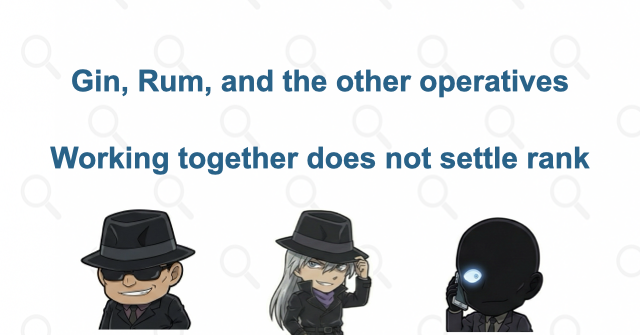
Gin’s partner, not a comfortably protected younger brother
Vodka calls Gin aniki, a familiar expression of respect for a senior or older-brother figure. It describes their dynamic, not a claim that they are biological brothers. They have worked together since the beginning of the series, with Vodka generally carrying out Gin’s instructions.
The Itakura incident makes clear how little protection that familiarity offers. Gin’s readiness to threaten him with a gun shows that this is not an affectionate partnership free of danger. Vodka understands the threat and rarely challenges his orders.
Repeatedly accompanying Gin on important assignments suggests that his loyalty and practical ability have value. It remains too strong to call him Gin’s most trusted person. The evidence supports a durable working relationship, not a complete account of Gin’s feelings.
Rum’s subordinate without full access to Rum
Volume 100 presents Rum as a superior whom Vodka appears not to have met; Volume 108 places Vodka inside an operation that Rum directs. These stages do not establish when, or whether, Vodka learns the face behind the orders.
That information gap is ominous. Readers can see Rum moving close to Conan as Wakita while still directing operatives who may not recognize the disguise. Vodka’s questions help expose how much even an established Organization member may be kept from knowing.
Cooperation does not settle the internal hierarchy
Vodka works with Vermouth, Chianti, Korn, and Bourbon, and the films also pair him with Pinga. Their exact relative ranks and private feelings are not established merely by their exchanges.
His ability to pass information and move an operation forward across those personalities is part of his usefulness. The middle-manager impression captures that burden, provided it is kept distinct from a formal rank.
Four films show his criminal role from another angle
The following are movie-only examples. They illustrate Vodka’s screen characterization but should not be treated as additional manga events or as proof that the manga version knows Conan’s identity.
Countdown to Heaven
In the movie-only story of Countdown to Heaven, Vodka acts with Gin around the killing of Yoshiaki Hara and the erasure of data after Hara accesses Organization information. His place is on the side suppressing evidence, rather than investigating the mystery with Conan.
The Raven Chaser
In the movie-only operation in The Raven Chaser, Vodka participates in the effort to recover sensitive information about Organization operatives, not the NOC list featured in The Darkest Nightmare. When Irish is exposed and discarded by the Organization, Vodka remains beside Gin. The film preserves his place within the team enforcing the Organization’s priorities.
The Darkest Nightmare
The movie-only crisis in The Darkest Nightmare concerns information about agents infiltrating the Organization. Suspicion falls on Bourbon and Kir, making the Organization’s internal danger as important as its threat to outsiders. Vodka remains part of Gin’s operational side of that conflict.
Black Iron Submarine
In the movie-only story of Black Iron Submarine, Vodka works with Pinga in the abduction of Ai Haibara. The plot involves Pacific Buoy, its links to surveillance cameras, and an age-recognition system capable of connecting faces across different stages of life.
Vodka examines data associated with Naomi Argento and approaches the possibility that Haibara is a younger Sherry, reporting the suspicion to Gin. In this movie-only plot, he abducts Haibara with Pinga and guards Naomi and Haibara aboard the submarine. That does not establish that he also identifies Conan as Shinichi.
Here the awkward subordinate abruptly becomes someone who tears a child away from her ordinary life. The movie-only example makes the underlying point especially stark: being occasionally funny does not make Vodka harmless.
Where to read and watch the key evidence
The first case: the transaction that changes Shinichi’s life
Vodka debuts in Volume 1, File 1, and Roller Coaster Murder Case, Episode 1 (Japanese episode 1). Shinichi and Ran Mouri encounter Gin and Vodka at Tropical Land. After the roller-coaster murder is solved, Shinichi witnesses Vodka’s illicit deal and is attacked from behind by Gin.
Gin administers APTX 4869; Vodka is not the person who gives Shinichi the drug. His transaction nevertheless supplies the immediate distraction that leads into Shinichi’s transformation and his life as Conan Edogawa. The apparent return to normality after a solved case becomes the beginning of a much larger danger.
Volumes 37-42: careless in one case, observant in another
The Itakura sequence spans On the Trail of a Silent Witness (Part 1) and On the Trail of a Silent Witness (Part 2), Episodes 332-333 (Japanese episodes 307-308), followed by Contact with the Black Organization (The Negotiation) through Contact with the Black Organization (Desperation), Episodes 334-336 (Japanese episodes 309-311). Together, these cases cover the death and the software handover in Volumes 37-38.
The recognition of the disguised Heiji occurs in Volume 42’s Head-to-Head Match with the Black Organization: A Dual Mystery on a Full Moon Night (2.5 Hour Special), Episodes 371-375 (Japanese episode 345).
Watching those sequences together produces a more useful judgment than calling Vodka either brilliant or useless. One exposes his vulnerability to a trap; the other shows a memory that can still be useful to the Organization.
Volumes 100 and 108: the continuing FBI conflict
The Volume 100 operation is adapted in Episodes 1135-1137 (Japanese episodes 1077-1079), from The Black Organization’s Scheme (Hunt) through The Black Organization’s Scheme (Identity). It combines the pursuit of Camel with the conversation that reveals Vodka’s limited knowledge of Rum.
Volume 108 continues the conflict through the attempt to abduct Camel. The renewed operation gives the earlier pursuit a continuing consequence: Vodka remains part of the team acting against the FBI.
A fallible operative is still a dangerous one
Vodka’s weaknesses are real. He can follow instructions too readily and needs Gin to recognize a trap. His strengths are real too: he remembers faces, carries out varied assignments, coordinates with other members, and remains active through Volume 108.
His legal name, age, nationality, precise rank, and the full extent of his knowledge remain limited or uncertain. Those unanswered questions do not make his role vague. He is one of the people who turns the Black Organization’s plans into things that actually happen to its victims, and the humor around him makes that contrast more disturbing.
Further reading (contains spoilers): Black Organization codenames and allegiances.

Comments