This article examines Haibara and Ran through jealousy, romantic tension, Akemi Miyano‘s influence, and the movie Black Iron Submarine. Major spoilers follow.
Haibara and Ran are not enemies. Their relationship grows from distance into trust, with admiration, possible jealousy, and gratitude layered together. Haibara’s knowledge of Conan’s identity makes that relationship unequal from the beginning: she understands Ran’s place in Shinichi’s life, while Ran sees her as Conan’s young friend.
The turning point is Ran’s willingness to protect her. That act gives Haibara a reason to see Ran as more than someone whose warmth and ordinary life feel out of reach.
Why Haibara initially keeps her distance
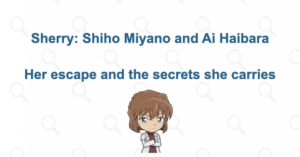
Haibara has fled the Black Organization, lost her sister Akemi, and survived the drug that changes her body into a child’s. As Shiho Miyano, she is eighteen; in everyday life, she must be treated as an elementary-school pupil.
Ran occupies a very different position. She has family, friends, and a place in the life Shinichi hopes to recover. She does not know the full danger surrounding Haibara or why Conan cannot simply return to her.
That contrast helps explain Haibara’s guardedness. Reading it as dislike alone leaves out how painfully Ran can remind her of a life she does not believe she belongs to.
There is another uncomfortable reversal: Haibara is older than Ran, yet her appearance puts her in the position of a child being looked after. It is understandable to read some of her reserve as difficulty accepting care, rather than rejection of the person offering it.
Ran does not need to solve Haibara’s identity to be kind to her. From Haibara’s perspective, that ordinary kindness is extraordinary precisely because it arrives without a demand for an explanation.
Is Haibara jealous of Ran?
Jealousy or envy is a reasonable interpretation of some scenes, but it is not a complete description of the relationship. Haibara shares a dangerous secret with Conan and repeatedly depends on his determination to save her. She also knows how much Ran means to him.
That creates room for romantic tension. It also creates a wider comparison between the lives the two girls appear to have: one can openly wait for Shinichi, while the other must hide her past and her real identity.
The dolphin and the shark
The Mystery in the Net gives this tension a particularly sharp image. Haibara compares Ran with a dolphin and herself with a shark that has escaped a dark, cold place.
Haibara: “Not a shark… The other one is a dolphin… Yes, the darling of the sea… A nasty shark that escaped from the dark, cold ocean floor could never compete with her…” (unofficial translation)
The metaphor tells us at least as much about Haibara’s view of herself as it does about her view of Ran. Ran is admired and at home in the world; Haibara casts herself as an unwelcome creature from somewhere frightening.
That is why the line feels more bitter than a simple declaration of rivalry. It suggests that Haibara believes the comparison has already been decided against her. Her Organization past, guilt, and losses give that self-judgment a context.
The scene is in Volume 31, Japanese episodes 246–247, or international episodes 265–266. It supports a reading of envy and self-reproach; it does not require us to decide that every feeling Haibara has for Conan is explicitly romantic.
Awareness does not turn into an attack on Ran
Haibara can recognize Ran as someone important to Conan without trying to damage their relationship. The restraint is part of what makes the emotional tension convincing.
Conan is special to her as both a rescuer and a companion who understands living in a younger body. Ran is also becoming someone she has personal reasons to value. Treating the two girls only as competitors would erase that second connection.
When Ran protects Haibara, the relationship changes
A major turning point comes in the Full Moon confrontation. Ran protects Haibara when Vermouth targets her.
The Full Moon confrontation is in Volume 42, Japanese episode 345, or international episodes 371–375. Ran acts without knowing that the girl she is shielding was once the Organization’s scientist Sherry.
For Haibara, that matters. The protection is not a reward for confessing everything or proving herself innocent. Ran sees someone in danger and moves to help.
Her action challenges the distance in the dolphin-and-shark comparison. Haibara may feel that they belong to different worlds, but Ran does not accept that division as a reason to leave her unprotected.
Why Ran brings Akemi to mind
Ran’s protection also evokes Haibara’s older sister, Akemi. Akemi was one of the few sources of warmth in Shiho’s life inside the Organization; losing her makes an act of unreserved care especially powerful.
Ran is not a replacement for Akemi, and she does not need to know that history for the resemblance to matter to Haibara. The emotional connection arises from what she does: placing someone else’s safety before her own.
This is the warmth at the center of their relationship. The person Haibara once seemed unable to approach becomes someone associated with rescue and the memory of being loved.


How Black Iron Submarine develops the tension
The film puts Haibara’s fear, her dependence on Conan, and her awareness of Ran into the same urgent story. Conan’s resolve to help her draws an emotional response.
Conan: “Do not make that face! I told you, did I not? I will definitely find a way!” (unofficial translation)
Haibara: “Why… Why can you always… always make a face like that?” (unofficial translation)
The underwater resuscitation scene then gives that closeness an ambiguous emotional meaning. The action itself is lifesaving. Haibara’s response allows a reading in which it means more to her than a purely practical exchange.
Haibara: “Kudo, you may not know this… but a moment ago, we… kissed.” (unofficial translation)
Her later gesture of “returning” the kiss to Ran can be read as a way to acknowledge those feelings without keeping something she associates with Conan and Ran’s relationship solely for herself.
That interpretation is poignant because it contains both desire and care. Haibara may want closeness with Conan, yet she also values Ran enough not to treat her simply as an obstacle.
This is an interpretation of the film’s emotional framing, not proof that the manga has established a new romantic relationship. The movie scenes should be considered separately from the manga’s evidence about Haibara and Ran.
They do, however, draw on a familiar tension: Haibara knows too much to approach the situation innocently, but knowing the complications does not free her from feeling them.
More than friends versus rivals
Haibara’s distance, the dolphin-and-shark metaphor, Ran’s protection, and the memory of Akemi trace a change that a single label cannot capture. Envy and gratitude can coexist; so can affection for Conan and respect for Ran.
For me, the crucial movement is from comparison to connection. Ran first seems to represent everything Haibara cannot have. By protecting her, she becomes part of the life Haibara is learning she can still belong to.
Further reading (contains spoilers): Haibara and Akai's family connection.

Comments