Spoilers: This article covers the Akai family, the case from seventeen years earlier, and revelations about Tsutomu Akai and Rum through manga Volume 108.
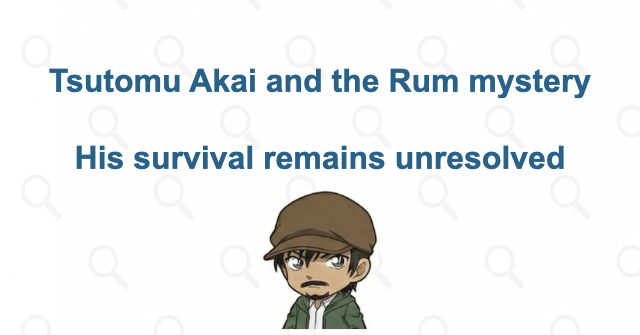
Tsutomu Akai is an agent of Britain’s Secret Intelligence Service, commonly called MI6, and the father of Shuichi Akai. Whether he is alive remains unresolved through Volume 108. Rum believes he died, but Tsutomu’s body has not been found. His confrontation with Rum is established; whether he caused the loss of Rum’s left eye is not.
His appearances are few, yet his absence connects several of the series’ largest mysteries. Mary, their children, Rumi Wakasa, and Rum all carry pieces of his story. Each new piece changes the meaning of something that happened long before he vanished.
Tsutomu’s identity and the Akai family
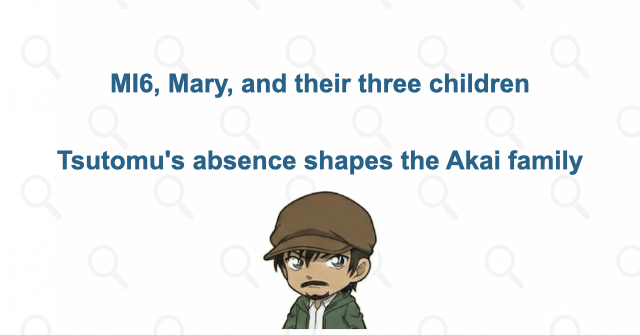
Tsutomu and his wife, Mary Sera, are both associated with MI6. Their three children are Shuichi Akai, Shukichi Haneda, and Masumi Sera. Seventeen years before the present-day story, Tsutomu travels to America to investigate Koji Haneda’s murder and subsequently disappears.
His present location and appearance are unknown. Nor is it established that he is still carrying out intelligence work. Identifying his profession does not tell us what happened after he lost contact with his family.
One family, three surnames
Shuichi is an FBI agent who infiltrated the Black Organization under the identity Dai Moroboshi and later adopted the disguise Subaru Okiya. Shukichi is a professional shogi player adopted into the Haneda family. Masumi is a high-school detective who acts alongside Mary in Japan.
Shukichi’s adoption explains his Haneda surname. Shuichi retains Akai, while Mary and Masumi use Sera. The full history of the Sera surname is not established here, including whether it was Mary’s maiden name. The timing and reasons for their use of it should not be supplied as fact; hiding from the Organization is a possible explanation, not a confirmed one.
The different names can make the family look disconnected at first. Tsutomu’s disappearance provides a common thread: Mary pursues the danger around her husband, Shuichi follows the investigation into the FBI, and family members build their lives in different places. His absence keeps affecting people who cannot simply wait together for him to return.
Mary herself is attacked by Vermouth and given APTX 4869, leaving her in a younger body. The family consequences of the Organization’s pursuit therefore reach beyond the original missing-person mystery.
How old is Tsutomu?
His age is not stated. Mary is described as thirty-six seventeen years earlier, giving an age of about fifty-three by simple story chronology. That is a basis for imagining Tsutomu as being around the same age, not proof that the spouses are the same age.
A man with an adult son and an intelligence career could plausibly be in his fifties. Without a stated age, the estimate remains an inference from family history and appearance.
His voice belongs to a scene involving an impostor
Koichi Yamadera provides Tsutomu’s Japanese voice. The anime sequence beginning with Episode 1102 (Japanese episode 1045) gives a voice to someone appearing in Tsutomu’s form, but that person is Vermouth in disguise, not a confirmed present-day return of Tsutomu himself.
That difference is crucial when looking for his appearances. The performance can make the absent agent feel more tangible without solving his whereabouts. Hearing that calm voice from an impostor makes the prospect of eventually meeting the real man more intriguing, rather than less.
Is Tsutomu alive? Separate the evidence from the beliefs
No body has been found
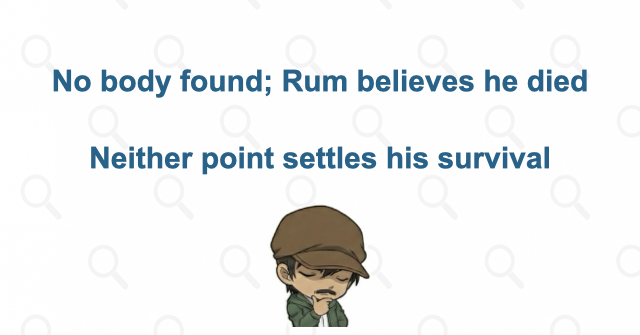
In the flashback to ten years earlier, Mary speaks to the children on the assumption that Tsutomu is dead. Shuichi challenges that assumption by pointing out that his father’s body has never been found.
The exchange establishes the lack of a recovered body and Shuichi’s unwillingness to abandon the possibility of survival. It does not establish that Shuichi knows Tsutomu is alive, or that the absence of a body proves survival.
Mary’s later response to a message apparently from her husband also leaves room for hope. She goes to the London meeting because the possibility of his return matters to her. Reading that as a mixture of professional caution and a spouse’s hope is persuasive; it is not evidence that she has secret confirmation of his survival.
A death can remain unverified after violence or an accident. Even so, the deliberate emphasis on the missing body keeps the question open. It gives the family something they can neither conclusively accept nor conclusively dismiss.
Rum believes Tsutomu died
Volume 108 places a sharply different belief beside Shuichi’s. On seeing Okiya’s eyes, Rum remembers the man he confronted seventeen years earlier. Okiya is Shuichi in disguise, so the resemblance links the son with the father in Rum’s recollection.
Rum briefly considers Tsutomu, then rejects that possibility because he believes Tsutomu is dead. Rum’s certainty is evidence of his belief, not objective confirmation of Tsutomu’s death.
The end of their confrontation is still missing from the account. Rum is not shown confirming a recovered body, and the reason he is so sure of the outcome remains unclear. He could know more than the family, or his certainty could rest on an assumption; the available scenes do not settle which.
That tension makes Volume 108 deepen the mystery instead of closing it. The son emphasizes a missing body, while the enemy dismisses survival. Both positions exist in the story, and neither can simply be substituted for the answer.
No present-day disguise or location is confirmed
If Tsutomu survived, concealment might protect his family, or circumstances might prevent contact. Those are possible explanations for an absence, not established accounts of seventeen years of activity.
No present-day character is confirmed to be Tsutomu under another identity in the material covered here. An unidentified elderly man with a breathing apparatus is not enough to establish a match. Nor can Tsutomu’s current assignment or location be inferred merely because he was an MI6 agent.
The uncertainty can be frustrating, but it is also what gives each recollection its force. The story keeps showing what Tsutomu meant to others while withholding where, or whether, he can now be found.
Why he disappeared: the investigation after Koji Haneda’s murder
Tsutomu was not a participant in the hotel events that day
Koji Haneda and Amanda Hughes are murdered at the Juke Hotel seventeen years earlier. The people connected to that day’s events include Koji, Amanda, her bodyguard Asaka, Rum, and Hyoue Kuroda, who was due to meet Amanda.
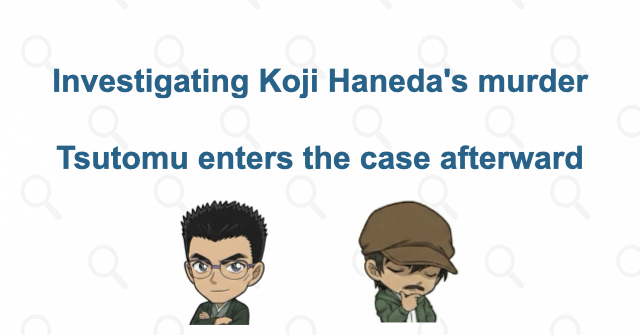
Tsutomu’s investigation begins afterward. Koji’s father, a friend of his, asks him to investigate, and Tsutomu travels to America in response. Placing him in the hotel on the day of the murders would collapse two different stages of the chronology.
As the investigation brings him closer to a dangerous adversary, Tsutomu tells Mary to take the children from Britain to Japan. The need to move his family abroad suggests that he sees a threat extending beyond himself. This is not merely an investigator becoming absorbed in a puzzle; the people at home are now part of the risk.
Protecting Asaka connects him to Rumi Wakasa
During the investigation, Tsutomu encounters and protects Asaka, who is now known as Rumi Wakasa, an assistant homeroom teacher at Teitan Elementary School. In Volume 103, Okiya’s eyes prompt her memory of Tsutomu standing between her and a dangerous enemy.
He tells the young woman to stay back, judging the adversary too dangerous for her to risk her future against. He chooses to face the threat himself. Asaka has already lost Amanda and Koji, and she is being hunted by the Organization; his intervention gives her a chance to survive.
At that stage the enemy’s identity is withheld. Volume 108 connects the confrontation to Rum. The later identification changes the weight of the earlier scene: Tsutomu was prepared to stand against the Organization’s number two to protect someone younger.
It is easy to see an echo of Shuichi’s strength and protective instinct in that decision. That is a reading of their parallel behavior, rather than proof of every part of Tsutomu’s personality. The action is enough to explain why Wakasa remembers him so powerfully.
Did Tsutomu destroy Rum’s left eye?
Tsutomu targets Rum’s unusual left eye, but a successful attack causing its loss is not shown through Volume 108. The recollection establishes their direct confrontation and Tsutomu’s recognition that the eye is a serious problem.
Rum now has an artificial left eye, making a connection to that fight plausible. What remains absent is the actual impact, the moment he loses sight, or a conclusive statement identifying the cause. Another cause has not been ruled out.
The two mysteries may belong to the same unfinished encounter: what happened to the eye, and what happened to Tsutomu. The scene is compelling precisely because it provides a threat and a target while withholding the outcome.
What happened to the Kuroda theory?
The theory that Hyoue Kuroda might be Tsutomu drew on several striking details. Kuroda had been in a prolonged coma after an accident, had an injured right eye, and looked dramatically different afterward. Yui Uehara describes his formerly black hair turning white and a nurse reacting in shock when his facial bandages were removed.
Those details explain why the theory appealed. An account of someone looking like a different person can invite the suspicion that a different person has literally taken his place. Yet resemblance, injury, and a changed appearance do not by themselves establish a disguise.
Volume 104 gives Kuroda and Tsutomu distinct roles in the older case. Kuroda is at the hotel on the day of the murders; Tsutomu begins investigating afterward at the Haneda family’s request. They are presented as separate men in that history, not one participant under two names.
This chronology undercuts the identification. It also does not supply positive proof of a later identity switch, so Kuroda should not be presented as Tsutomu’s confirmed hiding place. The historical account clarifies Kuroda’s involvement while leaving Tsutomu’s present situation unresolved.
How his absence shapes Mary and Shuichi
Vermouth uses his face to lure Mary
Vermouth contacts Mary while posing as Tsutomu and arranges a meeting in London. A message that her husband might be alive after seventeen years is not something Mary can easily ignore.
At the meeting, a detail in the conversation about Masumi exposes the impostor. Mary realizes that the person before her is not her husband. Vermouth then forces her to take APTX 4869, which results in her body shrinking.
The attack is painful because Tsutomu’s image becomes the means of exploiting Mary’s attachment to him. Her professional ability does not remove the emotional importance of a possible reunion.
The deception establishes that Vermouth can use his appearance and family history. It does not establish what every Organization member believes about his survival. Vermouth’s operation and Rum’s later confidence are separate pieces of evidence, not a single collective statement from the entire Organization.
Shuichi enters the FBI to pursue his father’s case
Tsutomu’s disappearance and the Haneda murder help explain Shuichi’s determination to enter the FBI. In the flashback to ten years earlier, he has gone to America to study and is moving toward that career. Mary fears that he will enter the same dangerous world that took her husband away.
When Shuichi becomes interested in a seaside case, Mary hears an echo of Tsutomu in the way he describes his consuming curiosity. The parallel suggests that Tsutomu, too, found it difficult to turn away from a dangerous truth. It is a glimpse through Mary’s memory, not a complete personality profile.
Shuichi later joins the FBI and infiltrates the Black Organization. The son reaches the enemy his father had pursued, without a depicted direct handover of a mission from father to son.
That structure gives Tsutomu’s absence an active role in the story. The Organization’s threat to the father becomes part of what produces one of its most formidable opponents in the next generation.
The key volumes and anime episodes
Volume 89: the name on a marriage registration
Tsutomu’s name appears in the father field of Shukichi’s marriage registration in Volume 89. The relevant anime case is The Marriage Registration’s Password (Part 1) and The Marriage Registration’s Password (Part 2), Episodes 904-905 (Japanese episodes 849-850).
This is a name appearing in a document, not Tsutomu entering the present-day action. It supplies the family connection before the later scenes give his disappearance its full weight.
Volume 92: the family ten years earlier
The Wizard of the Ripples (Part 1) and The Wizard of the Ripples (Part 2), Episodes 936-937 (Japanese episodes 881-882), adapt the family flashback in Volume 92.
The conversation connects his disappearance during the Haneda investigation, the family’s move to Japan, and Shuichi’s determination to pursue the matter. Tsutomu becomes more vivid through what the others say about him, even in his absence.
Volumes 98-99: the London impostor
The Birthday Party of Divine Punishment (Part 1) and The Birthday Party of Divine Punishment (Part 2), Episodes 1102-1103 (Japanese episodes 1045-1046), cover the revelation involving MI6, Vermouth’s disguise, and Mary’s poisoning.
This is also the sequence featuring Yamadera’s voice in Tsutomu’s apparent form. It should not be counted as proof of the real Tsutomu returning alive.
Volumes 103-104: the protector and the earlier crime
Volume 103’s recollection is adapted in The Detective Boys and the Two Leaders (Part 1) and The Detective Boys and the Two Leaders (Part 2), Episodes 1206-1207 (Japanese episodes 1148-1149). Wakasa remembers the man who protected her, while the adversary is still unnamed at that stage.
Volume 104 develops the murder-day chronology in Episodes 1222-1225 (Japanese episodes 1164-1167), from The 17-Year-Old Truth (The Bloody Knight) through The 17-Year-Old Truth (The Queen’s Gambit). It separates Kuroda’s presence that day from Tsutomu’s later investigation.
Volume 108: the encounter becomes Rum’s memory too
Rum’s reaction to Okiya connects the confrontation to Tsutomu and shows his belief that Tsutomu died. The recollection also reveals Tsutomu targeting the left eye. Neither the missing body nor the missing outcome of the attack is resolved by those additions.
Seeing the same absent man remembered from opposite sides is effective. For Wakasa he is a protector; for Rum he is an enemy believed to be dead. Shuichi carries the unresolved family question into the same scene simply by having eyes that recall his father’s.
What is established, and what remains open?
Tsutomu is Mary’s husband, the father of their three children, and an MI6 agent who investigated Koji Haneda’s murder after the event. He protected Asaka and confronted Rum. Those connections explain why a character so rarely seen remains central to the larger story.
Through Volume 108, his survival, whereabouts, current identity, and any continuing assignment remain unclear. Rum believes he is dead, but that belief is not a recovered body. Tsutomu aimed at the left eye, but intent is not a demonstrated result. Keeping those distinctions intact is essential to understanding the mystery that still surrounds him.
Further reading (contains spoilers): the Akai and Miyano family tree and why the Kuroda-is-Tsutomu theory fails.

Comments