Spoiler warning: this article covers the Café Poirot mystery through Volume 106 and Episodes 1264-1265 (Japanese episodes 1204-1205).
Who is the regular master of Café Poirot?
Why does Kanamaru’s history leave that question open?
Café Poirot’s regular master, the person who runs the café, remains unidentified in the chapters discussed here; Reita Kanamaru was a former temporary master. That distinction explains why learning Kanamaru’s history does not settle the cafe’s central mystery. Azusa and Amuro refer to a real employer, yet employing Amuro alone does not establish a connection to his undercover work. The scenes below separate what is revealed from the theories surrounding the absent master.
That absence is striking because Café Poirot is one of the series’ most familiar everyday locations. Has the master’s identity already been revealed, or has another character merely been mistaken for him? This article sorts through the available clues.
The Original Master of Café Poirot Is Still Unidentified
Kanamaru’s former temporary role and the regular master’s present absence belong to different parts of Poirot’s history. Likewise, an ordinary employment relationship with Amuro does not establish knowledge of Rei Furuya or Bourbon. The mystery is compelling because a familiar place keeps one person outside the frame, but that absence leaves possibilities open rather than identifying a hidden mastermind.
The story has not revealed the name or face of Café Poirot’s regular master.
His age, background, and activities away from the cafe are also unknown. That does not mean the master is imaginary: Azusa and Amuro speak of him as a real person who makes decisions about the business and its staffing.
- Regular master: name, face, age, and history are unknown
- Reita Kanamaru: a former temporary master who once looked after the cafe
- Episodes 380-381 (Japanese episodes 350-351): an unnamed master-like man appears in an anime-only addition
- Volume 106: Kanamaru’s past is explained, but the regular master does not appear
Kanamaru’s arrival can initially feel like the solution. What the story actually reveals, however, is the identity of someone who worked at Poirot in the past, not the identity of its regular master. The central question therefore remains open.
The Person Who Employs Tooru Amuro and Azusa Enomoto
The master is presented as the person who employs Tooru Amuro and Azusa Enomoto. Azusa worked there before Amuro and appears familiar with the master’s plans and decisions. Amuro, as a part-time employee, is likewise subject to the cafe’s ordinary staffing and operating arrangements.
Amuro is also Rei Furuya, an officer of the Public Security Bureau, and he infiltrates the Black Organization as Bourbon. That complicated identity makes his quiet job at Poirot an appealing contrast between daily life and the main plot.
It is unclear whether the master knows Amuro’s real position or his undercover role. Employing Amuro does not by itself connect the master to either Public Security or the Black Organization. The supported conclusion is simply that the master is treated as Amuro and Azusa’s employer at Café Poirot.
Whether the Master and Owner Are the Same Person Is Unknown
It is important to keep the labels “master” and “owner” separate. Azusa and the others normally call the unseen person the master. In ordinary usage, an owner is the person who possesses the business, but the story has not established whether Poirot’s master also owns the cafe.
There may be a separate owner or manager, or the master may fill more than one role; the story does not resolve that point. Calling the unseen master the confirmed owner would therefore go beyond the evidence.
The same distinction applies to Kanamaru. His disclosed role was temporary master, not temporary owner. Separating these similar terms preserves the unanswered question of who owns the cafe and who has merely been entrusted with its daily operation.
Reita Kanamaru Is Not the Regular Master
Reita Kanamaru, age 38, appears in Volume 106 and is first framed as a customer. He nevertheless knows the kitchen, the location of supplies, and Azusa herself. Those details make it clear that he is not an uninformed visitor.
For a time, his behavior can suggest that the original master has entered the cafe while pretending to be a customer. The later explanation is different: Kanamaru previously served as temporary master while the regular master was hospitalized.
The reveal deliberately lands one step away from the expected answer. The suspicious customer was once central to the cafe, but he was a substitute from its past rather than its present regular master.
Reita Kanamaru Was Café Poirot’s Former Temporary Master
Reita Kanamaru once looked after Café Poirot as its temporary master while the regular master was in the hospital. This history explains his knowledge of the stockroom and kitchen as well as his prior acquaintance with Azusa.
His role changes the impression created by his introduction. A seemingly suspicious stranger becomes someone who remembers an earlier period in the cafe’s life. The clues to his past were visible in the very details that initially made him look threatening.
He Appears in Volume 106 as a Suspicious Customer Who Knows Poirot
Kanamaru visits Café Poirot in Volume 106, File 3. At first, the sight of him drinking coffee at the counter is completely ordinary. His attention to Amuro and Azusa soon makes his behavior feel less innocent.
He knows where an item Azusa needs is stored and shows detailed familiarity with the kitchen. A customer who understands the workplace better than its current staff creates an immediate sense that something is wrong.
Amuro becomes wary, while Azusa behaves as though she recognizes Kanamaru. The setup leaves several possibilities open, including a current master, a former employee, another associate of the cafe, or someone involved in the case. Once his history is known, his suspicious knowledge reads instead as the residue of experience.
He Took Charge While the Regular Master Was Hospitalized
Kanamaru knows Café Poirot because he worked there as temporary master when the regular master was hospitalized after an injury. That position gave him practical knowledge of the kitchen layout, supply storage, and the flow of work inside the cafe.
His familiarity does not show that he owned the business. Nor does the story state that he still regularly fills in whenever the master is absent. What is confirmed is limited to his temporary service during a period in the past.
His ability to remember such small details after being away also suggests that Poirot mattered to him, although the extent of that attachment is an interpretation rather than a disclosed fact.
Azusa Knew Him, but Amuro Did Not
Azusa already knew Kanamaru, whereas Amuro had no prior acquaintance with him. This difference suggests, but does not independently prove, that Kanamaru’s time at Poirot predates Amuro’s employment there.
Azusa’s prior acquaintance with Kanamaru gives her knowledge of Poirot’s history that Amuro does not share. Even though they now work in the same place, they do not possess the same knowledge of its past.
That reversal is part of the scene’s charm: Amuro is usually the person who notices everything, but Azusa is ahead of him when the subject is Poirot’s older relationships. Kanamaru gives the audience a brief glimpse of Poirot’s earlier history.
He Came to Check a Dating Rumor, Not as a Mastermind
Kanamaru came to investigate a rumor that Amuro and Azusa were dating. His watchful behavior initially resembles that of a suspicious figure connected to the case. His real concern was the romantic life of Azusa, someone he had known from his time at the cafe.
The tonal shift is playful: a man introduced with the air of a hidden mastermind turns out to be a former colleague curious about gossip. That does not make him a major force in Amuro and Azusa’s relationship. His principal story function here is to connect Poirot’s present staff with its past and reveal his own former role.
Episodes and Chapters Featuring the Café Poirot Master Mystery
The key appearances are Episodes 380-381 (Japanese episodes 350-351), Volume 106 Files 3-5, and Episodes 1264-1265 (Japanese episodes 1204-1205).
- Episode 380 (Japanese episode 350), “The Forgotten Cell Phone (Part 1)”
- Episode 381 (Japanese episode 351), “The Forgotten Cell Phone (Part 2)”
- Volume 106, Files 3-5: Reita Kanamaru appears
- Episodes 1264-1265 (Japanese episodes 1204-1205): the Volume 106 story is animated
Kanamaru’s later backstory offers a possible way to understand the older anime’s master-like man. The story does not explicitly identify the two as the same person, and Kanamaru’s former temporary role does not identify the regular master.
Episodes 380-381: The Forgotten Cell Phone
An unnamed master-like man is shown in Episodes 380-381 (Japanese episodes 350-351), “The Forgotten Cell Phone (Part 1)” and “The Forgotten Cell Phone (Part 2).”
The anime added this portrayal; the corresponding manga material did not include it. The man speaks with Azusa, but the episodes do not disclose his name or detailed profile.
Volume 106 later introduces Kanamaru as someone who was temporarily entrusted with the cafe, not its regular master. Kanamaru therefore cannot be identified as the current regular master. Whether the older anime scene depicts that period of his life is a plausible interpretation, not an explicit reveal.
Volume 106, Files 3-5: Who Kidnapped Conan and Azusa?
Reita Kanamaru appears in Volume 106, Files 3-5. The story begins with his suspicious conduct at Poirot. Azusa then becomes caught up in the incident, while Conan and Amuro move toward the truth.
- File 3: The Suspicious Character
- File 4: The Deadline is Midnight
- File 5: The Detonator to the Counterattack
Near the end of the story, Kanamaru’s knowledge of Poirot is explained by his past service as temporary master. This makes him the first manga character with a disclosed history so close to the master’s role, but the regular master himself still does not appear.
Episodes 1264-1265 Aired in 2026
The Volume 106 story was adapted for television in June 2026.
- Episode 1264 (Japanese episode 1204), “Who Kidnapped Conan and Azusa? (Part 1)”: aired June 20, 2026
- Episode 1265 (Japanese episode 1205), “Who Kidnapped Conan and Azusa? (Part 2)”: aired June 27, 2026
The adaptation made Kanamaru’s former position available to anime-only viewers. More than twenty years after the older anime depicted a master-like man, a character who knew Poirot’s past became active in a major story.
The new episodes clarify Kanamaru’s position, not the identity of the regular master. The regular master does not appear in Episodes 1264-1265.
Junichi Kanemaru Voiced the Earlier Master-Like Man, While Makoto Naruse Voiced Kanamaru
The master-like man in Episodes 380-381 (Japanese episodes 350-351) was voiced by Junichi Kanemaru. Reita Kanamaru was voiced by Makoto Naruse in Episodes 1264-1265 (Japanese episodes 1204-1205).
The similar surnames, Kanemaru and Kanamaru, suggest a possible naming reference, though this remains unconfirmed. The productions are separated by more than twenty years, and the different casting neither proves nor disproves that the characters are the same person.
The actor’s surname is an intriguing clue, but it does not establish the unnamed man’s identity.
Is the Episode 380 Master-Like Man Reita Kanamaru?
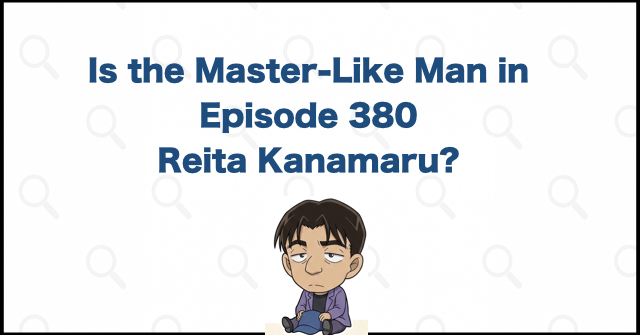
It is plausible to read the master-like man in Episode 380 (Japanese episode 350) as Reita Kanamaru during his temporary service, but the story does not explicitly identify them as the same person.
Even if they are the same person, that would not make Kanamaru the present regular master. His manga role remains a temporary position held in the past.
The Kanamaru Name Echoes the Older Anime
Junichi Kanemaru voiced the master-like man in the older anime, and Volume 106 later introduced Reita Kanamaru as a former temporary master. Because the surnames are similar, it is easy to read the later character as a nod to the anime’s earlier invention.
It is also possible to imagine that an anime-only idea was reshaped into a form the manga could use. However, no published statement confirms that the character was named after the actor or that this was the creative process.
The safest reading is that the surname is a suggestive coincidence or possible reference, not a confirmed production fact.
The Manga Confirms Only His Former Temporary Role
Volume 106 confirms that Reita Kanamaru once served as temporary master. It does not reveal that Kanamaru is the regular master’s name or face.
The older anime did not distinguish its master-like man as regular or temporary at the time. Kanamaru’s later backstory makes a temporary-master reading possible, but it does not explicitly name the earlier figure.
The story has revealed someone who once received control of the cafe, while leaving unseen the person who entrusted it to him. The apparent solution thus preserves the mystery at its center.
Is Café Poirot’s Master the Boss of the Black Organization?
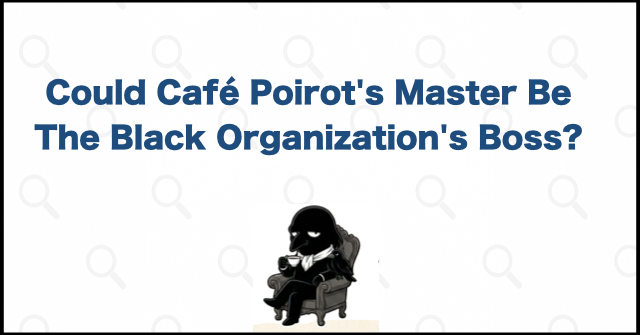
A fan theory has proposed that Café Poirot’s regular master might be the boss of the Black Organization. No manga or anime scene connects the master to the organization. An unseen face may invite suspicion, but absence alone does not establish a mastermind.
Why the Mastermind Theory Emerged
The theory grows from Poirot’s location and the master’s long absence from view. The cafe sits directly beneath the Mouri Detective Agency, where Conan, Ran, and Kogoro are close at hand, and Public Security officer Amuro works inside the cafe.
Despite the importance of those people, Poirot’s master has remained unnamed and unseen. A reveal that the mastermind had always occupied this familiar everyday space would dramatically reframe the story.
That contrast makes an attractive theory: a friendly cafe on one side and the series’ central criminal organization on the other. It remains speculation, however, because the proximity and secrecy do not provide a factual link.
No Scene Supports the Café Poirot Mastermind Theory
The boss of the Black Organization is named Renya Karasuma. The regular master of Café Poirot, by contrast, does not even have a revealed real name.
No scene presented here identifies the two as the same person or connects the regular master to the Black Organization. Employing Amuro is not decisive evidence, because the story has not established that the master knows Amuro’s Public Security identity or undercover mission.
The theory remains unsupported by a scene connecting the master to the organization. The master could still receive a future role, but identifying him as Karasuma would require new information that directly connects them.
Conclusion
The regular master of Café Poirot remains unidentified.
Poirot is a familiar place where Conan and Ran stop by and Amuro and Azusa work, yet the employer behind the cafe remains outside the frame. Reita Kanamaru seemed at first to fill that blank: he knew the interior, remembered its supplies, and already knew Azusa.
The twist is that Kanamaru was not the present regular master but a former temporary master who ran the cafe during the regular master’s hospitalization. His history explains the clues without solving the larger identity question.
The older anime man may be Kanamaru, but that connection remains unconfirmed and would not identify the regular master. The scenes discussed here also provide no link between Poirot’s unseen master and Renya Karasuma or the Black Organization.
One layer of the mystery has been explained, while the person at its center remains hidden. That lingering gap is precisely why ordinary references to the master in Azusa and Amuro’s conversations continue to feel significant.
Further reading (contains spoilers): File 1126 review, File 1128 review and the mysterious baby theory.




Comments